

3 sols – French West Indies
Add to wishlist
France
Obverse
Description:
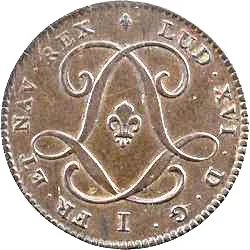
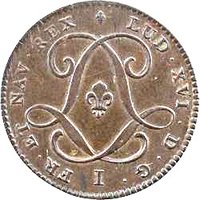
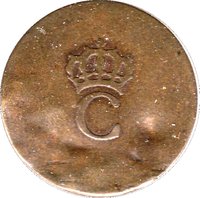
DL monogram.
Inscription:
LUD . XVI . D . G . I FR . ET NAV . REX
Script: Latin
Engraver: Jean-Pierre Droz
Reverse
Description:
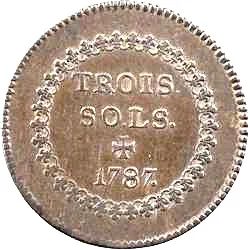
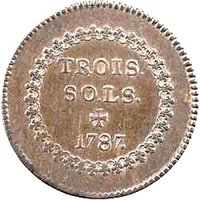
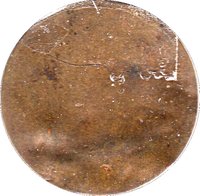
Cross, date in fleur-de-lis wreath.
Inscription:
TROIS
SOLS.
+
1787.
SOLS.
+
1787.
Script: Latin
Engraver: Jean-Pierre Droz
Edge
Reeded
Mints
| Name | Mark |
|---|---|
| Limoges | I |
Mintings
| Year | Mint Mark | Mintage | Quality | Collection |
|---|---|---|---|---|
| 1787 | I | — |
Historical background
In 1787, the French West Indies, particularly the economically vital colony of Saint-Domingue, were mired in a complex and debilitating currency crisis. The official medium of exchange was the livre tournois, but the physical money in circulation was a chaotic mix of undervalued French coinage, heavily debased Spanish colonial coins (known as piastres or pieces of eight), and a plethora of foreign coins from across the Americas. The core problem was a severe shortage of official French specie, as much of it was siphoned away to pay for massive imports of food, timber, and other necessities from North American traders, who preferred hard currency.
This scarcity led to the widespread use of "monnaie de carte" – playing cards signed and issued as emergency currency by local authorities. While this paper scrip facilitated daily transactions, its value was highly unstable and subject to depreciation. Furthermore, the colony operated on a dual-rate system: one official exchange rate set by Paris and a much higher market rate determined by supply and demand. This created a distorted economy where planters paid taxes at the artificial official rate but had to procure currency for trade at the punishing real-world market rate, exacerbating their already significant debt burdens.
The currency chaos of 1787 was more than a financial inconvenience; it was a symptom of the structural weaknesses of the mercantilist colonial system and a source of profound grievance among the white planter class. Their growing resentment towards metropolitan control, fueled by this and other economic restrictions, would soon feed into the revolutionary ferment that would engulf the islands. Within a few years, these monetary tensions would be subsumed by the massive slave uprising in Saint-Domingue and the broader French Revolution, which would ultimately reshape the Atlantic world.
This scarcity led to the widespread use of "monnaie de carte" – playing cards signed and issued as emergency currency by local authorities. While this paper scrip facilitated daily transactions, its value was highly unstable and subject to depreciation. Furthermore, the colony operated on a dual-rate system: one official exchange rate set by Paris and a much higher market rate determined by supply and demand. This created a distorted economy where planters paid taxes at the artificial official rate but had to procure currency for trade at the punishing real-world market rate, exacerbating their already significant debt burdens.
The currency chaos of 1787 was more than a financial inconvenience; it was a symptom of the structural weaknesses of the mercantilist colonial system and a source of profound grievance among the white planter class. Their growing resentment towards metropolitan control, fueled by this and other economic restrictions, would soon feed into the revolutionary ferment that would engulf the islands. Within a few years, these monetary tensions would be subsumed by the massive slave uprising in Saint-Domingue and the broader French Revolution, which would ultimately reshape the Atlantic world.
✨ Legendary