

5 Centimes – French West Indies
France
Context
Years: 1825–1830
Country: France 
Issuer: French West Indies
Ruler: Charles X
Currency:
(1795—1959)
Demonetized: Yes
Total mintage: 2,409,161
Material
References
KM: #Click to copy to clipboard10
Numista: #1899
Obverse
Description:
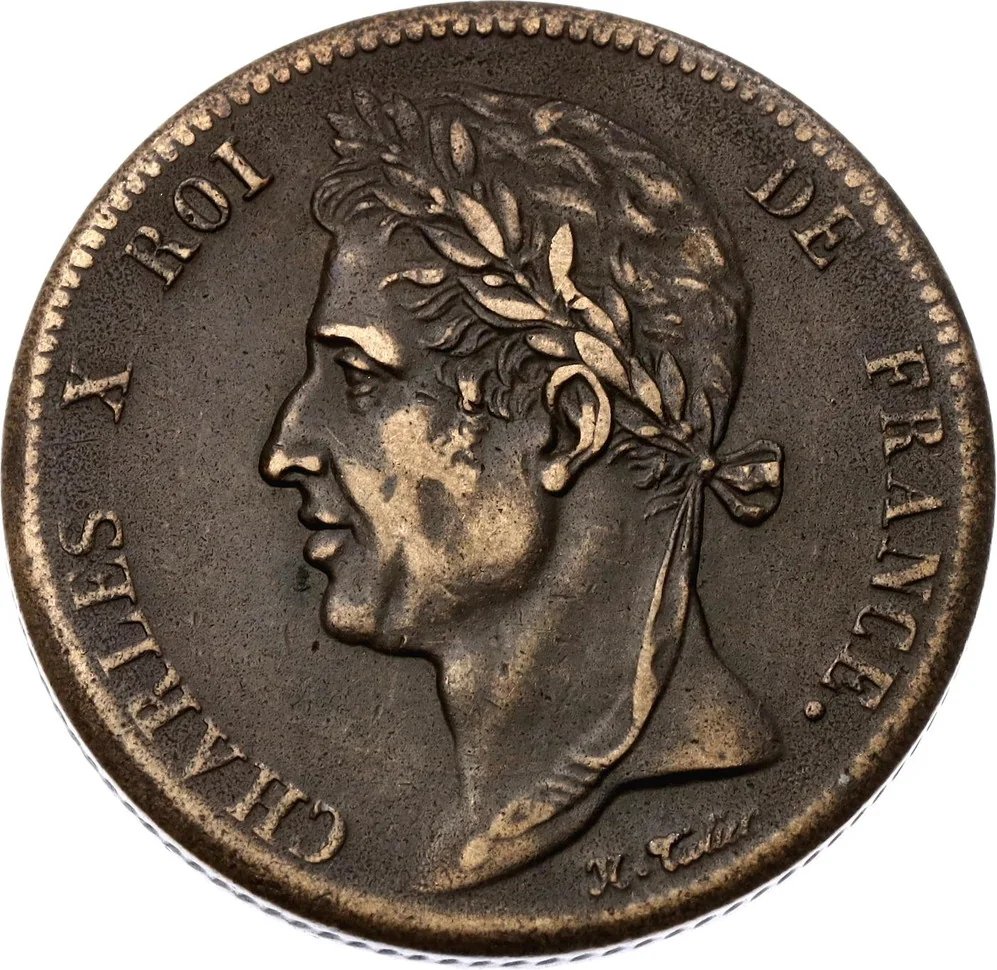
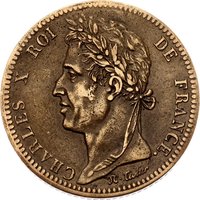
Laureate head left, engraver's NP monogram below.
Inscription:
CHARLES X ROI DE FRANCE.
NP. TIOLIER
NP. TIOLIER
Translation:
CHARLES X KING OF FRANCE.
N.P. TIOLIER
N.P. TIOLIER
Script: Latin
Language: French
Engraver: Nicolas-Pierre Tiolier
Reverse
Description:
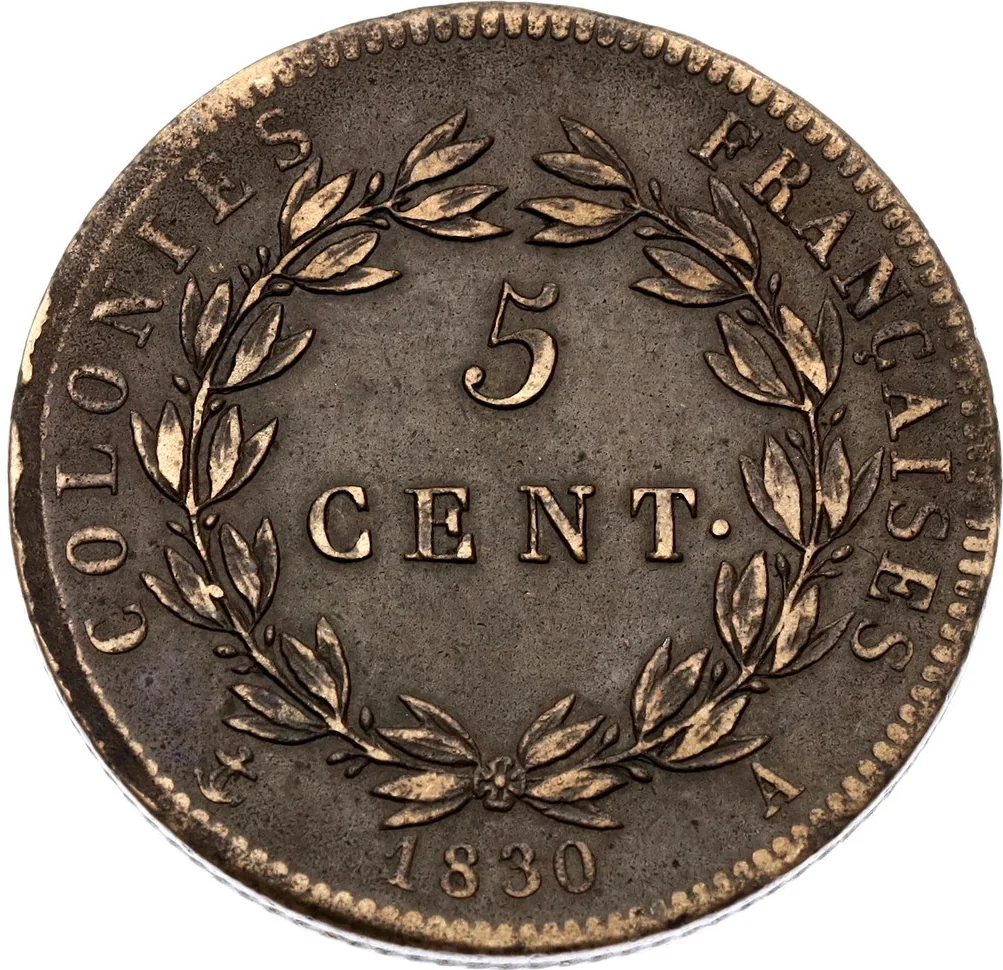
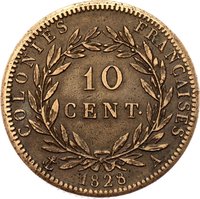
Denomination in wreath, date with mint letter below right.
Inscription:
5
CENT·
COLONIES FRANÇAISES
1830 A
CENT·
COLONIES FRANÇAISES
1830 A
Translation:
5
CENT·
FRENCH COLONIES
1830 A
CENT·
FRENCH COLONIES
1830 A
Script: Latin
Engraver: Nicolas-Pierre Tiolier
Edge
Center slanted reeding right.
Mints
| Name | Mark |
|---|---|
| Monnaie de Paris | A |
| La Rochelle | H |
Mintings
Historical background
In 1825, the currency situation in the French West Indies, particularly in the restored colonies of Martinique and Guadeloupe, was defined by monetary scarcity and a complex circulation of multiple coinages. The official currency was the French franc, tied to a bimetallic (gold and silver) standard. However, French specie was chronically in short supply across the Atlantic. This vacuum was filled by a variety of foreign coins, most notably Spanish and Spanish-American silver pesos (pieces of eight) and their fractional parts, which served as the de facto everyday medium of exchange due to their wide acceptance in Atlantic trade.
This monetary heterogeneity created significant practical and administrative challenges. Colonial merchants and planters had to constantly negotiate exchange rates between the official franc livre and the fluctuating value of the dominant Spanish coins, leading to commercial friction. The problem was acute for the colonial government and the French state, which demanded tax payments in French currency. This forced a cumbersome and often loss-inducing conversion process for colonists, stifling economic transactions and complicating the financial reintegration of the islands into the French system following the Napoleonic Wars.
The year 1825 is particularly significant as it marks the imposition of the "Indemnité de Saint-Domingue" (Haitian Independence Debt). France's demand for 150 million gold francs from Haiti to recognize its independence, while a separate issue, profoundly impacted the broader French colonial monetary mindset. It underscored the metropolitan focus on extracting hard currency from the Caribbean and likely further strained the already tight circulation of specie, as French policy prioritized fiscal extraction over solving the colonies' chronic liquidity crisis. Thus, the currency situation remained unstable, a patchwork system impeding economic development while serving the needs of a mercantilist empire.
This monetary heterogeneity created significant practical and administrative challenges. Colonial merchants and planters had to constantly negotiate exchange rates between the official franc livre and the fluctuating value of the dominant Spanish coins, leading to commercial friction. The problem was acute for the colonial government and the French state, which demanded tax payments in French currency. This forced a cumbersome and often loss-inducing conversion process for colonists, stifling economic transactions and complicating the financial reintegration of the islands into the French system following the Napoleonic Wars.
The year 1825 is particularly significant as it marks the imposition of the "Indemnité de Saint-Domingue" (Haitian Independence Debt). France's demand for 150 million gold francs from Haiti to recognize its independence, while a separate issue, profoundly impacted the broader French colonial monetary mindset. It underscored the metropolitan focus on extracting hard currency from the Caribbean and likely further strained the already tight circulation of specie, as French policy prioritized fiscal extraction over solving the colonies' chronic liquidity crisis. Thus, the currency situation remained unstable, a patchwork system impeding economic development while serving the needs of a mercantilist empire.
🌱 Common