

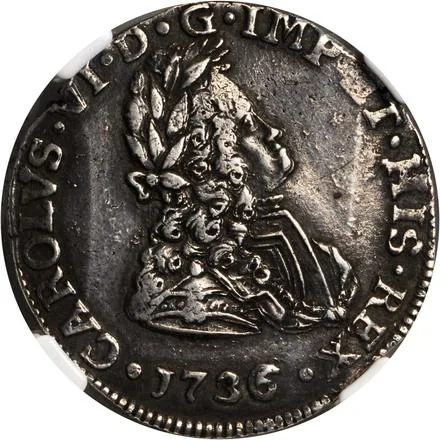
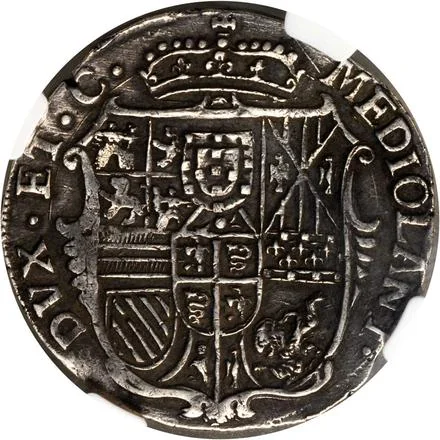
½ Filippo – Milan
Italy
Context
Years: 1728–1736
Country: Italy 
Issuer: Milan
Ruler: Charles III
Currency:
(1515—1796)
Demonetized: Yes
Material
References
KM: #Click to copy to clipboard152
Numista: #99048
Obverse
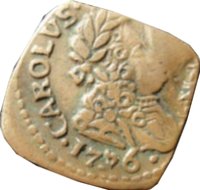
Description:
Right-facing bust, date beneath.
Inscription:
CAROLVS·VI·D·G·IMP·ET·HIS·REX
·1736·
·1736·
Script: Latin
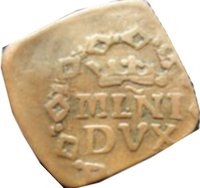
Reverse
Edge
Categories
| Object> Armour |
| Symbols> Coat of Arms |
Mints
| Name | Mark |
|---|---|
| Milan | — |
Mintings
| Year | Mint Mark | Mintage | Quality | Collection |
|---|---|---|---|---|
| 1728 | — | — | ||
| 1733 | — | — | ||
| 1736 | — | — |
Historical background
In 1728, Milan found itself at a complex monetary crossroads, governed by the Austrian Habsburgs but deeply embedded in the diverse economic landscape of northern Italy. The official currency was the Milanese scudo, a silver-based coin, but the reality of daily commerce was far more fragmented. The city's markets saw a simultaneous circulation of older Spanish and local Italian coins, alongside a persistent influx of gold zecchino coins from Venice. This proliferation of different coins, each with fluctuating metallic values and exchange rates, created chronic confusion, hampered trade, and invited widespread fraud, as clipping and counterfeiting were common.
The Habsburg administration, recognizing the economic inefficiency and loss of seigniorage revenue, was actively pursuing a policy of monetary standardization and control. This was part of a broader centralizing trend within the empire, aiming to replace regional coinages with uniform imperial currency. In Milan, this meant a concerted effort to suppress the circulation of foreign coins, particularly the ubiquitous Venetian gold, and to assert the primacy of the Milanese mint. The year 1728 thus falls within a period of transition and enforcement, where imperial decrees clashed with entrenched mercantile habits.
Consequently, the currency situation was one of tension between imperial decree and market reality. While the state sought to impose order and fiscal authority through a unified silver standard, the practical needs of regional commerce, especially with Venice and Genoa, ensured that a multiplicity of coins remained in use. The result was a dual system: official accounts and state payments were conducted in the prescribed Milanese scudo and its subdivisions, while private merchants and international traders continued to negotiate a more complex, bimetallic world of both silver and gold, navigating the risks and opportunities of a non-uniform monetary space.
The Habsburg administration, recognizing the economic inefficiency and loss of seigniorage revenue, was actively pursuing a policy of monetary standardization and control. This was part of a broader centralizing trend within the empire, aiming to replace regional coinages with uniform imperial currency. In Milan, this meant a concerted effort to suppress the circulation of foreign coins, particularly the ubiquitous Venetian gold, and to assert the primacy of the Milanese mint. The year 1728 thus falls within a period of transition and enforcement, where imperial decrees clashed with entrenched mercantile habits.
Consequently, the currency situation was one of tension between imperial decree and market reality. While the state sought to impose order and fiscal authority through a unified silver standard, the practical needs of regional commerce, especially with Venice and Genoa, ensured that a multiplicity of coins remained in use. The result was a dual system: official accounts and state payments were conducted in the prescribed Milanese scudo and its subdivisions, while private merchants and international traders continued to negotiate a more complex, bimetallic world of both silver and gold, navigating the risks and opportunities of a non-uniform monetary space.
✨ Legendary