

1 Mariengroschen – Brunswick-Lüneburg-Calenberg-Hannover
Germany

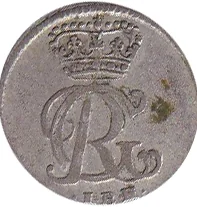
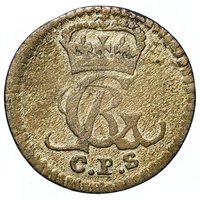
Obverse
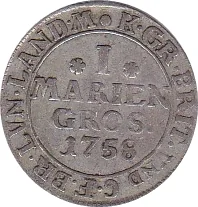
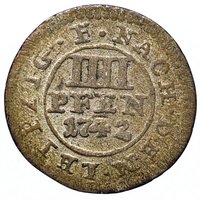
Reverse
Description:
Central inscription: denomination and date.
Inscription:
*I* // MARIEN // GROS
1758
K.GR.BRIT.C.F.BR.LUN.LANDM.
1758
K.GR.BRIT.C.F.BR.LUN.LANDM.
Script: Latin
Edge
Mints
| Name | Mark |
|---|---|
| Clausthal | — |
| Zellerfeld | — |
Mintings
| Year | Mint Mark | Mintage | Quality | Collection |
|---|---|---|---|---|
| 1738 | — | — | ||
| 1739 | — | — | ||
| 1740 | — | — | ||
| 1741 | — | — | ||
| 1742 | — | — | ||
| 1751 | C | — | ||
| 1753 | — | — | ||
| 1753 | C | — | ||
| 1755 | — | — | ||
| 1758 | — | — |
Historical background
In 1738, the currency situation in the Duchy of Brunswick-Lüneburg, specifically the Principality of Calenberg (with its capital in Hanover), was complex and fragmented, reflecting the broader monetary disarray of the Holy Roman Empire. The territory did not have a single, unified coinage. Instead, circulation was dominated by the Reichsthaler, an imperial silver standard, alongside a plethora of older regional and municipal coins, as well as foreign currencies from neighbouring states like Brunswick-Wolfenbüttel. This multiplicity created a constant challenge for trade and administration, requiring cumbersome exchange calculations.
The root of this complexity lay in the monetary policies of Elector George II Augustus, who was also King of Great Britain and Ireland. His focus was often drawn to his British affairs, leaving Hanover's domestic finances under the management of local officials. While the Reichsthaler provided a theoretical anchor, its value in practice was undermined by the circulation of inferior subsidiary coins, such as Gute Groschen and Mariengroschen, which were often debased. Furthermore, the need to finance state activities and military engagements led to periodic issuance of lower-quality coinage, contributing to inflation and public distrust.
Consequently, the year 1738 fell within a period of monetary instability before a major reform. The chaotic system hampered economic development and state revenue collection. This pressing need for order would ultimately lead to a significant currency reform in 1750, initiated by George II's successor, which introduced the Conventionsfuß standard and began minting the distinctive Conventionsthaler. Therefore, the situation in 1738 was one of lingering disorder, setting the stage for the systematic changes that would follow in the subsequent decade.
The root of this complexity lay in the monetary policies of Elector George II Augustus, who was also King of Great Britain and Ireland. His focus was often drawn to his British affairs, leaving Hanover's domestic finances under the management of local officials. While the Reichsthaler provided a theoretical anchor, its value in practice was undermined by the circulation of inferior subsidiary coins, such as Gute Groschen and Mariengroschen, which were often debased. Furthermore, the need to finance state activities and military engagements led to periodic issuance of lower-quality coinage, contributing to inflation and public distrust.
Consequently, the year 1738 fell within a period of monetary instability before a major reform. The chaotic system hampered economic development and state revenue collection. This pressing need for order would ultimately lead to a significant currency reform in 1750, initiated by George II's successor, which introduced the Conventionsfuß standard and began minting the distinctive Conventionsthaler. Therefore, the situation in 1738 was one of lingering disorder, setting the stage for the systematic changes that would follow in the subsequent decade.
✨ Legendary