

5 Cents – East Africa
Context
Years: 1913–1919
Issuer: East Africa
Ruler: George V
Currency:
(1906—1920)
Demonetized: Yes
Total mintage: 1,740,000
Material
Diameter: 25.5 mm
Weight: 6.48 g
Shape: Round with a round hole
Composition: Copper-nickel
Technique: Milled
Alignment: Medal alignment
flip
References
KM: #Click to copy to clipboard11
Numista: #12030
Obverse
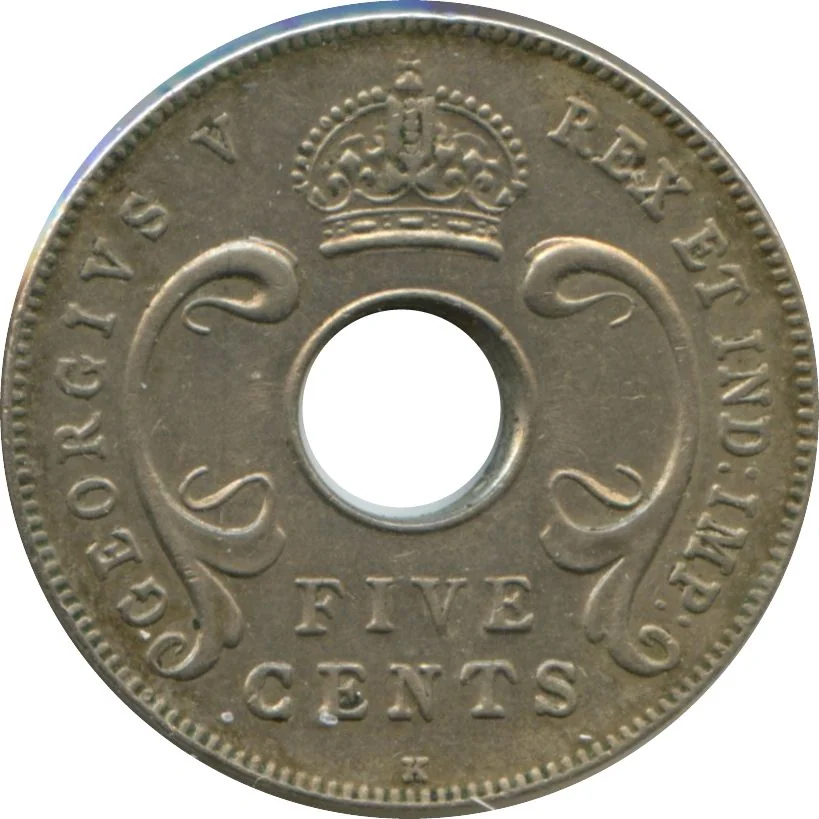
Description:
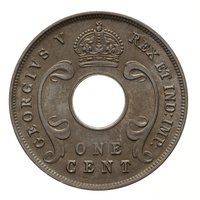
Central hole separates crown and denomination, encircled by legend. Mintmark under the N in CENTS.
Inscription:
GEORGIVS V REX ET IND:IMP:
FIVE
CENTS
K
FIVE
CENTS
K
Script: Latin
Reverse
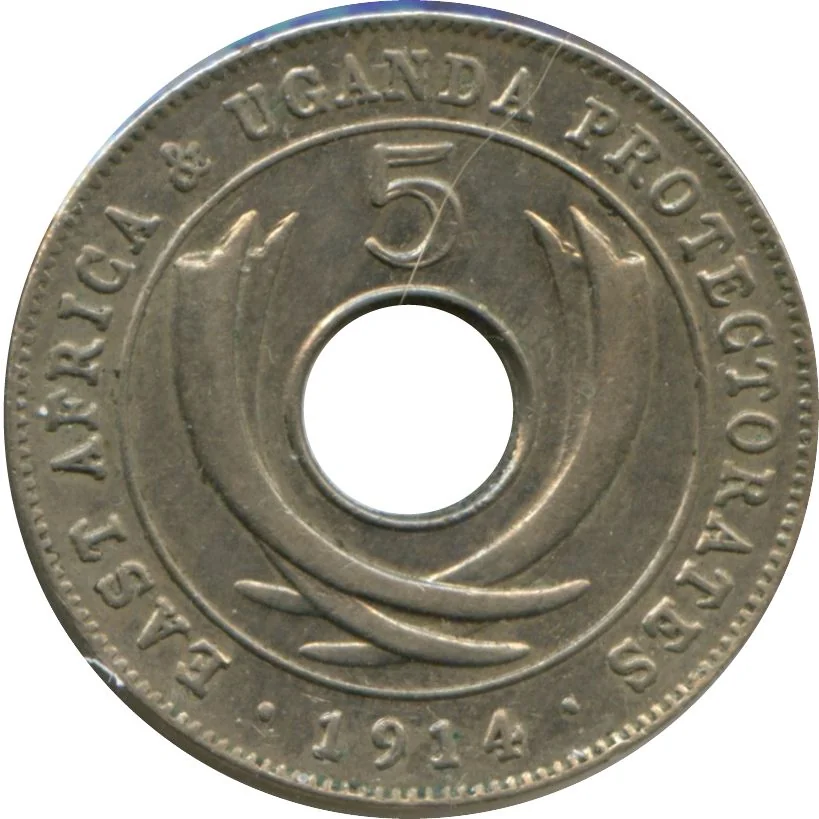
Description:
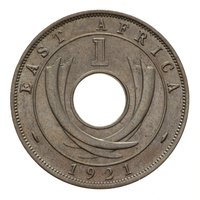
Curved tusks frame the central opening.
Inscription:
EAST AFRICA & UGANDA PROTECTORATES
5
·1914·
5
·1914·
Script: Latin
Edge
Plain
Mints
| Name | Mark |
|---|---|
| Heaton and Sons / The Mint Birmingham | H |
| Kings Norton Metal Company | K |
Historical background
In 1913, the currency landscape of East Africa was predominantly shaped by European colonial powers, each imposing its own monetary system within its sphere of influence. The British East Africa Protectorate (present-day Kenya) and the Uganda Protectorate used the East African rupee, introduced in 1906 to replace the Indian rupee and sterling. This silver-based currency was issued by the East African Currency Board, established in London, and was pegged to the Indian rupee, facilitating trade within the Indian Ocean basin. Meanwhile, German East Africa (present-day Tanzania, Rwanda, Burundi) circulated the German East African rupie, also a silver standard currency, though its value was officially tied to the German gold mark.
These colonial currencies existed alongside and actively supplanted a rich variety of indigenous mediums of exchange. In the interior, traditional barter and commodity monies, such as cowrie shells, cloth (merikani), iron hoes, and livestock, remained vital for local and regional trade, especially away from the coast and railway lines. The Maria Theresa thaler, a silver trade coin of legendary acceptance, continued to be a trusted medium for larger transactions, particularly in Ethiopia and in cross-border trade across the Horn of Africa, stubbornly resisting full displacement by the new colonial systems.
The year 1913 thus represents a period of monetary transition and fragmentation, where imported colonial systems overlay but did not completely erase established networks. This created a complex multi-currency environment, with exchange values fluctuating based on silver prices and colonial policy. This imposed order would be violently disrupted just a year later with the outbreak of the First World War, which led to the expulsion of Germany from the region and set the stage for the eventual unification of the British territories under a single shilling-based currency in the 1920s.
These colonial currencies existed alongside and actively supplanted a rich variety of indigenous mediums of exchange. In the interior, traditional barter and commodity monies, such as cowrie shells, cloth (merikani), iron hoes, and livestock, remained vital for local and regional trade, especially away from the coast and railway lines. The Maria Theresa thaler, a silver trade coin of legendary acceptance, continued to be a trusted medium for larger transactions, particularly in Ethiopia and in cross-border trade across the Horn of Africa, stubbornly resisting full displacement by the new colonial systems.
The year 1913 thus represents a period of monetary transition and fragmentation, where imported colonial systems overlay but did not completely erase established networks. This created a complex multi-currency environment, with exchange values fluctuating based on silver prices and colonial policy. This imposed order would be violently disrupted just a year later with the outbreak of the First World War, which led to the expulsion of Germany from the region and set the stage for the eventual unification of the British territories under a single shilling-based currency in the 1920s.
🌟 Uncommon