

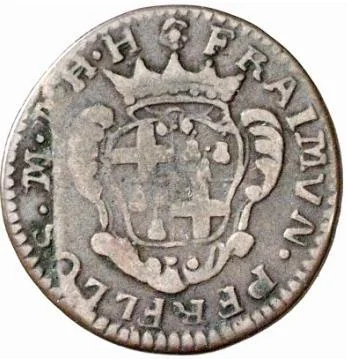
Obverse
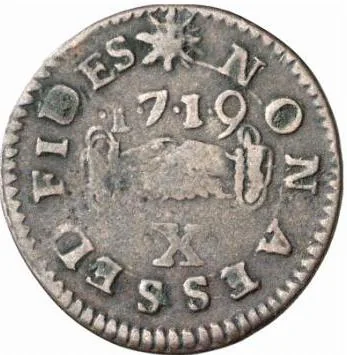
Reverse
Description:
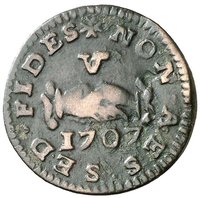
Clasped hands between date and value.
Inscription:
NON AES SED FIDES
·1·7·1·9
X
·1·7·1·9
X
Script: Latin
Edge
Mintings
| Year | Mint Mark | Mintage | Quality | Collection |
|---|---|---|---|---|
| 1719 | — | — |
Historical background
In 1719, Malta's currency situation was complex and challenging, reflecting its position as a strategic crossroads under the rule of the Knights of St. John. The primary unit of account was the Maltese scudo, but the actual circulating medium was a chaotic mix of physical coins from across Europe and the Mediterranean. Spanish pieces of eight (reales), French louis d'or, Venetian sequins, and Turkish piastres all circulated simultaneously, their values fluctuating based on weight, metal content, and market confidence. This created a perpetual headache for merchants and the treasury, as daily transactions required constant calculation and assay.
The Knights' government attempted to impose order by issuing its own limited coinage at the Zecca (mint) in Valletta, primarily copper grani and tari for small change, and silver scudi. However, these official issues were insufficient to meet the island's commercial needs. A critical and worsening problem was the widespread clipping and debasement of silver coins, particularly the ubiquitous Spanish pieces of eight. As these coins lost intrinsic value through wear and fraud, it drove sound money out of circulation (Gresham's Law), exacerbating inflation and undermining both local trade and the Order's own financial operations.
Consequently, the economy functioned on a dual system: a cumbersome reality of heterogeneous physical coins for daily use and an official accounting in the stable Maltese scudo for large contracts and government finance. This instability prompted ongoing discussions within the Order about monetary reform, setting the stage for more systematic interventions in the 1720s aimed at standardizing the coinage and asserting greater sovereign control over the currency, crucial for funding the island's formidable fortifications and naval activities.
The Knights' government attempted to impose order by issuing its own limited coinage at the Zecca (mint) in Valletta, primarily copper grani and tari for small change, and silver scudi. However, these official issues were insufficient to meet the island's commercial needs. A critical and worsening problem was the widespread clipping and debasement of silver coins, particularly the ubiquitous Spanish pieces of eight. As these coins lost intrinsic value through wear and fraud, it drove sound money out of circulation (Gresham's Law), exacerbating inflation and undermining both local trade and the Order's own financial operations.
Consequently, the economy functioned on a dual system: a cumbersome reality of heterogeneous physical coins for daily use and an official accounting in the stable Maltese scudo for large contracts and government finance. This instability prompted ongoing discussions within the Order about monetary reform, setting the stage for more systematic interventions in the 1720s aimed at standardizing the coinage and asserting greater sovereign control over the currency, crucial for funding the island's formidable fortifications and naval activities.
✨ Legendary