

1 pfennig – Reuss-Untergreiz
Add to wishlist
Germany
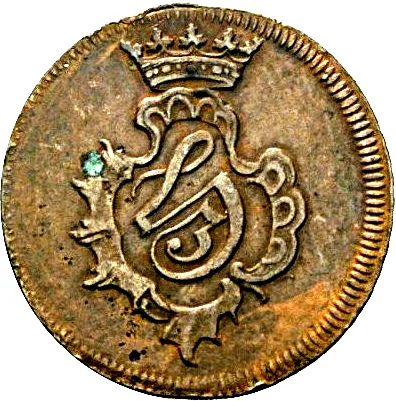
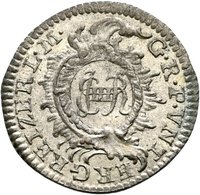
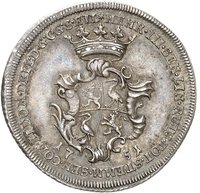
Obverse
Description:
H3 monogram in rococo cartouche.
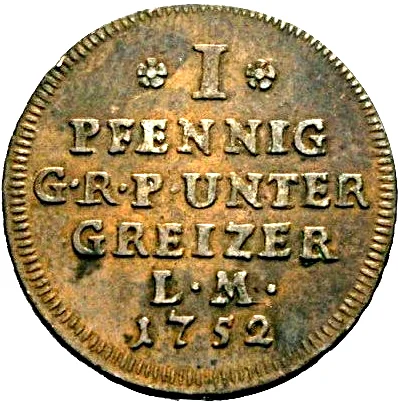
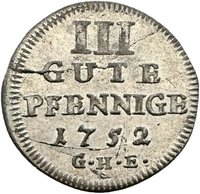
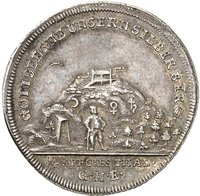
Reverse
Description:
Denomination, date, and mintmaster initials in six lines.
Inscription:
*I*
PFENNIG
G.R.P.UNTER
GREIZER
L.M.
1752
PFENNIG
G.R.P.UNTER
GREIZER
L.M.
1752
Script: Latin
Edge
Mints
| Name | Mark |
|---|---|
| Saalfeld | — |
Mintings
| Year | Mint Mark | Mintage | Quality | Collection |
|---|---|---|---|---|
| 1752 | — | — |
Historical background
In 1752, the small Thuringian principality of Reuss-Untergreiz, like many minor German states of the Holy Roman Empire, faced a complex and challenging currency situation. The territory was part of a fragmented monetary landscape where dozens of sovereigns minted their own coins, leading to chronic instability. Reuss-Untergreiz itself issued limited coinage, primarily small-denomination Groschen and Pfennige for local use, but these circulated alongside a multitude of foreign coins, especially from larger neighbors like Saxony and Prussia, whose heavier, high-quality Reichsthaler were preferred for larger transactions.
The core problem was the disparity between the official face value of coins and their intrinsic metal content. Princes often engaged in "coin debasement," reducing the silver or gold content in their mintings to generate short-term revenue, which eroded public trust. While the Empire had attempted to standardize currency through the Reichsmünzfuß (Imperial minting standard), enforcement was weak. Consequently, the monetary system in Reuss-Untergreiz was characterized by confusion, with merchants and officials constantly evaluating and disputing the actual worth of hundreds of different coin types based on weight, fineness, and often dubious stamped valuations.
This environment created significant daily hardship and hindered commerce. Prices were unstable, and the populace, particularly those on fixed incomes, suffered from the hidden tax of inflation. For the ruling Count Henry XI, managing the currency was a delicate balancing act between fulfilling his sovereign minting rights, meeting state expenses, and maintaining some semblance of monetary order to ensure economic functionality within his modest lands, all while navigating the wider, turbulent monetary currents of the mid-18th century Empire.
The core problem was the disparity between the official face value of coins and their intrinsic metal content. Princes often engaged in "coin debasement," reducing the silver or gold content in their mintings to generate short-term revenue, which eroded public trust. While the Empire had attempted to standardize currency through the Reichsmünzfuß (Imperial minting standard), enforcement was weak. Consequently, the monetary system in Reuss-Untergreiz was characterized by confusion, with merchants and officials constantly evaluating and disputing the actual worth of hundreds of different coin types based on weight, fineness, and often dubious stamped valuations.
This environment created significant daily hardship and hindered commerce. Prices were unstable, and the populace, particularly those on fixed incomes, suffered from the hidden tax of inflation. For the ruling Count Henry XI, managing the currency was a delicate balancing act between fulfilling his sovereign minting rights, meeting state expenses, and maintaining some semblance of monetary order to ensure economic functionality within his modest lands, all while navigating the wider, turbulent monetary currents of the mid-18th century Empire.

✨ Legendary