

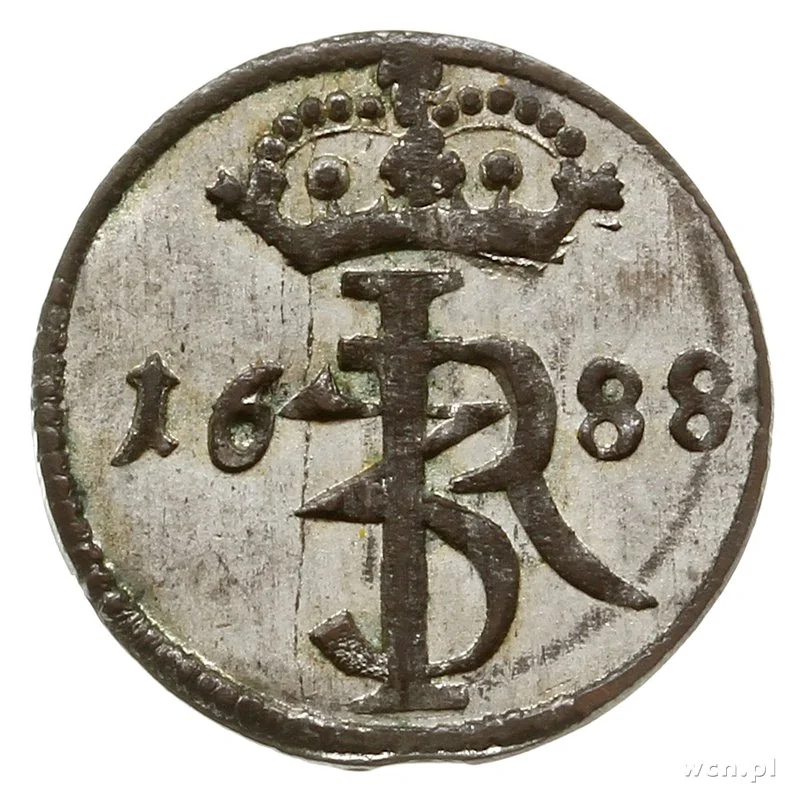
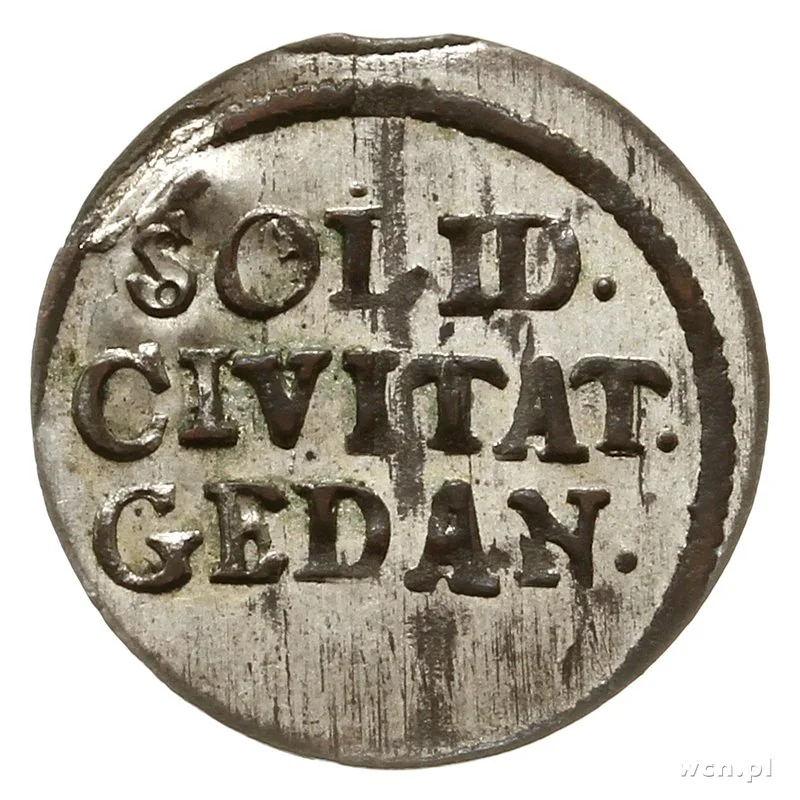
1 Schilling – Polish–Lithuanian Commonwealth
Poland
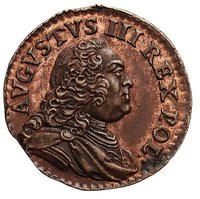
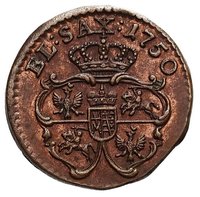
Context
Year: 1688
Country: Poland 
Issuer: Polish–Lithuanian Commonwealth
Ruler: John III Sobieski
Currency:
(1573—1795)
Demonetized: Yes
Total mintage: 128,000
References
KM: #Click to copy to clipboard77
Numista: #96567
Mints
| Name | Mark |
|---|---|
| Gdańsk | — |
Mintings
| Year | Mint Mark | Mintage | Quality | Collection |
|---|---|---|---|---|
| 1688 | — | 128,000 |
Historical background
By 1688, the currency situation in the Polish–Lithuanian Commonwealth was one of profound instability and debasement, a direct result of decades of fiscal mismanagement and external pressure. The primary unit, the złoty, was not a coin but a unit of account, valued at 30 groszy. However, the actual circulating coins, particularly the small silver tymf and copper boratynka (shilling), had been systematically degraded by the royal mints. To finance endless wars against the Ottoman Empire, Sweden, and Russia, the state, often through private minting leases, drastically reduced the silver content in coins while maintaining their nominal face value, a profitable but destructive practice known as "crying down" the currency.
This monetary policy led to rampant inflation, a loss of public trust, and economic chaos. Prices for goods and services soared as merchants and peasants alike recognized the intrinsic worth of the debased coins was far below their stated value. Gresham's law took full effect, with older, full-value coins being hoarded or melted down, leaving only the poor-quality money in circulation. The situation was exacerbated by a flood of even worse counterfeit coins and by the circulation of a vast array of foreign currencies within the Commonwealth's borders, as international traders demanded payment in stable specie like thalers.
The crisis had deep political roots, stemming from the "Golden Liberty" of the nobility and the weakness of the central government. Any meaningful monetary reform required the approval of the Sejm (parliament), where the szlachta (nobility) routinely blocked royal attempts to strengthen fiscal authority or introduce new taxes. Consequently, in 1688, the Commonwealth lacked a uniform, stable monetary system. The debasement continued as a short-term fix to fund the military, particularly for King John III Sobieski’s campaigns, while eroding the economic foundations of the state and burdening the lower classes, setting the stage for further decline in the coming century.
This monetary policy led to rampant inflation, a loss of public trust, and economic chaos. Prices for goods and services soared as merchants and peasants alike recognized the intrinsic worth of the debased coins was far below their stated value. Gresham's law took full effect, with older, full-value coins being hoarded or melted down, leaving only the poor-quality money in circulation. The situation was exacerbated by a flood of even worse counterfeit coins and by the circulation of a vast array of foreign currencies within the Commonwealth's borders, as international traders demanded payment in stable specie like thalers.
The crisis had deep political roots, stemming from the "Golden Liberty" of the nobility and the weakness of the central government. Any meaningful monetary reform required the approval of the Sejm (parliament), where the szlachta (nobility) routinely blocked royal attempts to strengthen fiscal authority or introduce new taxes. Consequently, in 1688, the Commonwealth lacked a uniform, stable monetary system. The debasement continued as a short-term fix to fund the military, particularly for King John III Sobieski’s campaigns, while eroding the economic foundations of the state and burdening the lower classes, setting the stage for further decline in the coming century.
✨ Legendary