

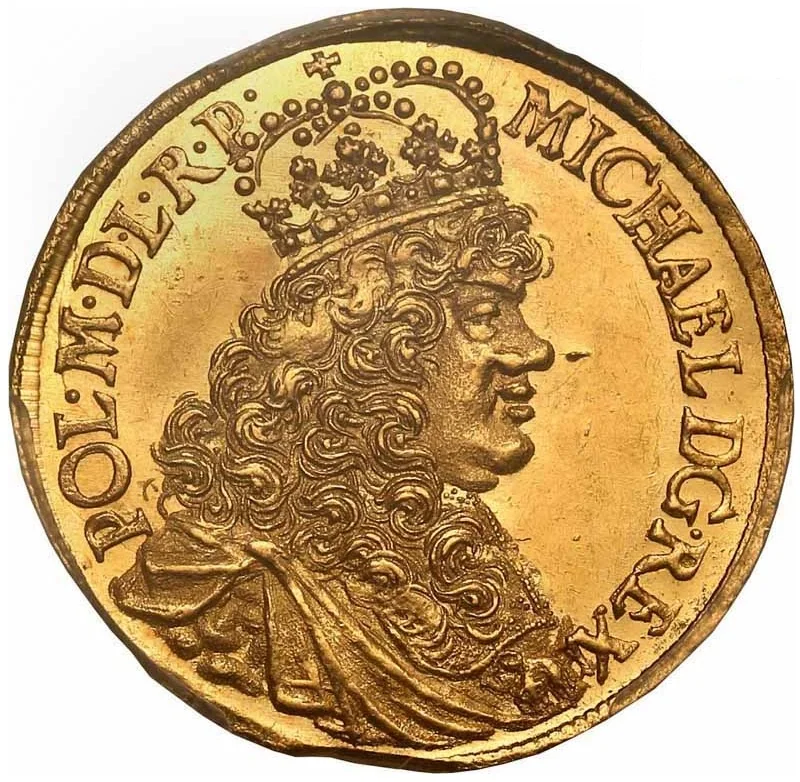
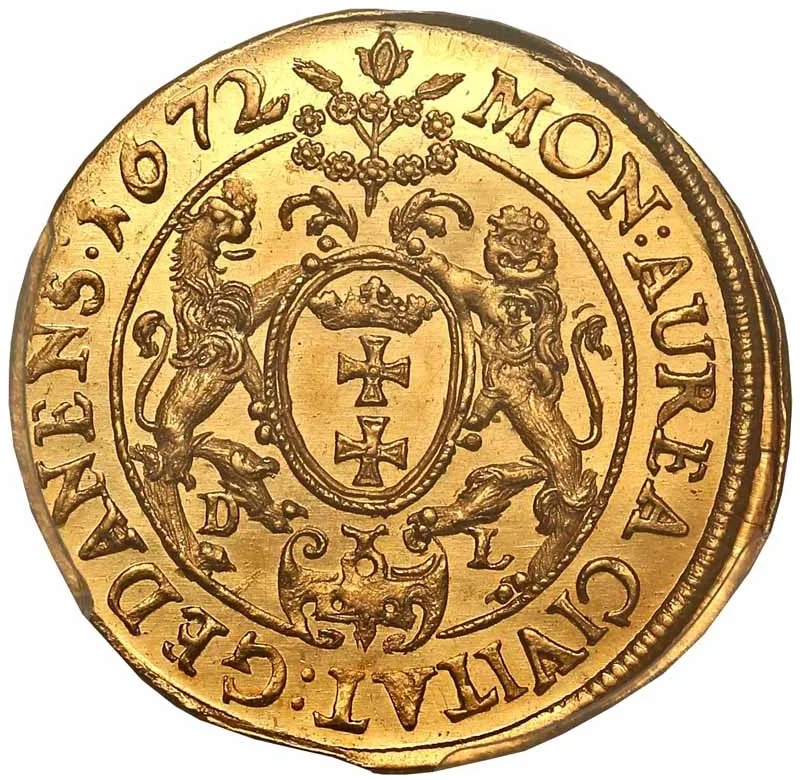
1 Ducat – Polish–Lithuanian Commonwealth
Poland
Context
Years: 1672–1673
Country: Poland 
Issuer: Polish–Lithuanian Commonwealth
Ruler: Michael I
Currency:
(1573—1795)
Demonetized: Yes
Material
References
KM: #Click to copy to clipboard71.2
Numista: #96425
Value
Bullion value: $576.36
Mints
| Name | Mark |
|---|---|
| Gdańsk | — |
Mintings
| Year | Mint Mark | Mintage | Quality | Collection |
|---|---|---|---|---|
| 1672 | — | — | ||
| 1673 | — | — |
Historical background
By 1672, the currency system of the Polish–Lithuanian Commonwealth was in a state of severe crisis, a direct result of decades of fiscal mismanagement and external economic warfare. The primary unit, the złoty, was not a coin but a unit of account worth 30 groszy, while the actual circulating medium consisted of a chaotic mix of domestic and foreign coins. The Commonwealth's own mint output, particularly silver coins like the tymf and boratynka, had been deliberately debased by the Treasury to fund the state's enormous military expenditures during the Deluge (1655–1660) and subsequent wars. This practice destroyed public trust in the currency and fueled rampant inflation.
The situation was exacerbated by the influx of vast quantities of debased copper szelągs (shillings), minted in enormous numbers by private minters like Tytus Liwiusz Boratini, who had purchased the right to coinage from the Crown. While these small-denomination coins were necessary for everyday trade, their overproduction and low intrinsic value further distorted the economy. Simultaneously, high-quality full-weight foreign coins, such as German thalers and Dutch ducats, circulated alongside this debased domestic coinage, leading to Gresham's Law in action: "bad money drove out good." These sound foreign coins were hoarded, exported, or used for large transactions, leaving the populace to struggle with the ever-worsening local currency.
This monetary collapse occurred at a moment of extreme political and military vulnerability, as the Commonwealth faced the devastating invasion of the Ottoman Empire that culminated in the fall of Kamianets-Podilskyi and the humiliating Treaty of Buchach in 1672. The currency chaos crippled the state's ability to efficiently raise and pay armies, as soldiers and suppliers demanded payment in reliable specie. Thus, the monetary disorder of 1672 was not merely an economic issue but a critical factor that weakened the Commonwealth's capacity to defend itself, reflecting the deep interconnection between its fragile fiscal structures and its escalating political and military decline.
The situation was exacerbated by the influx of vast quantities of debased copper szelągs (shillings), minted in enormous numbers by private minters like Tytus Liwiusz Boratini, who had purchased the right to coinage from the Crown. While these small-denomination coins were necessary for everyday trade, their overproduction and low intrinsic value further distorted the economy. Simultaneously, high-quality full-weight foreign coins, such as German thalers and Dutch ducats, circulated alongside this debased domestic coinage, leading to Gresham's Law in action: "bad money drove out good." These sound foreign coins were hoarded, exported, or used for large transactions, leaving the populace to struggle with the ever-worsening local currency.
This monetary collapse occurred at a moment of extreme political and military vulnerability, as the Commonwealth faced the devastating invasion of the Ottoman Empire that culminated in the fall of Kamianets-Podilskyi and the humiliating Treaty of Buchach in 1672. The currency chaos crippled the state's ability to efficiently raise and pay armies, as soldiers and suppliers demanded payment in reliable specie. Thus, the monetary disorder of 1672 was not merely an economic issue but a critical factor that weakened the Commonwealth's capacity to defend itself, reflecting the deep interconnection between its fragile fiscal structures and its escalating political and military decline.
✨ Legendary