

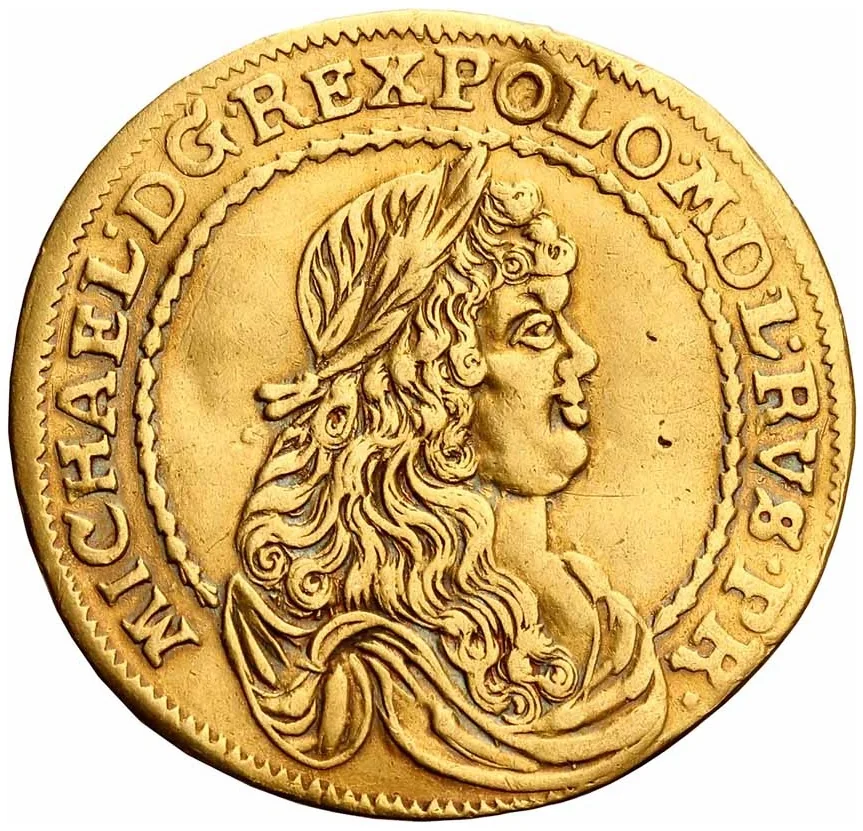
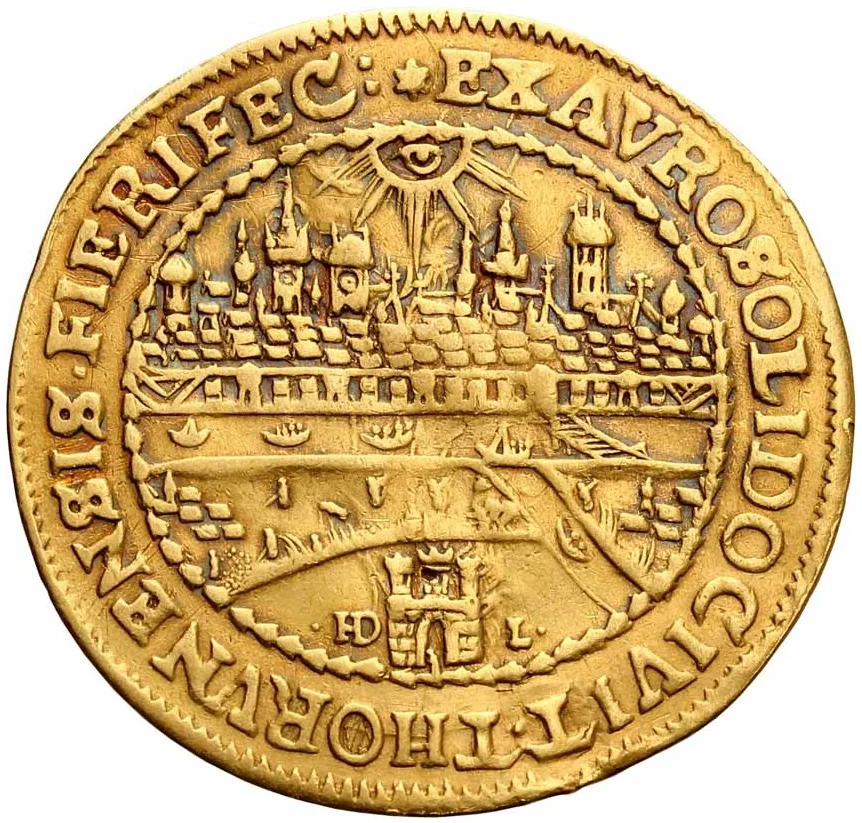
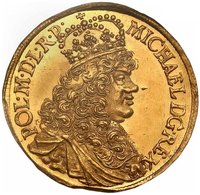
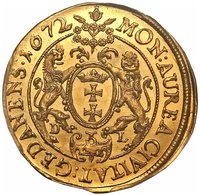
2 Ducats – Polish–Lithuanian Commonwealth
Poland
Context
Years: 1669–1673
Country: Poland 
Issuer: Polish–Lithuanian Commonwealth
Ruler: Michael I
Currency:
(1573—1795)
Demonetized: Yes
Material
References
KM: #Click to copy to clipboard52
Numista: #96426
Value
Bullion value: $1082.12
Obverse
Inscription:
MICHAEL DG REX POLO MD L RVS PR
Script: Latin
Reverse
Inscription:
EX AVRO SOLIDO CIVIT THORVNENSIS FIERIFEC
HD-L
HD-L
Script: Latin
Edge
Mints
| Name | Mark |
|---|---|
| Toruń | — |
Mintings
| Year | Mint Mark | Mintage | Quality | Collection |
|---|---|---|---|---|
| — | — | — |
Historical background
By 1669, the currency system of the Polish–Lithuanian Commonwealth was in a state of severe crisis, a direct consequence of the devastating "Deluge" (a series of mid-century wars with Sweden, Russia, and Cossacks) and decades of fiscal mismanagement. The state treasury was bankrupt, and to raise funds, the monarchy and minting authorities had resorted to the highly destructive practice of debasement. This involved drastically reducing the silver content in coins like the ubiquitous tymf and szóstak while maintaining their nominal face value, a form of seigniorage that amounted to state-sanctioned inflation.
The year 1669 itself was particularly turbulent, marked by the interregnum following the abdication of King John II Casimir Vasa in 1668 and the election of Michał Korybut Wiśniowiecki. The monetary chaos was a central issue for the nobility (szlachta) assembled at the convocation sejm. They decried the proliferation of inferior coinage, often from foreign mints and domestic counterfeits, which drove good-quality full-weight coins out of circulation (Gresham's Law). Prices soared, credit markets froze, and foreign merchants demanded payment in bullion or foreign currency, crippling internal trade and deepening economic depression.
Despite recognizing the problem, the Commonwealth's weak central authority and the liberum veto made comprehensive reform impossible. While the 1669 sejm attempted to address the issue, any substantive measures were blocked by powerful magnates who profited from the debasement through their control of mint leases (czopowe and kwarta taxes). Consequently, the monetary spiral continued unabated into the early 1670s, eroding economic stability and state revenue, and symbolizing the Commonwealth's deepening political paralysis in the face of internal decay.
The year 1669 itself was particularly turbulent, marked by the interregnum following the abdication of King John II Casimir Vasa in 1668 and the election of Michał Korybut Wiśniowiecki. The monetary chaos was a central issue for the nobility (szlachta) assembled at the convocation sejm. They decried the proliferation of inferior coinage, often from foreign mints and domestic counterfeits, which drove good-quality full-weight coins out of circulation (Gresham's Law). Prices soared, credit markets froze, and foreign merchants demanded payment in bullion or foreign currency, crippling internal trade and deepening economic depression.
Despite recognizing the problem, the Commonwealth's weak central authority and the liberum veto made comprehensive reform impossible. While the 1669 sejm attempted to address the issue, any substantive measures were blocked by powerful magnates who profited from the debasement through their control of mint leases (czopowe and kwarta taxes). Consequently, the monetary spiral continued unabated into the early 1670s, eroding economic stability and state revenue, and symbolizing the Commonwealth's deepening political paralysis in the face of internal decay.
✨ Legendary