

1 Thaler – Austrian Empire
Austria
Context
Years: 1716–1722
Country: Austria 
Issuer: Austrian Empire
Ruler: Charles VI
Currency:
(1520—1754)
Demonetized: Yes
Material
References
KM: #Click to copy to clipboard1579.1
Numista: #95683
Value
Bullion value: $82.66
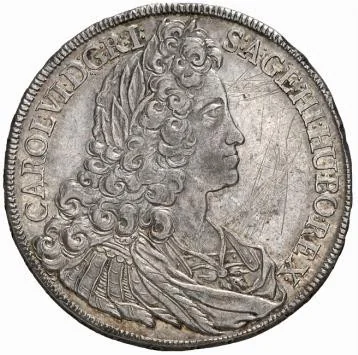
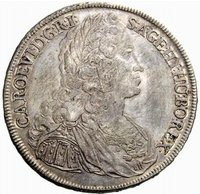
Obverse
Description:
Laureate right, legend around (from 8h).
Inscription:
CAROL VI D G R I // S A GE HI HU BO REX
Script: Latin
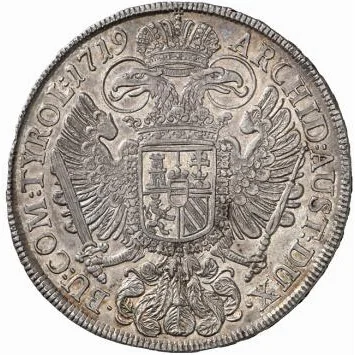
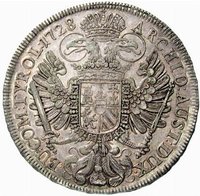
Reverse
Description:
Imperial double-headed eagle with central shield of Austria, encircled by the arms of Castile, Hungary, Bohemia, and Burgundy, and surrounded by the Golden Fleece chain. Legend around, divided by tail feathers, with date at end.
Inscription:
ARCHID AVST DVX // BU COM TYROL 1719
Script: Latin
Edge
Mints
| Name | Mark |
|---|---|
| Münze Österreich | A |
Historical background
In 1716, the currency situation within the Habsburg-ruled Austrian Empire was one of profound complexity and instability, a direct legacy of the immense financial strain caused by the long and costly wars of the previous decades, particularly the War of the Spanish Succession (1701-1714). The state treasury was deeply depleted, and to meet its obligations, the government frequently resorted to debasement—reducing the precious metal content in coins while officially maintaining their face value. This practice, especially with the small-denomination kreuzer coins used in daily life, led to a severe proliferation of underweight and adulterated currency, causing widespread confusion and loss of public trust.
The monetary landscape was a chaotic patchwork. While the official reckoning was in Gulden (florins) divided into 60 kreuzer, the empire's diverse lands, from Austria and Bohemia to Hungary, often used different standards and physical coins. Furthermore, high-value trade was conducted using full-weight silver thalers (like the Reichsthaler), which existed alongside the debased domestic coinage, creating a disruptive system of "good" and "bad" money. Gresham's Law was in full effect, where "bad money drives out good"—people hoarded the full-weight thalers and used the poor kreuzers for transactions, further distorting the economy and hampering commerce.
Recognizing the crisis, the government under Emperor Charles VI was in the early stages of attempting reform. The year 1716 fell within a period of investigation and proposal, leading up to the more definitive—though ultimately only partially successful—coinage ordinance of 1717. This planned reform aimed to standardize the kreuzer on a new, stable footing and restore confidence. Thus, the situation in 1716 was one of a low point in monetary credibility, characterized by inflationary pressure from debased coinage and a dual circulation system, but with the first tentative steps being taken toward a necessary, yet historically difficult, imperial monetary consolidation.
The monetary landscape was a chaotic patchwork. While the official reckoning was in Gulden (florins) divided into 60 kreuzer, the empire's diverse lands, from Austria and Bohemia to Hungary, often used different standards and physical coins. Furthermore, high-value trade was conducted using full-weight silver thalers (like the Reichsthaler), which existed alongside the debased domestic coinage, creating a disruptive system of "good" and "bad" money. Gresham's Law was in full effect, where "bad money drives out good"—people hoarded the full-weight thalers and used the poor kreuzers for transactions, further distorting the economy and hampering commerce.
Recognizing the crisis, the government under Emperor Charles VI was in the early stages of attempting reform. The year 1716 fell within a period of investigation and proposal, leading up to the more definitive—though ultimately only partially successful—coinage ordinance of 1717. This planned reform aimed to standardize the kreuzer on a new, stable footing and restore confidence. Thus, the situation in 1716 was one of a low point in monetary credibility, characterized by inflationary pressure from debased coinage and a dual circulation system, but with the first tentative steps being taken toward a necessary, yet historically difficult, imperial monetary consolidation.
✨ Legendary