

1 Thaler – Austrian Empire
Austria
Context
Years: 1720–1735
Country: Austria 
Issuer: Austrian Empire
Ruler: Charles VI
Currency:
(1520—1754)
Demonetized: Yes
Material
References
KM: #Click to copy to clipboard1579.2
Numista: #86734
Value
Bullion value: $75.42
Obverse
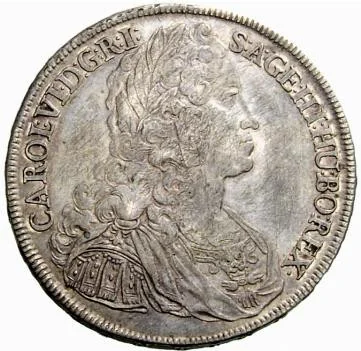
Description:
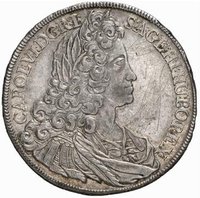
Portrait facing right, feathered headdress, devil's head on breast. Circular legend.
Inscription:
CAROL VI D G R I // S A GE HI HU BO REX
Script: Latin
Reverse
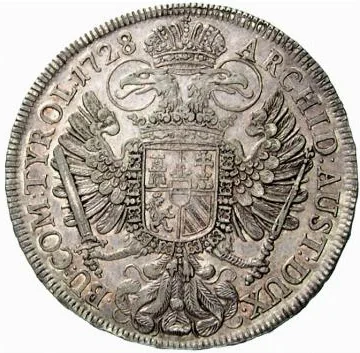
Description:
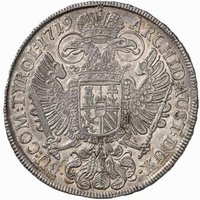
Imperial double-headed eagle with central shield of Austria, encircled by arms of Castile, Hungary, Bohemia, and Burgundy, and the chain of the Golden Fleece. Legend around, divided by tail feathers, with date.
Inscription:
ARCHID AVST DVX // BU COM TYROL 1728
Script: Latin
Edge
Smooth with embossed inscriptions
Legend:
orbem constante(r) continea
Mints
| Name | Mark |
|---|---|
| Münze Österreich | — |
Mintings
| Year | Mint Mark | Mintage | Quality | Collection |
|---|---|---|---|---|
| 1720 | — | — | ||
| 1721 | — | — | ||
| 1722 | — | — | ||
| 1723 | — | — | ||
| 1724 | — | — | ||
| 1725 | — | — | ||
| 1726 | — | — | ||
| 1727 | — | — | ||
| 1728 | — | — | ||
| 1729 | — | — | ||
| 1730 | — | — | ||
| 1731 | — | — | ||
| 1732 | — | — | ||
| 1733 | — | — | ||
| 1734 | — | — | ||
| 1735 | — | — |
Historical background
In 1720, the currency situation in the Austrian Habsburg Monarchy was characterized by severe instability and the lingering consequences of decades of war finance. The state's finances had been devastated by the costs of the War of the Spanish Succession (1701-1714) and the recent Austro-Turkish War (1716-1718). To meet these enormous expenses, the government had repeatedly debased the coinage, notably the small-denomination kreuzer, by reducing its silver content. This led to a classic "bad money drives out good" scenario (Gresham's Law), where older, fuller-weight coins were hoarded or melted down, leaving the economy awash in depreciated and untrusted currency.
The primary unit of account was the Gulden (florin), divided into 60 kreuzer. However, the actual circulating coins varied wildly in real value against this notional standard. Alongside domestic coinage, a multitude of foreign currencies, particularly Dutch thalers and German coins, circulated widely, especially for larger transactions, further complicating trade and accounting. The Vienna City Bank (Wiener Stadtbank), established in 1706, attempted to bring stability by accepting deposits and making payments in a stable "bank money" unit (Banco Gulden), which held a premium over the depreciated "current money" (Courant Gulden). This created a two-tiered monetary system.
Overall, the year 1720 found the monarchy in a precarious state of monetary confusion, with a significant gap between the official face value of coins and their intrinsic metallic worth. This debasement had fueled price inflation, eroded public trust, and hampered economic recovery. While the immediate pressure of war had subsided, the structural fiscal weaknesses remained unaddressed, setting the stage for future attempts at reform, which would prove to be a persistent and difficult challenge for the 18th-century Habsburg state.
The primary unit of account was the Gulden (florin), divided into 60 kreuzer. However, the actual circulating coins varied wildly in real value against this notional standard. Alongside domestic coinage, a multitude of foreign currencies, particularly Dutch thalers and German coins, circulated widely, especially for larger transactions, further complicating trade and accounting. The Vienna City Bank (Wiener Stadtbank), established in 1706, attempted to bring stability by accepting deposits and making payments in a stable "bank money" unit (Banco Gulden), which held a premium over the depreciated "current money" (Courant Gulden). This created a two-tiered monetary system.
Overall, the year 1720 found the monarchy in a precarious state of monetary confusion, with a significant gap between the official face value of coins and their intrinsic metallic worth. This debasement had fueled price inflation, eroded public trust, and hampered economic recovery. While the immediate pressure of war had subsided, the structural fiscal weaknesses remained unaddressed, setting the stage for future attempts at reform, which would prove to be a persistent and difficult challenge for the 18th-century Habsburg state.
💎 Extremely Rare