

3 Kreuzer – Austrian Empire
Austria
Context
Years: 1714–1720
Country: Austria 
Issuer: Austrian Empire
Ruler: Charles VI
Currency:
(1520—1754)
Demonetized: Yes
Material
References
KM: #Click to copy to clipboard1568
Numista: #44253
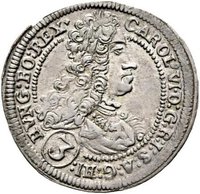
Obverse
Description:
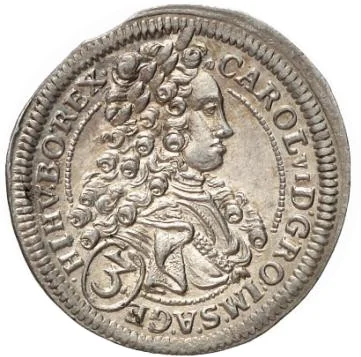
Karl VI portrait centered in a circle, his head touching the top. Legend: "Carolus VI...Rex".
Inscription:
CAROL·VI·D·G·RO·IM·S·A·GE (3) HI·HV·BO·REX
VI in small characters
VI in small characters
Script: Latin
Reverse
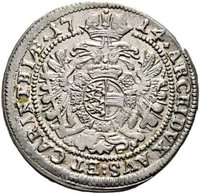
Description:
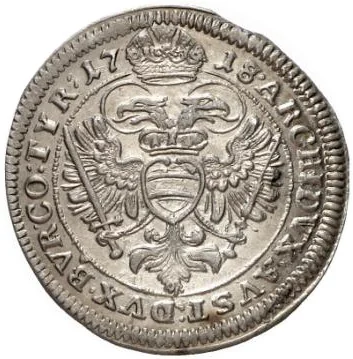
Austrian double-headed eagle with crown-divided date. Legend: "Archidux Austriae, Dux Burgundiae, Comes Tyrolis."
Inscription:
ARCHIDVX·AVST·DVX·BVR·CO·TYR· 1717
Script: Latin
Edge
Mints
| Name | Mark |
|---|---|
| Münze Österreich | — |
Mintings
| Year | Mint Mark | Mintage | Quality | Collection |
|---|---|---|---|---|
| 1714 | — | — | ||
| 1715 | — | — | ||
| 1716 | — | — | ||
| 1717 | — | — | ||
| 1718 | — | — | ||
| 1719 | — | — | ||
| 1720 | — | — |
Historical background
In 1714, the currency situation in the Austrian Habsburg monarchy was complex and fragmented, reflecting the empire's diverse and decentralized political structure. The core lands operated on a dual system: the Rechnungsgulden (or Gulden) was the unit of account for official finance and large transactions, valued at 60 Kreuzer. However, the physical coins in circulation were silver Reichstalers, with their value fluctuating against the Gulden. Alongside these, a plethora of smaller silver and copper coins, often debased, circulated for daily use. Crucially, each crown land (like Bohemia or Hungary) and even major cities frequently minted their own subsidiary coinage, leading to a bewildering variety of valuations and exchange rates across the empire.
This monetary fragmentation was a direct result of chronic state weakness following the costly Wars of Spanish Succession (1701-1714) and the Ottoman wars. The imperial government in Vienna, perpetually short of revenue, repeatedly resorted to debasement—reducing the silver content in coins—to generate seigniorage profit to fund its armies. This practice, alongside the circulation of foreign coins and counterfeit money, led to significant inflation, a loss of public trust in the currency, and frequent price instability. The situation was most severe with small-denomination coins used by the common people, where debasement was most acute.
Consequently, 1714 fell within a period of ongoing monetary crisis and attempted reform. Emperor Charles VI's government recognized the need for standardization to facilitate trade and stabilize finances. Efforts were underway to centralize minting authority and impose uniform standards, most notably through the anticipated Münzordnung (coinage ordinance) of 1715. This reform aimed to stabilize the relationship between the Reichstaler and the Gulden and curb the worst abuses of debasement, setting the stage for a long, uneven struggle toward a more unified imperial monetary system in the decades that followed.
This monetary fragmentation was a direct result of chronic state weakness following the costly Wars of Spanish Succession (1701-1714) and the Ottoman wars. The imperial government in Vienna, perpetually short of revenue, repeatedly resorted to debasement—reducing the silver content in coins—to generate seigniorage profit to fund its armies. This practice, alongside the circulation of foreign coins and counterfeit money, led to significant inflation, a loss of public trust in the currency, and frequent price instability. The situation was most severe with small-denomination coins used by the common people, where debasement was most acute.
Consequently, 1714 fell within a period of ongoing monetary crisis and attempted reform. Emperor Charles VI's government recognized the need for standardization to facilitate trade and stabilize finances. Efforts were underway to centralize minting authority and impose uniform standards, most notably through the anticipated Münzordnung (coinage ordinance) of 1715. This reform aimed to stabilize the relationship between the Reichstaler and the Gulden and curb the worst abuses of debasement, setting the stage for a long, uneven struggle toward a more unified imperial monetary system in the decades that followed.
💎 Extremely Rare