

1 rupee – Maratha Empire
Add to wishlist
India
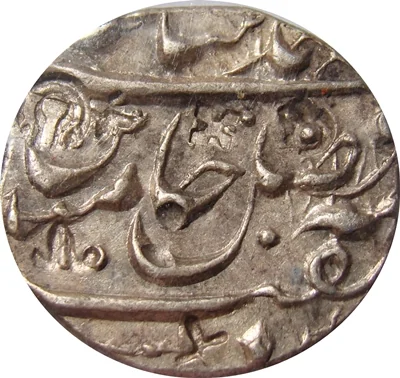
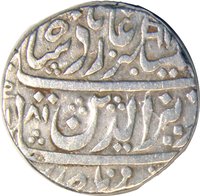
Obverse
Description:
Shah Alam II (M&W#T7)
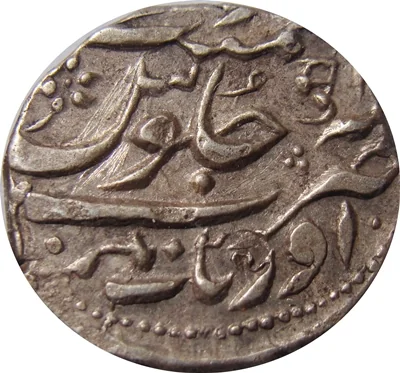
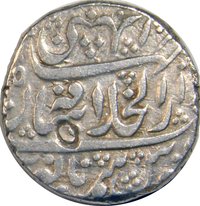
Reverse
Description:
Lingam and Nagari "Mu/Mo" inscription, regnal year.
Inscription:
मु
Edge
Mintings
| Year | Mint Mark | Mintage | Quality | Collection |
|---|---|---|---|---|
| — | — | — | ||
| 1767 | — | — | ||
| 1773 | — | — |
Historical background
By 1767, the currency situation within the Maratha Empire was complex and fragmented, reflecting the confederate nature of its political structure. While nominally under the Peshwa's authority in Pune, power was distributed among major chiefs like the Gaekwads in Baroda, the Holkars in Indore, and the Scindias in Gwalior. There was no single, unified imperial currency. Instead, the system was a mosaic of local and regional coinages, with the most prominent being the Chhatrapati or Shivrai copper coin and the Hon gold coin, which carried the prestige of the Maratha state but were minted at various locations under different authorities.
This decentralization led to significant variability in weight, purity, and design, causing practical challenges for trade and revenue collection. The Peshwa's government attempted to maintain standards by issuing minting licenses (sikkayachi sanad) and enforcing the use of official Maratha coins in revenue payments, but the sheer volume of local imitations and the continued circulation of older Mughal coins, like the silver Rupee, created a chronically heterogeneous monetary environment. Furthermore, the empire's expansion had incorporated regions with their own strong currency traditions, such as the Chandori rupee in the north, which further complicated the picture.
The year 1767 itself fell within a period of both internal consolidation and external pressure, impacting currency stability. The Peshwa's administration was actively engaged in auditing regional accounts and asserting central control, which included monitoring mint operations. Simultaneously, the empire was financially strained by ongoing military campaigns, particularly against the Nizam of Hyderabad and in the looming shadow of conflict with the British East India Company following the Treaty of Allahabad (1765). These pressures made the standardization of currency for efficient taxation and military financing a pressing, yet unresolved, administrative challenge for the Maratha state.
This decentralization led to significant variability in weight, purity, and design, causing practical challenges for trade and revenue collection. The Peshwa's government attempted to maintain standards by issuing minting licenses (sikkayachi sanad) and enforcing the use of official Maratha coins in revenue payments, but the sheer volume of local imitations and the continued circulation of older Mughal coins, like the silver Rupee, created a chronically heterogeneous monetary environment. Furthermore, the empire's expansion had incorporated regions with their own strong currency traditions, such as the Chandori rupee in the north, which further complicated the picture.
The year 1767 itself fell within a period of both internal consolidation and external pressure, impacting currency stability. The Peshwa's administration was actively engaged in auditing regional accounts and asserting central control, which included monitoring mint operations. Simultaneously, the empire was financially strained by ongoing military campaigns, particularly against the Nizam of Hyderabad and in the looming shadow of conflict with the British East India Company following the Treaty of Allahabad (1765). These pressures made the standardization of currency for efficient taxation and military financing a pressing, yet unresolved, administrative challenge for the Maratha state.
✨ Legendary