

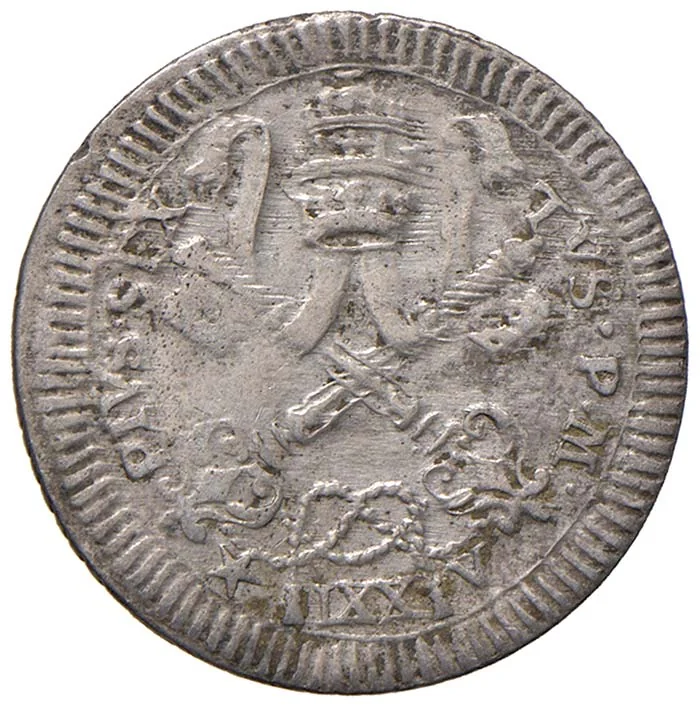
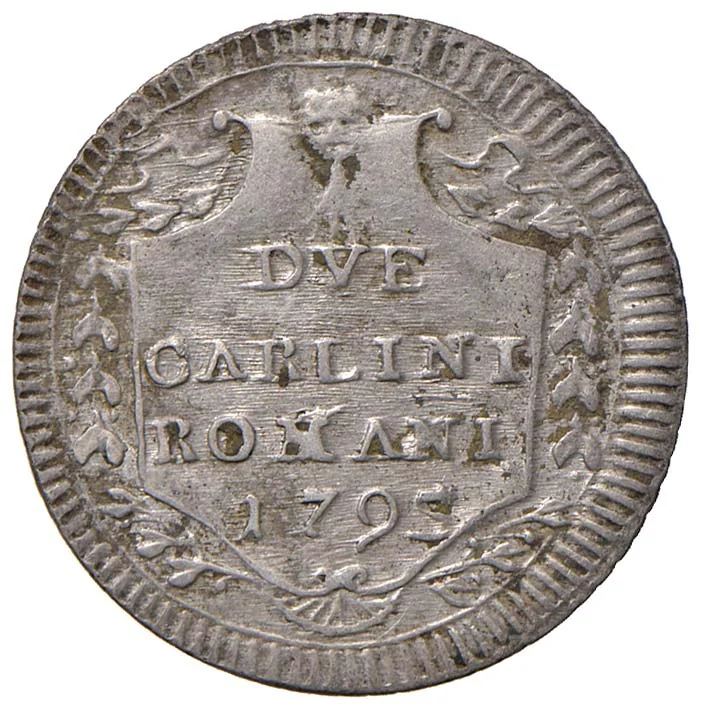
2 Carlins – Papal States
Vatican City
Context
Years: 1794–1795
Country: Vatican City 
Issuer: Papal States
Ruler: Pius VI
Currency:
(1534—1835)
Demonetized: Yes
Material
References
KM: #Click to copy to clipboard1215
Numista: #95402
Value
Bullion value: $8.14
Obverse
Reverse
Description:
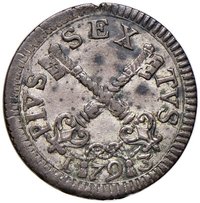
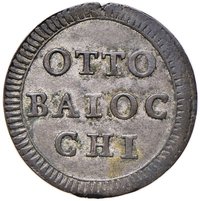
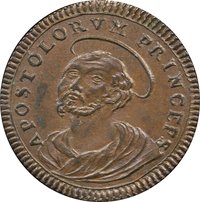
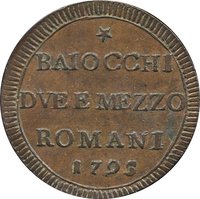
Inscription, date in laurel cartouche, shell below.
Inscription:
DVE
CARLINI
ROMANI
1795
CARLINI
ROMANI
1795
Script: Latin
Edge
Embossed leaves
Mints
| Name | Mark |
|---|---|
| Rome | — |
Mintings
| Year | Mint Mark | Mintage | Quality | Collection |
|---|---|---|---|---|
| 1794 | — | — | ||
| 1795 | — | — |
Historical background
In 1794, the Papal States found itself in a precarious monetary situation, caught between the pressures of revolutionary Europe and its own archaic financial systems. The state's currency, the scudo, was theoretically a silver-based coin, but its value and integrity were increasingly unstable. Decades of fiscal strain, exacerbated by the costs of maintaining temporal power and a complex, inefficient tax system, had led to repeated debasements. The papal treasury often resorted to issuing low-quality billon coins (copper mixed with silver) and excessive copper baiocchi to meet expenses, which eroded public trust and fueled inflation in local markets.
This internal fragility was severely compounded by external geopolitical shocks. The French Revolution and the subsequent wars spilled into Italy, disrupting trade and creating a climate of economic uncertainty. Most critically, the French occupation of the Comtat Venaissin and Avignon in 1791 had severed a traditionally reliable source of papal revenue. Furthermore, revolutionary France began exporting its own inflationary policies, flooding Italian markets with assignats (paper currency backed by confiscated church lands) that further destabilized regional monetary systems and undermined the value of the scudo.
Consequently, the monetary landscape within the Papal States in 1794 was one of confusion and devaluation. A dual crisis existed: a chronic shortage of "good" full-bodied silver scudi, which were hoarded or exported, and a glut of depreciated small change in circulation. This led to significant price fluctuations, hardship for the poor, and difficulties in commerce. While not yet in a state of total collapse, the currency system was weakening under the combined weight of structural deficits and the revolutionary tempest beyond its borders, foreshadowing the greater financial and political crises that would culminate in the French occupation of Rome just a few years later.
This internal fragility was severely compounded by external geopolitical shocks. The French Revolution and the subsequent wars spilled into Italy, disrupting trade and creating a climate of economic uncertainty. Most critically, the French occupation of the Comtat Venaissin and Avignon in 1791 had severed a traditionally reliable source of papal revenue. Furthermore, revolutionary France began exporting its own inflationary policies, flooding Italian markets with assignats (paper currency backed by confiscated church lands) that further destabilized regional monetary systems and undermined the value of the scudo.
Consequently, the monetary landscape within the Papal States in 1794 was one of confusion and devaluation. A dual crisis existed: a chronic shortage of "good" full-bodied silver scudi, which were hoarded or exported, and a glut of depreciated small change in circulation. This led to significant price fluctuations, hardship for the poor, and difficulties in commerce. While not yet in a state of total collapse, the currency system was weakening under the combined weight of structural deficits and the revolutionary tempest beyond its borders, foreshadowing the greater financial and political crises that would culminate in the French occupation of Rome just a few years later.
💎 Extremely Rare