

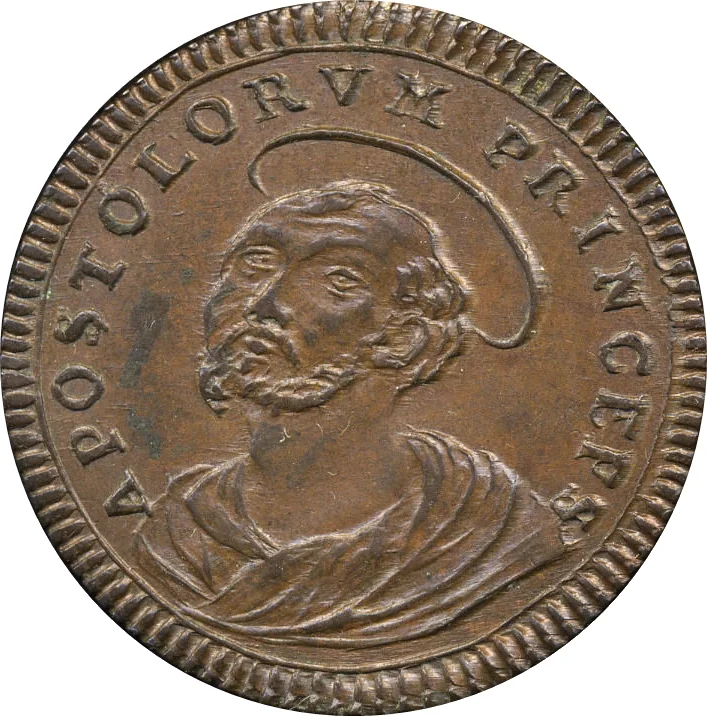
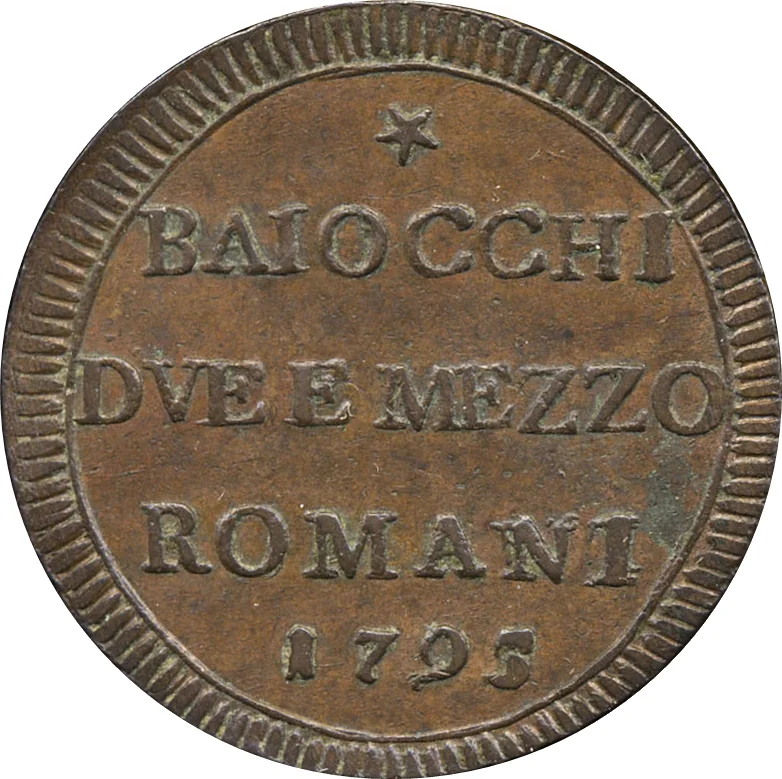
2½ Baiocchi – Papal States
Vatican City
Context
Year: 1795
Country: Vatican City 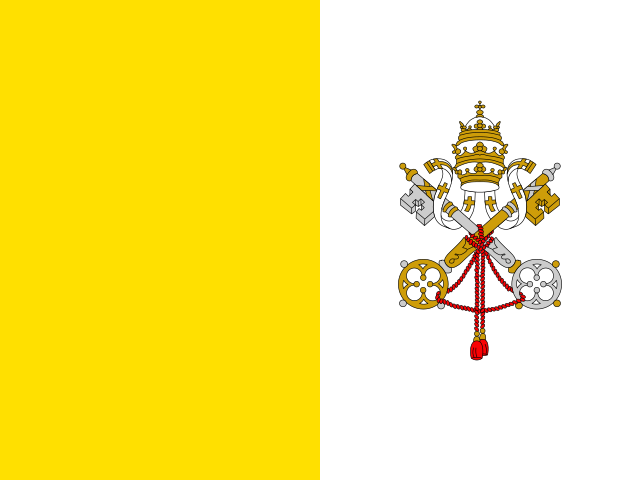
Issuer: Papal States
Ruler: Pius VI
Currency:
(1534—1835)
Demonetized: Yes
Material
References
KM: #Click to copy to clipboard1237
Numista: #46534
Obverse
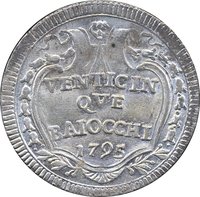
Reverse
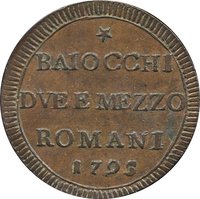
Description:
Star above value, date in circle.
Inscription:
*
BAIOCCHI
DVE E MEZZO
ROMANI
1795
BAIOCCHI
DVE E MEZZO
ROMANI
1795
Script: Latin
Edge
Plain
Categories
| Person> Religious figure |
| Mustache/Beard |
Mints
| Name | Mark |
|---|---|
| Rome | — |
Mintings
| Year | Mint Mark | Mintage | Quality | Collection |
|---|---|---|---|---|
| 1795 | — | — |
Historical background
In 1795, the Papal States found itself in a precarious monetary situation, caught between the pressures of revolutionary Europe and its own archaic financial structures. The state's currency, the scudo romano, was part of a complex bimetallic system of gold and silver coins, but its stability was undermined by chronic budget deficits. These deficits were fueled by the costs of administering the territories, the lavish patronage of the arts and architecture, and a taxation system that heavily favored the clergy and nobility while placing the burden on the peasantry and urban poor. To meet expenses, the papal government frequently resorted to debasing coinage and taking on loans, eroding public trust in the currency.
Externally, the financial landscape was dominated by the fallout from the French Revolution. The 1791 confiscation of Church properties in France had severed a vital source of revenue for the Papacy, while the subsequent European war disrupted trade and increased military preparedness costs. Most alarmingly, the 1794 Treaty of Tolentino with France had forced Pope Pius VI to pay a massive indemnity of 21 million scudi and surrender hundreds of precious manuscripts and artworks. This crippling financial blow drained the papal treasury of specie (gold and silver), forcing greater reliance on paper bills of credit, which circulated at a significant discount to metal coins.
Consequently, by 1795, the Papal States suffered from a severe liquidity crisis, with a scarcity of sound coinage in daily circulation. Inflation was rising as the value of the currency fell, causing hardship for the common people. The situation highlighted the profound vulnerability of the theocratic state's pre-modern economy. This financial weakness would prove fatal just two years later, when French troops under General Berthier marched into Rome in 1797, leading to the proclamation of a Roman Republic and the exile of the Pope, an event made possible in part by the bankrupt state of the papal treasury.
Externally, the financial landscape was dominated by the fallout from the French Revolution. The 1791 confiscation of Church properties in France had severed a vital source of revenue for the Papacy, while the subsequent European war disrupted trade and increased military preparedness costs. Most alarmingly, the 1794 Treaty of Tolentino with France had forced Pope Pius VI to pay a massive indemnity of 21 million scudi and surrender hundreds of precious manuscripts and artworks. This crippling financial blow drained the papal treasury of specie (gold and silver), forcing greater reliance on paper bills of credit, which circulated at a significant discount to metal coins.
Consequently, by 1795, the Papal States suffered from a severe liquidity crisis, with a scarcity of sound coinage in daily circulation. Inflation was rising as the value of the currency fell, causing hardship for the common people. The situation highlighted the profound vulnerability of the theocratic state's pre-modern economy. This financial weakness would prove fatal just two years later, when French troops under General Berthier marched into Rome in 1797, leading to the proclamation of a Roman Republic and the exile of the Pope, an event made possible in part by the bankrupt state of the papal treasury.
✨ Legendary