

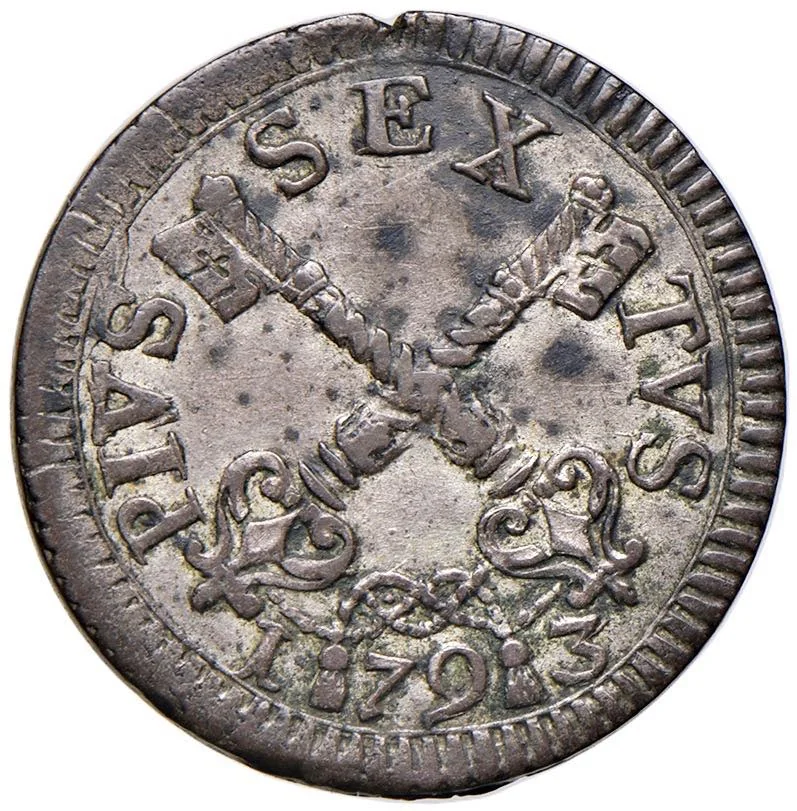
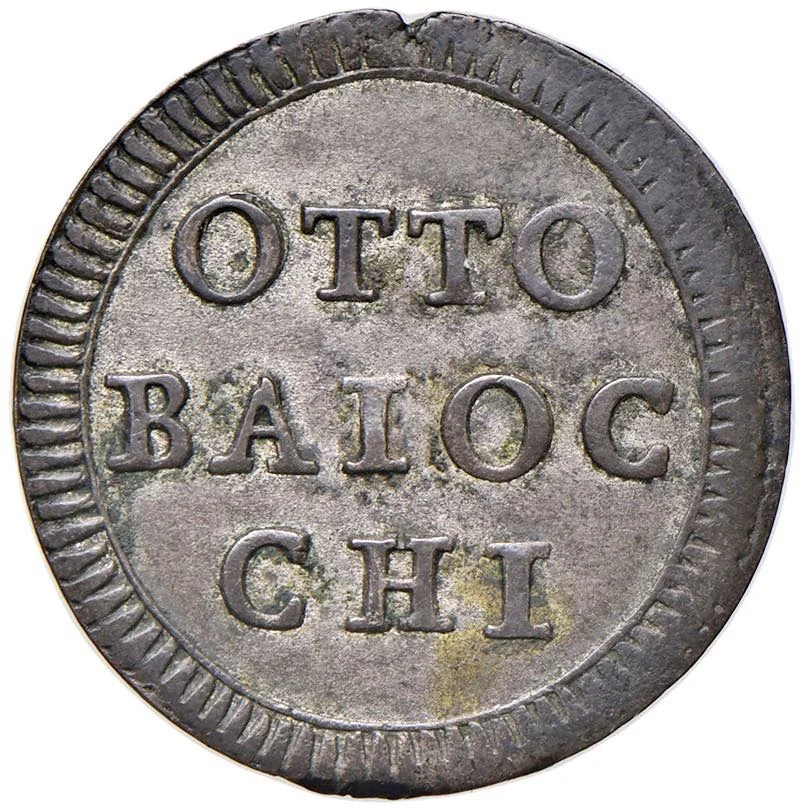
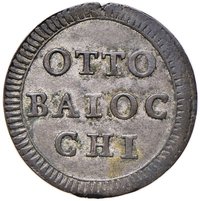
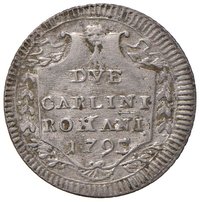
8 Baiocchi – Papal States
Vatican City
Context
Year: 1793
Country: Vatican City 
Issuer: Papal States
Ruler: Pius VI
Currency:
(1534—1835)
Demonetized: Yes
Material
References
KM: #Click to copy to clipboard1235
Numista: #324289
Value
Bullion value: $13.33
Obverse
Reverse
Edge
Mints
| Name | Mark |
|---|---|
| Rome | — |
Mintings
| Year | Mint Mark | Mintage | Quality | Collection |
|---|---|---|---|---|
| 1793 | — | — |
Historical background
In 1793, the Papal States found itself navigating a precarious and inflationary currency crisis, largely triggered by external political and military pressures. The French Revolutionary Wars had erupted the previous year, creating economic shockwaves across Europe. While not yet directly invaded, the Papal States faced severe financial strain from funding military preparedness, supporting émigrés, and dealing with disrupted trade. To meet these soaring expenses, the papal government, under Pope Pius VI, resorted to the debasement of its coinage—reducing the precious metal content in coins like the scudo while maintaining their face value, effectively a form of deficit financing.
This monetary manipulation led to a disastrous split between the official currency and real value. A parallel system emerged where "old" coins with higher silver content circulated at a premium over newly minted "light" coins, causing confusion, loss of public trust, and rampant price inflation. The situation was exacerbated by a flood of low-quality foreign coins and counterfeits entering the state, further undermining the currency's stability. Everyday commerce became fraught with difficulty as merchants and citizens alike struggled to assess the true worth of the money in their hands.
The crisis was symptomatic of a deeper vulnerability: the Papal States' antiquated feudal economy and fiscal system were ill-equipped to handle the demands of modern warfare and political upheaval. The currency debasement of 1793, while a short-term expedient, eroded economic confidence and weakened the state's resilience. This financial fragility would soon be tested catastrophically, as French forces would invade the Papal States in 1796 and impose a massive indemnity, leading to the further looting of precious metals and the complete collapse of the papal monetary system.
This monetary manipulation led to a disastrous split between the official currency and real value. A parallel system emerged where "old" coins with higher silver content circulated at a premium over newly minted "light" coins, causing confusion, loss of public trust, and rampant price inflation. The situation was exacerbated by a flood of low-quality foreign coins and counterfeits entering the state, further undermining the currency's stability. Everyday commerce became fraught with difficulty as merchants and citizens alike struggled to assess the true worth of the money in their hands.
The crisis was symptomatic of a deeper vulnerability: the Papal States' antiquated feudal economy and fiscal system were ill-equipped to handle the demands of modern warfare and political upheaval. The currency debasement of 1793, while a short-term expedient, eroded economic confidence and weakened the state's resilience. This financial fragility would soon be tested catastrophically, as French forces would invade the Papal States in 1796 and impose a massive indemnity, leading to the further looting of precious metals and the complete collapse of the papal monetary system.
✨ Legendary