Logo Title
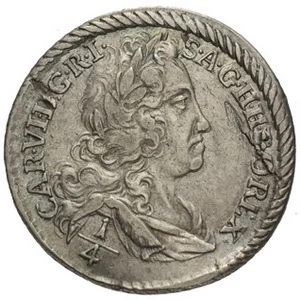
obverse
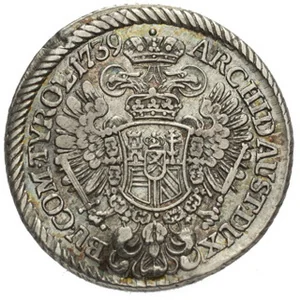
reverse
AUREA Numismatika

¼ Thaler – Kingdom of Bohemia

Context
Years: 1739–1740
Country: Bohemia
Ruler: Charles VI
Currency:
(1520—1754)
Demonetized: Yes
Material
Shape: Round
Composition: Silver
Magnetic: No
References
KM: #Click to copy to clipboard728
Numista: #95319

Obverse

Inscription:
CAR VII D G R I // S A G H H BO REX

1/4
Script: Latin

Reverse

Inscription:
ARCHID AVST DVX BVR COM TYROL 1739
Script: Latin

Edge

Mints

NameMark
Prague

Mintings

YearMint MarkMintageQualityCollection
1739
1740

Historical background

In 1739, the Kingdom of Bohemia, a core crown land of the Habsburg Monarchy, operated within a complex and often unstable currency system dictated by Vienna. The primary circulating coin was the Konventionstaler, a silver standard established by a 1753 convention but rooted in earlier reforms. However, the everyday reality for most Bohemians involved a proliferation of smaller, debased subsidiary coins, particularly kreuzers and groschen. The system was bi-metallic in theory but prone to fluctuation, as the fixed exchange rate between silver and gold often failed to reflect market values, leading to the hoarding of full-weight specie and the frustrating prevalence of inferior coinage in daily trade.

This monetary environment was directly shaped by the financial demands of the Habsburg state, especially the costs of the recent War of the Polish Succession (1733-1738) and ongoing military preparations against the Ottoman Empire. To raise revenue, the state frequently engaged in debasement—reducing the precious metal content in minted coins while maintaining their face value. This practice, alongside the influx of lower-quality coinage from neighboring German states, caused price inflation and eroded public trust. Merchants in Prague and major towns had to constantly refer to volatile exchange lists (Wechselkurse) to navigate the varying values of dozens of different coin types in circulation.

Consequently, the Bohemian economy of 1739 suffered from a lack of uniform, reliable currency. This instability hampered commerce and created a distinction between large-scale trade, which could be conducted using bank transfers or silver ingots, and the small-scale market economy, which was mired in cumbersome small-change transactions. The situation would persist until the more comprehensive reforms enacted by Empress Maria Theresa later in the 1740s, most notably the introduction of the stable Conventionstaler and the standardized Maria Theresa Thaler, which aimed to bring order to the Habsburg monetary system.
Legendary