

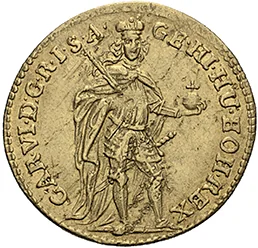
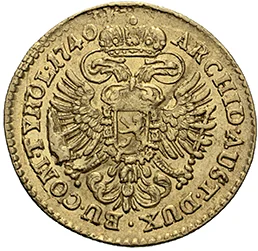
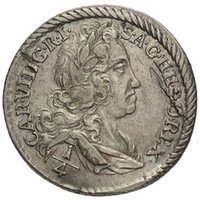
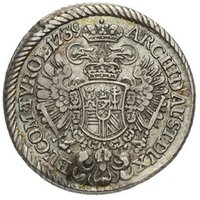
1 Ducat – Kingdom of Bohemia
Context
Years: 1735–1740
Country: Bohemia
Issuer: Kingdom of Bohemia
Ruler: Charles VI
Currency:
(1520—1754)
Demonetized: Yes
Total mintage: 3,287
References
KM: #Click to copy to clipboard725
Numista: #93057
Mints
| Name | Mark |
|---|---|
| Prague | — |
Mintings
| Year | Mint Mark | Mintage | Quality | Collection |
|---|---|---|---|---|
| 1735 | — | 3,287 | ||
| 1740 | — | — |
Historical background
In 1735, the Kingdom of Bohemia, a core crown land of the Habsburg Monarchy, operated within a complex and often unstable currency system. The primary unit of account was the Guiden (Gulden), divided into 60 Kreuzer. However, the actual circulating medium was a bewildering array of physical coins, including silver Reichsthalers, Gulden, and Kreuzer, alongside a flood of small, chronically debased copper coins known as "Münz" or "Heller." This duality between large silver and small copper coinage created a persistent monetary dichotomy that plagued everyday commerce.
The root of this instability lay in the state's chronic fiscal demands, particularly to finance the Habsburg military campaigns, such as the recent War of the Polish Succession (1733-1735). The Vienna-based Hofkammer (Treasury) and the Bohemian Münzamt (Mint) frequently resorted to debasement—reducing the precious metal content in coins—to generate seigniorage profit. This was especially true for the small-denomination coins used by the common populace, leading to inflation, loss of public trust, and frequent recoinage decrees that attempted to reset the nominal value of circulating metal.
Consequently, the monetary landscape was one of official proclamations struggling against market reality. Exchange rates between silver and copper coins fluctuated, and older, heavier coins were often hoarded or melted down, leaving poorer-quality money in circulation. While the Prague Mint was active, its output was directed by Vienna's fiscal needs. Thus, in 1735, Bohemia's currency situation was characterized by a fragile system burdened by war debt, a disconnect between accounting and physical money, and a persistent erosion of the smaller coinage that most directly affected the economic life of the kingdom's subjects.
The root of this instability lay in the state's chronic fiscal demands, particularly to finance the Habsburg military campaigns, such as the recent War of the Polish Succession (1733-1735). The Vienna-based Hofkammer (Treasury) and the Bohemian Münzamt (Mint) frequently resorted to debasement—reducing the precious metal content in coins—to generate seigniorage profit. This was especially true for the small-denomination coins used by the common populace, leading to inflation, loss of public trust, and frequent recoinage decrees that attempted to reset the nominal value of circulating metal.
Consequently, the monetary landscape was one of official proclamations struggling against market reality. Exchange rates between silver and copper coins fluctuated, and older, heavier coins were often hoarded or melted down, leaving poorer-quality money in circulation. While the Prague Mint was active, its output was directed by Vienna's fiscal needs. Thus, in 1735, Bohemia's currency situation was characterized by a fragile system burdened by war debt, a disconnect between accounting and physical money, and a persistent erosion of the smaller coinage that most directly affected the economic life of the kingdom's subjects.
✨ Legendary