

1 Ducat – Austrian Empire
Austria
Context
Years: 1686–1702
Country: Austria 
Issuer: Austrian Empire
Ruler: Leopold I
Currency:
(1520—1754)
Demonetized: Yes
Material
References
KM: #Click to copy to clipboard1325
Numista: #94298
Value
Bullion value: $574.52
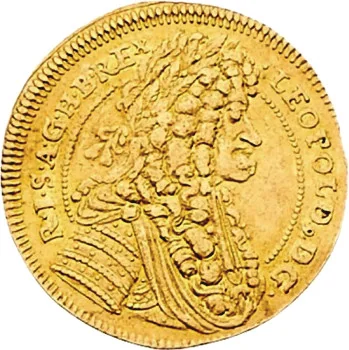
Obverse
Description:
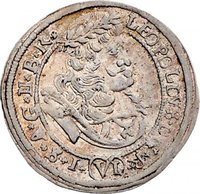
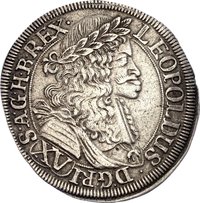
Laureate armored bust right, breaking beaded circle at bottom.
Inscription:
LEOPOLD D G // R I S A G H B REX
Script: Latin
Engraver: Matthias Mittermayer
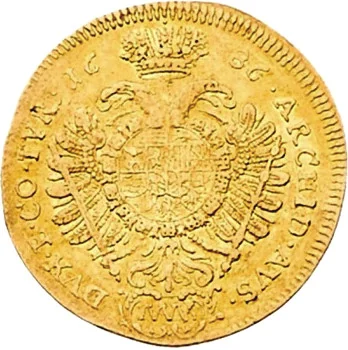
Reverse
Description:
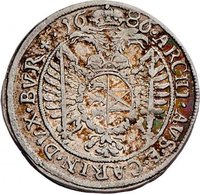
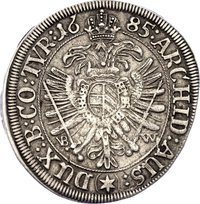
Imperial double-headed eagle, crown dividing date, mint mark in legend below.
Inscription:
ARCHID AVS (MM) DVX B CO TYR 1686
Script: Latin
Edge
Mints
| Name | Mark |
|---|---|
| Münze Österreich | — |
Mintings
| Year | Mint Mark | Mintage | Quality | Collection |
|---|---|---|---|---|
| 1686 | MM | — | ||
| 1687 | MM | — | ||
| 1689 | MM | — | ||
| 1694 | MM | — | ||
| 1695 | MM | — | ||
| 1696 | — | — | ||
| 1697 | — | — | ||
| 1700 | — | — | ||
| 1702 | — | — |
Historical background
In 1686, the currency system of the Habsburg-ruled Austrian Empire was a complex and fragmented patchwork, reflecting the empire's diverse and decentralized political structure. The primary large-denomination coin was the silver Reichsthaler, but its value and silver content were subject to constant fluctuation. Alongside it, a bewildering variety of regional and municipal coins circulated, including Kreuzers, Groschen, and Gulden, each with differing metallic values and limited acceptance outside their areas of issuance. This monetary chaos was exacerbated by the ongoing Great Turkish War (1683-1699), which placed immense fiscal strain on the imperial treasury in Vienna, leading to repeated debasements of coinage to fund the military campaigns, such as the ongoing siege of Buda.
The core of the problem lay in the lack of a unified, centrally controlled monetary policy. While the Reichstag (Imperial Diet) issued ordinances, individual territories within the Empire, such as the Archduchy of Austria, the Kingdom of Bohemia, and the Kingdom of Hungary, often minted their own versions of coins. Furthermore, vast quantities of physically worn and intentionally clipped coins from neighboring German states and beyond circulated freely, further undermining trust in the currency. This resulted in chronic instability, where exchange rates between coins were negotiable and unpredictable, hampering commerce and tax collection.
Consequently, the year 1686 fell within a period of significant monetary distress. The state's response to wartime finance—reducing the silver content in coins while demanding taxes be paid in full-weight specie—effectively drained sound money from circulation, a process known as Gresham's Law. This created a vicious cycle of inflation, public distrust, and economic inefficiency. While a major monetary reform was still decades away (the Konventionsmünzfuß of 1753), the pressures of the late 17th-century wars highlighted the urgent need for a standardized imperial currency, a goal that remained elusive due to the entrenched privileges of the Empire's constituent estates.
The core of the problem lay in the lack of a unified, centrally controlled monetary policy. While the Reichstag (Imperial Diet) issued ordinances, individual territories within the Empire, such as the Archduchy of Austria, the Kingdom of Bohemia, and the Kingdom of Hungary, often minted their own versions of coins. Furthermore, vast quantities of physically worn and intentionally clipped coins from neighboring German states and beyond circulated freely, further undermining trust in the currency. This resulted in chronic instability, where exchange rates between coins were negotiable and unpredictable, hampering commerce and tax collection.
Consequently, the year 1686 fell within a period of significant monetary distress. The state's response to wartime finance—reducing the silver content in coins while demanding taxes be paid in full-weight specie—effectively drained sound money from circulation, a process known as Gresham's Law. This created a vicious cycle of inflation, public distrust, and economic inefficiency. While a major monetary reform was still decades away (the Konventionsmünzfuß of 1753), the pressures of the late 17th-century wars highlighted the urgent need for a standardized imperial currency, a goal that remained elusive due to the entrenched privileges of the Empire's constituent estates.

✨ Legendary