

2 Thalers – Austrian Empire
Austria
Context
Years: 1640–1641
Country: Austria 
Issuer: Austrian Empire
Ruler: Ferdinand III
Currency:
(1520—1754)
Demonetized: Yes
Material
References
KM: #Click to copy to clipboard876.2
Numista: #94198
Value
Bullion value: $175.32
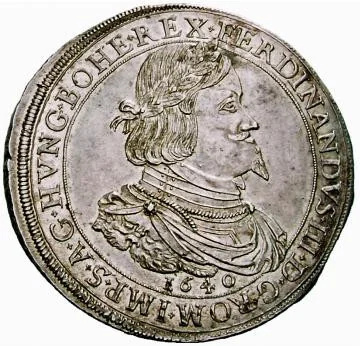
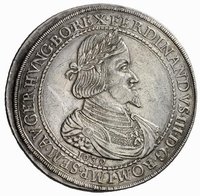
Obverse
Description:
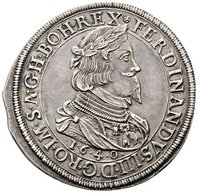
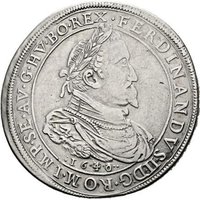
Laureate bust right in beaded circle, date below.
Inscription:
FERDINANDVS III D G ROM IMP S A G HVNG BOHE REX
Script: Latin
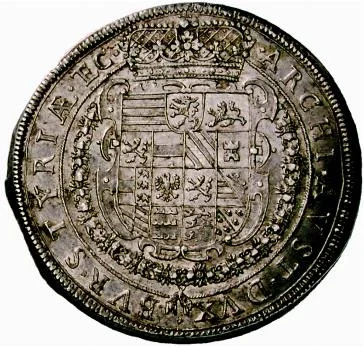
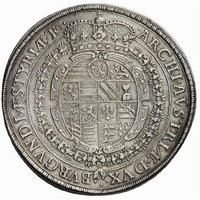
Reverse
Description:
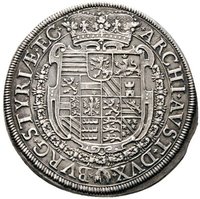
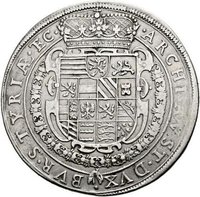
Crowned shield with Styrian panther, encircled by Golden Fleece chain. The crown breaks the surrounding circle and legend.
Inscription:
ARCHI AVST DVX BVR STYRIÆ ETc
Script: Latin
Edge
Mints
| Name | Mark |
|---|---|
| Graz | — |
Mintings
| Year | Mint Mark | Mintage | Quality | Collection |
|---|---|---|---|---|
| 1640 | — | — | ||
| 1641 | — | — |
Historical background
In 1640, the Habsburg monarchy of the Austrian Empire was grappling with a severe and protracted currency crisis, a direct consequence of the immense financial strain of the Thirty Years' War (1618-1648). The conflict demanded colossal expenditures for armies and subsidies to allies, far exceeding ordinary state revenue. To bridge this gap, the imperial government, under Ferdinand III, resorted to rampant debasement of the coinage. The state minted vast quantities of so-called Kipper- und Wipper coins—silver coins with drastically reduced precious metal content—while officially mandating they be accepted at their old, higher face value. This practice, which had plagued the Holy Roman Empire since the 1620s, created a vicious cycle of inflation and economic distrust.
The monetary landscape was chaotic, characterized by a bewildering variety of circulating currencies. Alongside the debased imperial coins, older, full-value Reichsthalers from before the debasement period were hoarded, disappearing from daily use. Furthermore, foreign coins, particularly the stable Dutch leeuwendaalder and Spanish real, circulated widely, often preferred in trade. This led to a Gresham's Law dynamic, where "bad money drove out good," crippling domestic commerce. Prices for goods and foodstuffs skyrocketed, causing widespread hardship for ordinary subjects and soldiers paid in worthless coin, while enriching speculators and mint masters contracted by the crown.
The crisis eroded the very foundations of state finance and authority. Attempts at reform, like the Imperial Minting Ordinance (Reichsmünzordnung) of 1559, were utterly obsolete and ignored. While the worst phase of the Kipper- und Wipperzeit had peaked in the early 1620s, the monetary system in 1640 remained deeply damaged and unstable. The situation would only begin to find resolution later in the decade with the Peace of Westphalia (1648), which reduced military spending, and the subsequent monetary reforms initiated by the Vienna Münzvertrag (Convention of 1657), which aimed to restore a standardized silver-based currency.
The monetary landscape was chaotic, characterized by a bewildering variety of circulating currencies. Alongside the debased imperial coins, older, full-value Reichsthalers from before the debasement period were hoarded, disappearing from daily use. Furthermore, foreign coins, particularly the stable Dutch leeuwendaalder and Spanish real, circulated widely, often preferred in trade. This led to a Gresham's Law dynamic, where "bad money drove out good," crippling domestic commerce. Prices for goods and foodstuffs skyrocketed, causing widespread hardship for ordinary subjects and soldiers paid in worthless coin, while enriching speculators and mint masters contracted by the crown.
The crisis eroded the very foundations of state finance and authority. Attempts at reform, like the Imperial Minting Ordinance (Reichsmünzordnung) of 1559, were utterly obsolete and ignored. While the worst phase of the Kipper- und Wipperzeit had peaked in the early 1620s, the monetary system in 1640 remained deeply damaged and unstable. The situation would only begin to find resolution later in the decade with the Peace of Westphalia (1648), which reduced military spending, and the subsequent monetary reforms initiated by the Vienna Münzvertrag (Convention of 1657), which aimed to restore a standardized silver-based currency.
✨ Legendary