

1 Rupee – Mughal Empire
India
Context
Years: 1687–1706
Country: India 
Issuer: Mughal Empire
Ruler: Aurangzeb
Currency:
(1540—1842)
Demonetized: Yes
Material
References
KM: #Click to copy to clipboard300.78
Numista: #93096
Value
Bullion value: $32.63
Obverse
Description:
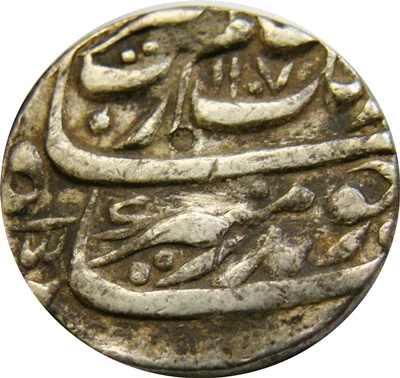
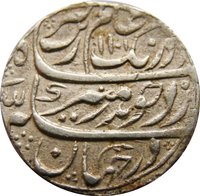
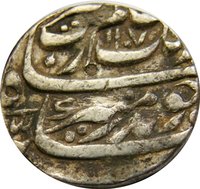
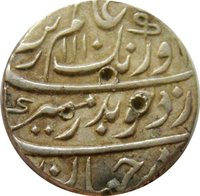
Badr Munir couplet, dated AH.
Reverse
Description:
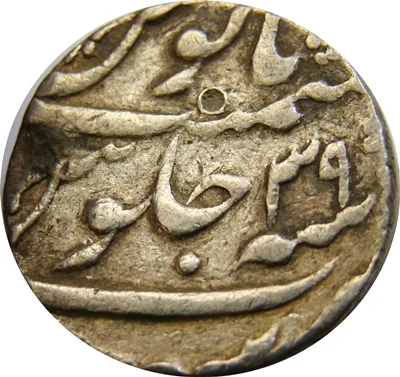
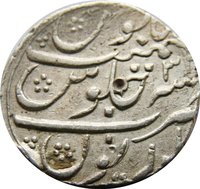
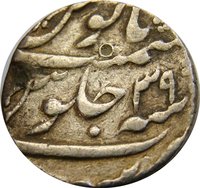
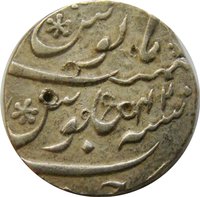
Inscription, regnal year, mint at base.
Edge
Mintings
| Year | Mint Mark | Mintage | Quality | Collection |
|---|---|---|---|---|
| 1687 | — | — | ||
| 1688 | — | — | ||
| 1689 | — | — | ||
| 1690 | — | — | ||
| 1691 | — | — | ||
| 1692 | — | — | ||
| 1693 | — | — | ||
| 1694 | — | — | ||
| 1695 | — | — | ||
| 1696 | — | — | ||
| 1697 | — | — | ||
| 1698 | — | — | ||
| 1699 | — | — | ||
| 1700 | — | — | ||
| 1701 | — | — | ||
| 1702 | — | — | ||
| 1704 | — | — | ||
| 1705 | — | — | ||
| 1706 | — | — |
Historical background
In 1687, the Mughal Empire's currency system under Emperor Aurangzeb was a sophisticated and highly regulated bimetallic standard, centered on the silver rupee and the gold mohur. The primary coin, the rupee, was renowned for its consistent purity and weight, having been standardized by Akbar a century earlier. This reliability made it the dominant medium for revenue collection, large-scale trade, and state expenditure, effectively serving as the backbone of the imperial economy across the subcontinent.
However, this period also presented significant monetary challenges. Aurangzeb's prolonged and costly military campaigns in the Deccan, particularly the ongoing siege of Golconda (which would fall in 1687), placed immense strain on the imperial treasury. To finance these wars, there was increased minting of coins, but this was coupled with a concerning inflow of silver from European trade, which risked inflationary pressures. Furthermore, while the imperial mints (sikkas) produced uniform coins, a vast array of local and older currencies remained in circulation, creating a complex monetary environment for everyday transactions.
Despite these pressures, the currency system in 1687 remained fundamentally intact, a testament to the empire's administrative strength. The stability of the rupee was crucial for the functioning of the jagirdari system and long-distance trade, from the ports of Surat and Bengal to the inland markets. Nevertheless, the fiscal demands of Aurangzeb's expansionist policies were beginning to stretch the system, planting seeds for the future economic difficulties that would emerge in the 18th century.
However, this period also presented significant monetary challenges. Aurangzeb's prolonged and costly military campaigns in the Deccan, particularly the ongoing siege of Golconda (which would fall in 1687), placed immense strain on the imperial treasury. To finance these wars, there was increased minting of coins, but this was coupled with a concerning inflow of silver from European trade, which risked inflationary pressures. Furthermore, while the imperial mints (sikkas) produced uniform coins, a vast array of local and older currencies remained in circulation, creating a complex monetary environment for everyday transactions.
Despite these pressures, the currency system in 1687 remained fundamentally intact, a testament to the empire's administrative strength. The stability of the rupee was crucial for the functioning of the jagirdari system and long-distance trade, from the ports of Surat and Bengal to the inland markets. Nevertheless, the fiscal demands of Aurangzeb's expansionist policies were beginning to stretch the system, planting seeds for the future economic difficulties that would emerge in the 18th century.
💎 Extremely Rare