

32 Marks – Aachen
Germany

Obverse
Description:
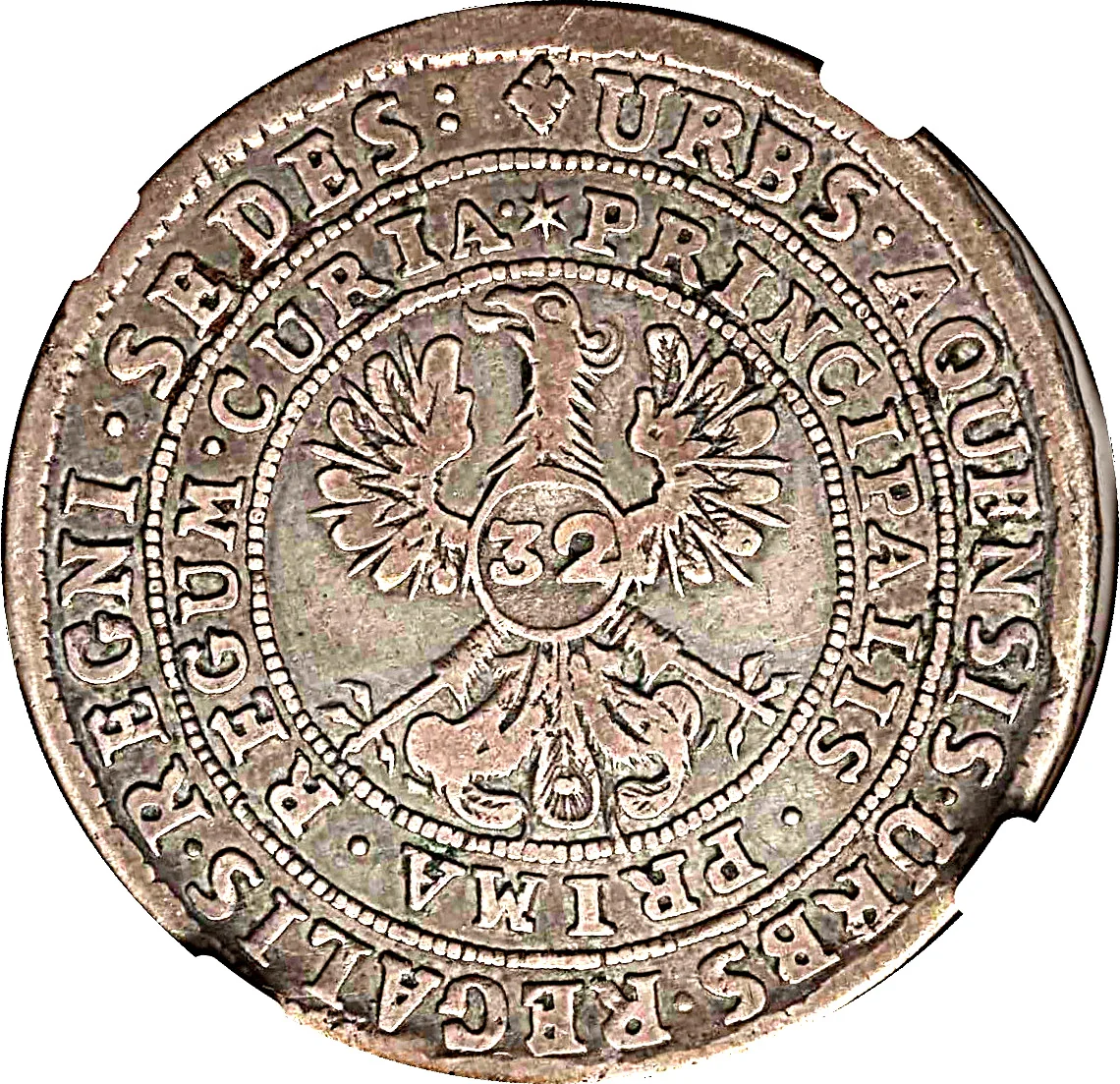
32, double legends, small center circle.
Inscription:
URBS.AQUENSIS.URBS.REGALIS.REGNI.SEDES:
PRINCIPALIS.PRIMA.REGUM.CURIA.
PRINCIPALIS.PRIMA.REGUM.CURIA.
Script: Latin
Reverse
Description:
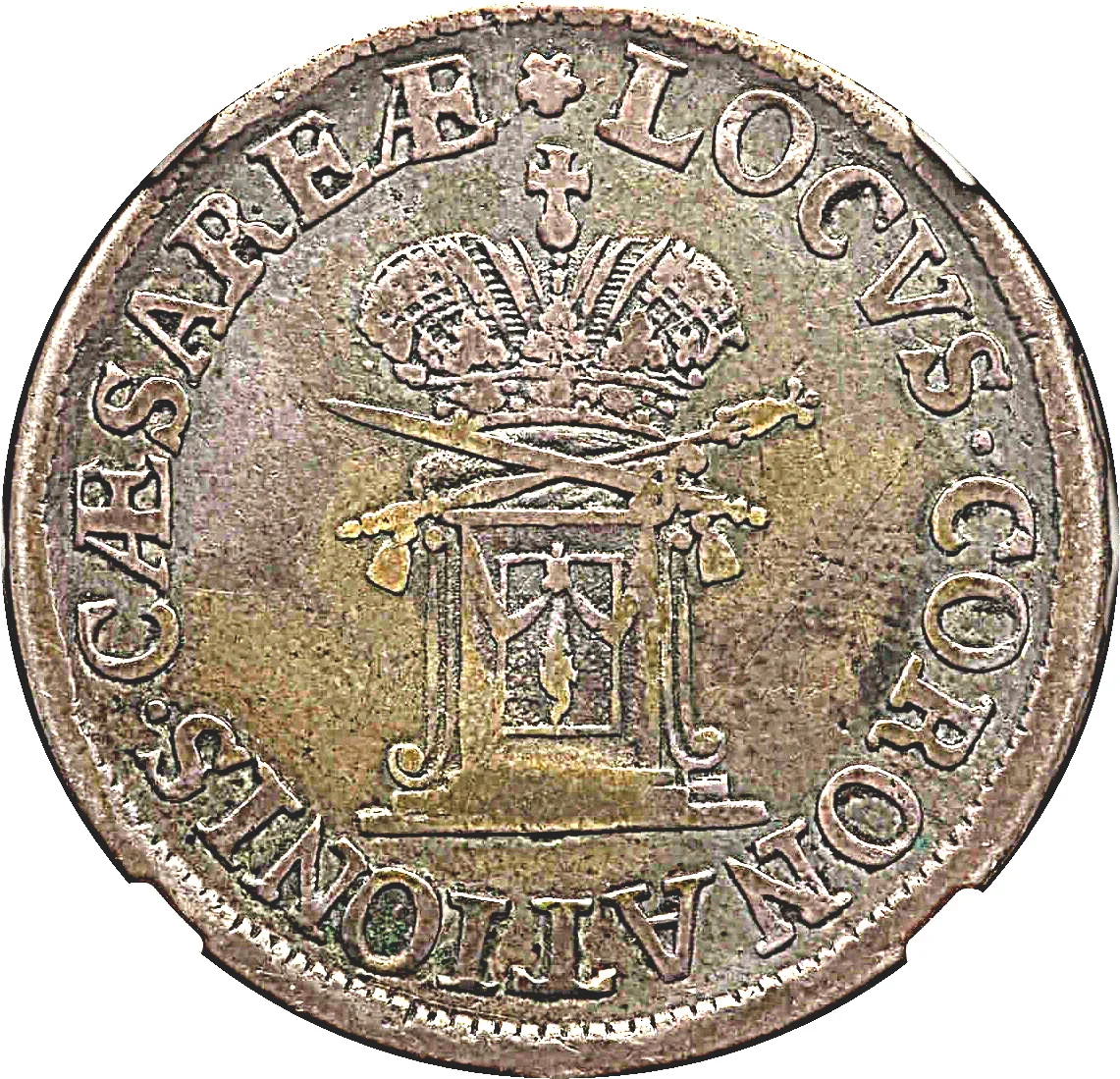
Crossed sword and scepter separate crown from frame.
Inscription:
LOCVS.CORONATIONIS.CÆSAREÆ
Script: Latin
Edge
Inscripted with chronogram
Legend:
A DEO SINT SANCTA CONSILIA MIHI
Mintings
| Year | Mint Mark | Mintage | Quality | Collection |
|---|---|---|---|---|
| 1755 | — | — |
Historical background
In 1755, the Free Imperial City of Aachen, a historically significant center of trade and pilgrimage within the Holy Roman Empire, operated within a complex and often chaotic monetary landscape. Like most German territories, it did not possess the sovereign right to mint its own principal coinage. Instead, its economy relied on a multitude of circulating currencies, primarily the Reichsthaler and its subdivisions (Gulden, Groschen, Pfennige), as established by Imperial monetary ordinances. However, the practical reality was a daily circulation of coins from neighboring states like the Austrian Netherlands, the United Provinces, and various German principalities, each with varying metallic content and value. This created a constant challenge for merchants and city officials, who had to reference constantly updated Wechselkurse (exchange rate bulletins) to conduct business.
The city's authorities attempted to manage this system through regulation and the issuance of local token coinage. While Aachen could not mint full-value Thalers, it did produce lower-denomination Scheidemünzen (small change coins) for local use. These coins, such as Albuses and Dreier, were vital for daily market transactions but their value was tied to the fluctuating value of the "real" silver coins they represented. A key tool of monetary policy was the official Kurantzettel, a published list that fixed the exchange rates between these various foreign and local coins, aiming to bring order and prevent the clipping and debasement that plagued the region.
This fragile system was under persistent strain by 1755. The looming Seven Years' War (1756-1763) was already causing economic apprehension, leading to hoarding of full-weight silver coins and a deterioration in the quality of circulating currency. Furthermore, Aachen's proximity to the dynamic commercial and financial centers of the Low Countries meant it was particularly susceptible to inflows of foreign specie and the speculative practices of money changers. Thus, while the city functioned with a veneer of monetary order through its ordinances and rate sheets, the actual currency situation on the eve of major European conflict was one of underlying instability, complexity, and vulnerability to external economic shocks.
The city's authorities attempted to manage this system through regulation and the issuance of local token coinage. While Aachen could not mint full-value Thalers, it did produce lower-denomination Scheidemünzen (small change coins) for local use. These coins, such as Albuses and Dreier, were vital for daily market transactions but their value was tied to the fluctuating value of the "real" silver coins they represented. A key tool of monetary policy was the official Kurantzettel, a published list that fixed the exchange rates between these various foreign and local coins, aiming to bring order and prevent the clipping and debasement that plagued the region.
This fragile system was under persistent strain by 1755. The looming Seven Years' War (1756-1763) was already causing economic apprehension, leading to hoarding of full-weight silver coins and a deterioration in the quality of circulating currency. Furthermore, Aachen's proximity to the dynamic commercial and financial centers of the Low Countries meant it was particularly susceptible to inflows of foreign specie and the speculative practices of money changers. Thus, while the city functioned with a veneer of monetary order through its ordinances and rate sheets, the actual currency situation on the eve of major European conflict was one of underlying instability, complexity, and vulnerability to external economic shocks.
✨ Legendary