

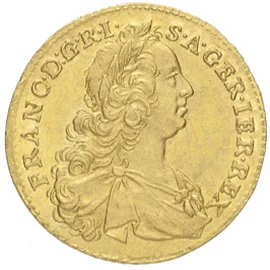
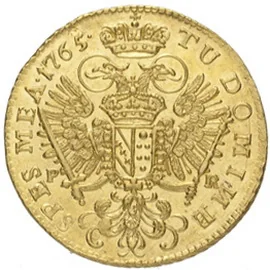
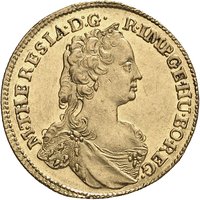
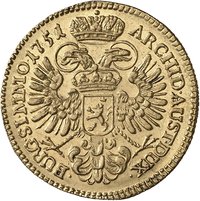
1 Ducat – Kingdom of Bohemia
Context
Years: 1746–1765
Country: Bohemia
Issuer: Kingdom of Bohemia
Ruler: Francis I of Lorraine
Currency:
(1520—1754)
Demonetized: Yes
References
KM: #Click to copy to clipboard751
Numista: #92328
Obverse
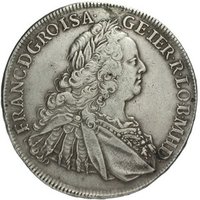
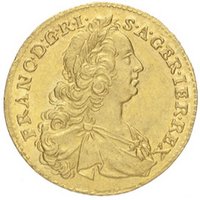
Inscription:
FRANC D G R I S A GER IER REX
Script: Latin
Reverse
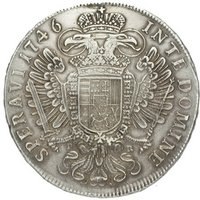
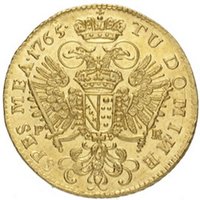
Inscription:
TU DOMINE SPES MEA 1765
Script: Latin
Edge
Mints
| Name | Mark |
|---|---|
| Prague | — |
Mintings
| Year | Mint Mark | Mintage | Quality | Collection |
|---|---|---|---|---|
| 1746 | P-R | — | ||
| 1748 | P-R | — | ||
| 1749 | P-R | — | ||
| 1750 | P-R | — | ||
| 1751 | P-R | — | ||
| 1752 | P-R | — | ||
| 1753 | P-R | — | ||
| 1754 | P-R | — | ||
| 1755 | P-R | — | ||
| 1756 | P-R | — | ||
| 1765 | P-R | — |
Historical background
In 1746, the Kingdom of Bohemia, a core crown land of the Habsburg Monarchy, operated within a complex and strained currency system. The primary circulating coin was the Conventionsthaler, a large silver coin standardized across much of the Holy Roman Empire after 1753, but whose precursor, the Reichsthaler, was already the accounting standard. However, the reality of daily transactions was dominated by a chaotic mix of older, debased coins and small change. Decades of war, particularly the ongoing War of the Austrian Succession (1740-1748), had placed enormous fiscal pressure on Vienna, leading to repeated currency manipulations and debasements to fund the military effort. This resulted in a severe loss of public confidence in the coinage.
The monetary landscape was characterized by a confusing duality: a stable bank money used for large contracts and state accounting (the Wiener Währung or Vienna Standard), and a vastly depreciated current money (Courantmünze) used in everyday trade. The gap between their values was wide and fluctuating. Furthermore, the Bohemian lands saw circulation of older Prague groschen, kreutzers, and a proliferation of low-quality "Scheidemünze" (small change coinage) often minted from inferior metals. Counterfeiting was rampant, exacerbated by the presence of armies and the circulation of coins from neighboring German states.
Consequently, 1746 fell within a period of significant monetary instability and transition. The Habsburg state authority, under Empress Maria Theresa, recognized the crippling economic effects of this chaos but was constrained by wartime finances. The situation created price inflation, hindered commerce, and caused friction between estates, merchants, and the central treasury. This pressing need for reform would culminate just a few years later with the great monetary reforms of the 1750s, which introduced the unified Conventionsthaler standard and began to restore order to the Habsburg currency system, including in Bohemia.
The monetary landscape was characterized by a confusing duality: a stable bank money used for large contracts and state accounting (the Wiener Währung or Vienna Standard), and a vastly depreciated current money (Courantmünze) used in everyday trade. The gap between their values was wide and fluctuating. Furthermore, the Bohemian lands saw circulation of older Prague groschen, kreutzers, and a proliferation of low-quality "Scheidemünze" (small change coinage) often minted from inferior metals. Counterfeiting was rampant, exacerbated by the presence of armies and the circulation of coins from neighboring German states.
Consequently, 1746 fell within a period of significant monetary instability and transition. The Habsburg state authority, under Empress Maria Theresa, recognized the crippling economic effects of this chaos but was constrained by wartime finances. The situation created price inflation, hindered commerce, and caused friction between estates, merchants, and the central treasury. This pressing need for reform would culminate just a few years later with the great monetary reforms of the 1750s, which introduced the unified Conventionsthaler standard and began to restore order to the Habsburg currency system, including in Bohemia.
✨ Legendary