

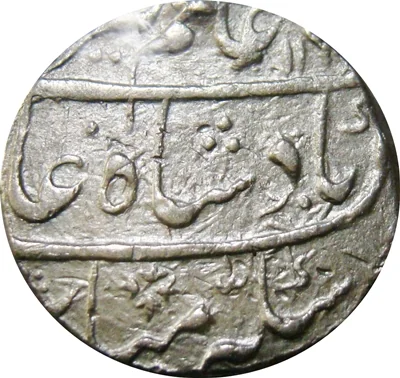
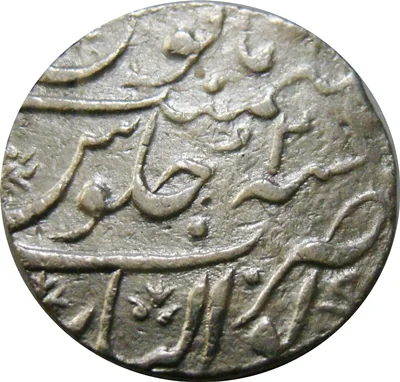

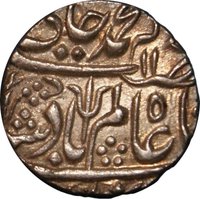
Obverse
Description:
Mint mark inscription
Inscription:
عالمگیر
بادشاہ غازی
سکہ مبارک
بادشاہ غازی
سکہ مبارک
Script: Persian (nastaliq)
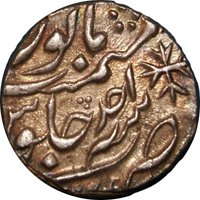
Reverse
Edge
Mintings
| Year | Mint Mark | Mintage | Quality | Collection |
|---|---|---|---|---|
| — | — | — | ||
| 1756 | — | — | ||
| 1757 | — | — |
Historical background
In 1756, the Maratha Empire's currency system reflected its vast, decentralized nature and the lingering influence of the declining Mughal Empire. The primary circulating coin was the silver rupee, which existed in multiple provincial variants—most notably the Poona Rupee minted in the Peshwa's capital and the Chandori Rupee from the Nagpur region. These coins often bore the name of the Mughal emperor Alamgir II (out of nominal tradition) alongside Maratha symbols like the surya (sun) or chhatra (umbrella), a duality showcasing the Marathas' practical transition from Mughal subordinates to de facto rulers. Alongside rupees, copper paisas and dabbas facilitated smaller, local trade.
However, this period was marked by significant monetary instability and fragmentation. The mid-18th century saw intense warfare, including the Third Battle of Panipat (1761), the buildup to which strained Maratha finances. Provincial chiefs (Sardars) and military commanders often exercised the right of sikka (coinage) within their own territories, leading to a lack of uniform weight and purity across the empire. Furthermore, the widespread circulation of foreign coins—like Portuguese xerafins in coastal areas and Mughal rupees from the north—complicated trade, requiring constant exchange and valuation.
The financial demands of constant military campaigns led to debasement and inflationary pressures. Revenue extraction was prioritized over monetary reform, and the state often relied heavily on saranjams (land-grants for military service) and levies from conquered territories rather than a centralized fiscal system. Consequently, while the Maratha rupee remained a key currency, its value and reliability could vary dramatically from one region to another, underscoring the empire's political decentralization and the ad-hoc financial management that characterized this turbulent phase of its expansion.
However, this period was marked by significant monetary instability and fragmentation. The mid-18th century saw intense warfare, including the Third Battle of Panipat (1761), the buildup to which strained Maratha finances. Provincial chiefs (Sardars) and military commanders often exercised the right of sikka (coinage) within their own territories, leading to a lack of uniform weight and purity across the empire. Furthermore, the widespread circulation of foreign coins—like Portuguese xerafins in coastal areas and Mughal rupees from the north—complicated trade, requiring constant exchange and valuation.
The financial demands of constant military campaigns led to debasement and inflationary pressures. Revenue extraction was prioritized over monetary reform, and the state often relied heavily on saranjams (land-grants for military service) and levies from conquered territories rather than a centralized fiscal system. Consequently, while the Maratha rupee remained a key currency, its value and reliability could vary dramatically from one region to another, underscoring the empire's political decentralization and the ad-hoc financial management that characterized this turbulent phase of its expansion.
✨ Legendary