

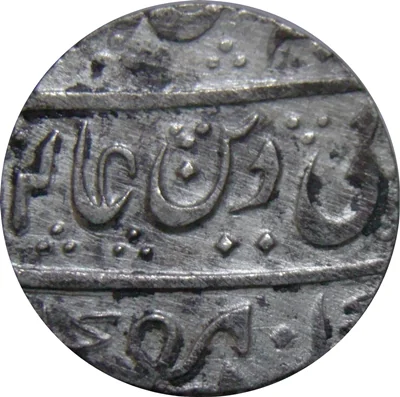
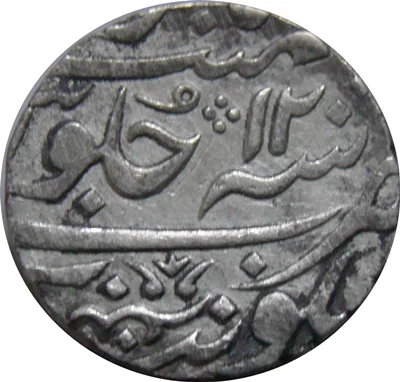

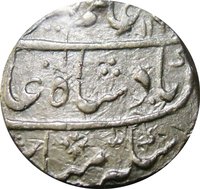
Obverse
Description:
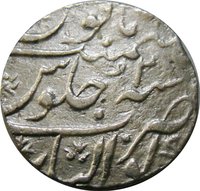
Shah Alam II was a Mughal emperor who reigned during a period of significant imperial decline.
Reverse
Edge
Mintings
| Year | Mint Mark | Mintage | Quality | Collection |
|---|---|---|---|---|
| 1755 | — | — | ||
| 1761 | — | — | ||
| 1762 | — | — | ||
| 1767 | — | — | ||
| 1768 | — | — | ||
| 1769 | — | — | ||
| 1770 | — | — | ||
| 1771 | — | — | ||
| 1772 | — | — |
Historical background
By 1755, the Maratha Empire, under the nominal leadership of the Peshwa in Pune, was at its zenith of territorial expansion and political influence. However, this vast, decentralized dominion lacked a unified monetary system. The empire was a confederacy (the Ashtapradhan system evolving into semi-independent sardar fiefdoms), and currency issuance was largely a regional prerogative. The heartland in the Deccan saw the continued circulation of the iconic Shivrai copper coin, named after Chhatrapati Shivaji, alongside older Mughal-era silver rupees, particularly the Ankushi rupee of the Ahmednagar Sultanate, which remained a trusted standard.
The primary currency for high-value and military transactions was the silver rupee, but its weight and purity varied significantly across regions. Key mints (taksals) in cities like Pune, Satara, Nashik, and Bagalkot produced rupees bearing the names of the current Peshwa (Balaji Baji Rao, or Nanasaheb, in 1755) or local chieftains. Simultaneously, Maratha conquests into North India brought territories like Malwa and Bundelkhand under their sway, where local Mughal-style rupees and even new Maratha-minted imitations circulated. This created a complex monetary landscape where merchants and bankers (sahukars) had to be experts in assay and exchange rates.
This period also saw the growing influence of European colonial currencies. The Gold Pagoda of the English East India Company in Madras and the silver rupees of the French in Pondicherry were increasingly used in maritime trade along the Konkan coast. While not yet a threat to the internal economy, their presence signaled the beginning of a financial shift. Thus, in 1755, the Maratha monetary scene was characterized by pragmatic pluralism—a functioning but heterogeneous system relying on a mix of legacy coins, regional issues, and foreign currencies, all held together by the network of indigenous bankers who facilitated revenue transfer and military logistics across the empire.
The primary currency for high-value and military transactions was the silver rupee, but its weight and purity varied significantly across regions. Key mints (taksals) in cities like Pune, Satara, Nashik, and Bagalkot produced rupees bearing the names of the current Peshwa (Balaji Baji Rao, or Nanasaheb, in 1755) or local chieftains. Simultaneously, Maratha conquests into North India brought territories like Malwa and Bundelkhand under their sway, where local Mughal-style rupees and even new Maratha-minted imitations circulated. This created a complex monetary landscape where merchants and bankers (sahukars) had to be experts in assay and exchange rates.
This period also saw the growing influence of European colonial currencies. The Gold Pagoda of the English East India Company in Madras and the silver rupees of the French in Pondicherry were increasingly used in maritime trade along the Konkan coast. While not yet a threat to the internal economy, their presence signaled the beginning of a financial shift. Thus, in 1755, the Maratha monetary scene was characterized by pragmatic pluralism—a functioning but heterogeneous system relying on a mix of legacy coins, regional issues, and foreign currencies, all held together by the network of indigenous bankers who facilitated revenue transfer and military logistics across the empire.
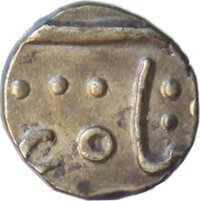
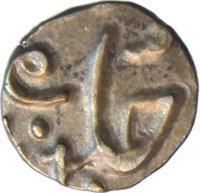
💎 Extremely Rare