

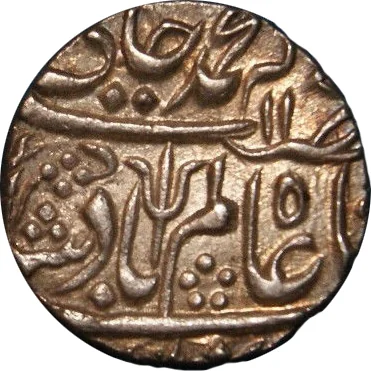

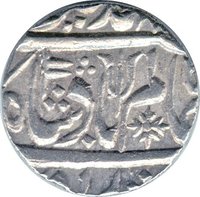
Obverse
Description:
Trishula (Trident)
Inscription:
Shah Alam II
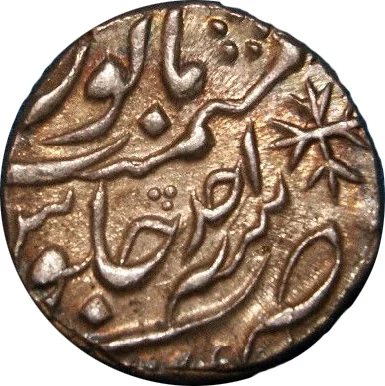
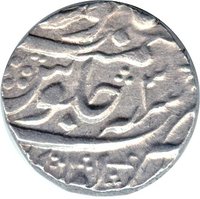
Reverse
Description:
Star Mint, RY Date
Inscription:
Zarb Kora
RY - 1
RY - 1
Edge
Plain
Mintings
| Year | Mint Mark | Mintage | Quality | Collection |
|---|---|---|---|---|
| — | //1 | — | ||
| — | //2 | — |
Historical background
By 1757, the Maratha Empire's currency system reflected its vast, decentralized nature and the intense military pressures of the period. The core of the system was the Chhatrapati's rupee, minted primarily at Pune and Satara, which served as the nominal imperial standard. However, in practice, powerful regional chiefs and military commanders like the Peshwa (in Pune), the Gaekwads (in Baroda), the Holkars (in Indore), and the Scindias (in Gwalior) exercised significant control over their own mints. This led to a proliferation of coin types—Holkari rupees, Shindeshahi rupees, Ankushi rupees—varying slightly in weight and purity, though generally adhering to the broad standard of the mohur (gold) and rupee (silver).
This monetary landscape was under severe strain due to the Third Battle of Panipat, which was looming on the horizon in 1757. The Maratha Empire was engaged in a massive, northward military expansion and was draining its treasury to fund armies and alliances across the subcontinent. The immense cost of continuous warfare placed a heavy burden on the agrarian economy and the system of revenue collection (sardeshmukhi and chauth). Precious metal, required for coinage, was being diverted to fund war efforts, leading to potential debasement in some areas and liquidity issues.
Consequently, while the Maratha rupee remained a respected and widely circulated currency, especially in central India, its uniformity was eroding. The period is characterized by a competition for fiscal resources between the central authority and powerful satraps, played out partly through minting rights. The currency situation in 1757 was, therefore, one of robust but fragmented multiplicity, underpinned by a sound metallic tradition but increasingly stressed by the empire's vast military ambitions and the impending confrontation with the Afghan Durrani Empire that would culminate at Panipat in 1761.
This monetary landscape was under severe strain due to the Third Battle of Panipat, which was looming on the horizon in 1757. The Maratha Empire was engaged in a massive, northward military expansion and was draining its treasury to fund armies and alliances across the subcontinent. The immense cost of continuous warfare placed a heavy burden on the agrarian economy and the system of revenue collection (sardeshmukhi and chauth). Precious metal, required for coinage, was being diverted to fund war efforts, leading to potential debasement in some areas and liquidity issues.
Consequently, while the Maratha rupee remained a respected and widely circulated currency, especially in central India, its uniformity was eroding. The period is characterized by a competition for fiscal resources between the central authority and powerful satraps, played out partly through minting rights. The currency situation in 1757 was, therefore, one of robust but fragmented multiplicity, underpinned by a sound metallic tradition but increasingly stressed by the empire's vast military ambitions and the impending confrontation with the Afghan Durrani Empire that would culminate at Panipat in 1761.
✨ Legendary