

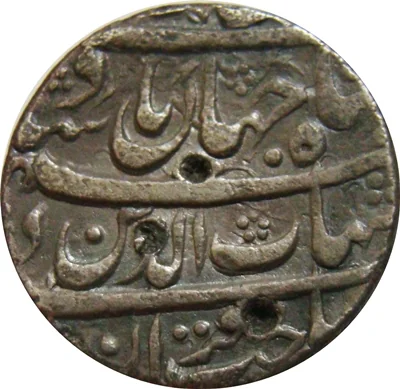
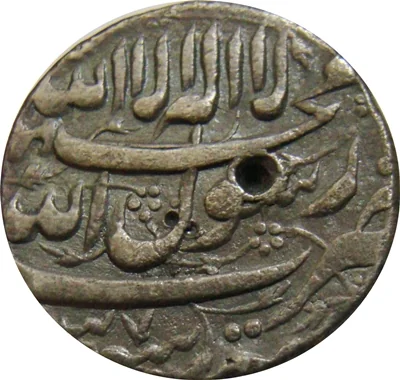
1 Rupee – Mughal Empire
India
Context
Years: 1725–1726
Country: India 
Issuer: Mughal Empire
Ruler: Shah Jahan
Currency:
(1540—1842)
Demonetized: Yes
Material
References
KM: #Click to copy to clipboard222.14
Numista: #90177
Value
Bullion value: $32.31
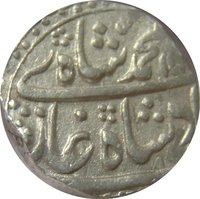
Obverse
Description:
Carved words.
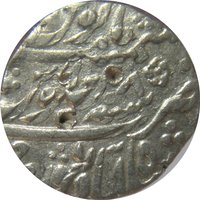
Reverse
Description:
Inscription, date, mint
Edge
Mintings
| Year | Mint Mark | Mintage | Quality | Collection |
|---|---|---|---|---|
| 1725 | — | — | ||
| 1726 | — | — |
Historical background
By 1725, the Mughal Empire's currency system, once a pillar of its centralized power and economic integration, was under severe strain. The empire still officially operated on the trimetallic system established by Emperor Akbar: the gold mohur, the silver rupee (the primary unit of account and trade), and the copper dam. The purity and uniformity of the rupee, particularly from the imperial mints at Delhi and Lahore, had long fostered confidence and facilitated vast commerce. However, following the death of Emperor Aurangzeb in 1707, political fragmentation directly impacted monetary stability. Regional nawabs and rebellious governors, such as those in Bengal, Awadh, and Hyderabad, began increasingly to mint their own coins, often debased or of varying weights, eroding the imperial monopoly.
This period saw a critical shortage of silver, the lifeblood of the currency. The empire's negative balance of trade, draining silver to pay for imports, was exacerbated by the diversion of trade routes and the rising power of European East India Companies. Furthermore, the immense cost of continuous warfare—against the Marathas, Sikhs, and Afghan invaders—led to the desperate melting of treasury reserves to pay armies. The result was a chaotic circulation where older, full-weight rupees were hoarded or melted down (Gresham's Law in action), while newer, lighter, or debased coins from various authorities proliferated in the marketplace, causing confusion and inflation.
Consequently, the monetary landscape in 1725 was one of declining imperial authority and economic uncertainty. While the Mughal rupee remained a recognized standard, its practical reality was a patchwork of issues. This financial decentralization mirrored the political reality, as regional economies began to coalesce around the currencies of emerging successor states. The weakening of a uniform currency hindered inter-regional trade and tax collection, accelerating the empire's fiscal decline and creating a vacuum that European companies, with their own minted currencies, would increasingly exploit in the decades to follow.
This period saw a critical shortage of silver, the lifeblood of the currency. The empire's negative balance of trade, draining silver to pay for imports, was exacerbated by the diversion of trade routes and the rising power of European East India Companies. Furthermore, the immense cost of continuous warfare—against the Marathas, Sikhs, and Afghan invaders—led to the desperate melting of treasury reserves to pay armies. The result was a chaotic circulation where older, full-weight rupees were hoarded or melted down (Gresham's Law in action), while newer, lighter, or debased coins from various authorities proliferated in the marketplace, causing confusion and inflation.
Consequently, the monetary landscape in 1725 was one of declining imperial authority and economic uncertainty. While the Mughal rupee remained a recognized standard, its practical reality was a patchwork of issues. This financial decentralization mirrored the political reality, as regional economies began to coalesce around the currencies of emerging successor states. The weakening of a uniform currency hindered inter-regional trade and tax collection, accelerating the empire's fiscal decline and creating a vacuum that European companies, with their own minted currencies, would increasingly exploit in the decades to follow.
✨ Legendary