

1 Rupee – Mughal Empire
India
Context
Years: 1726–1746
Country: India 
Issuer: Mughal Empire
Ruler: Muhammad Shah
Currency:
(1540—1842)
Demonetized: Yes
Material
References
KM: #Click to copy to clipboard436.5
Numista: #70916
Value
Bullion value: $33.07
Obverse
Description:
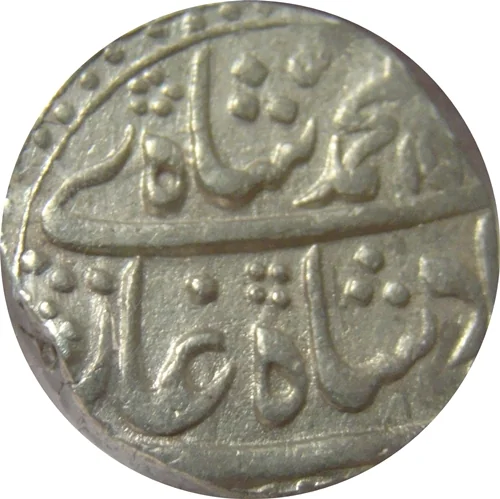
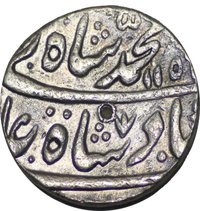
KM# 436. Rupee (Type 436). Inscribed.
Inscription:
sikka mubarak badshah ghazi
Reverse
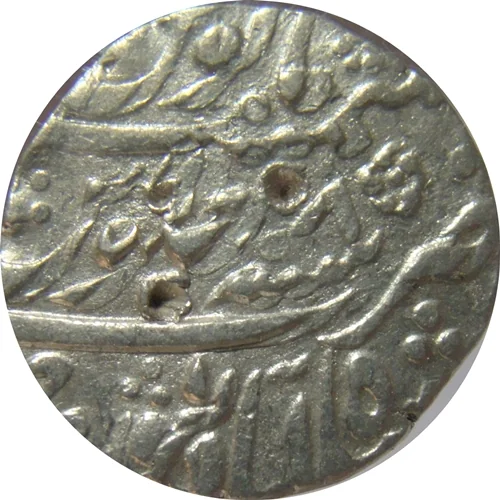
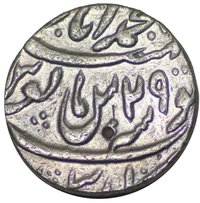
Description:
Carved words.
Inscription:
sana julus zarb
Edge
Mintings
| Year | Mint Mark | Mintage | Quality | Collection |
|---|---|---|---|---|
| 1726 | — | — | ||
| 1727 | — | — | ||
| 1728 | — | — | ||
| 1729 | — | — | ||
| 1730 | — | — | ||
| 1731 | — | — | ||
| 1732 | — | — | ||
| 1733 | — | — | ||
| 1734 | — | — | ||
| 1735 | — | — | ||
| 1736 | — | — | ||
| 1737 | — | — | ||
| 1738 | — | — | ||
| 1739 | — | — | ||
| 1740 | — | — | ||
| 1741 | — | — | ||
| 1741 | — | — | ||
| 1742 | — | — | ||
| 1743 | — | — | ||
| 1744 | — | — | ||
| 1746 | — | — |
Historical background
By 1726, the Mughal Empire's currency system, once a pillar of its administrative and economic strength, was under severe strain. The foundational trimetallic system—gold mohurs, silver rupees, and copper dams—remained nominally in place, with the silver rupee as the primary currency for revenue and trade. However, the imperial minting authority, a key symbol of sovereignty, was rapidly fragmenting. Powerful regional governors and emerging successor states like Bengal and Hyderabad began issuing their own coins in the name of the increasingly powerless Emperor Muhammad Shah, eroding the uniformity and credibility of the imperial currency.
This monetary decentralization mirrored the empire's political collapse following the reign of Aurangzeb (d. 1707). As central control weakened, the flow of bullion to the imperial mints in Delhi became unreliable. Simultaneously, the empire was bleeding silver, the lifeblood of its currency, due to a negative balance of trade—particularly with European trading companies. The influx of New World silver, which had once sustained the system, was now being diverted or hoarded. Furthermore, the chronic fiscal crises led to the debasement of coinage in some areas, with coins containing less precious metal than their face value, undermining public trust.
Consequently, the monetary landscape in 1726 was one of growing complexity and uncertainty. While the Mughal rupee still served as a widely recognized unit of account, its practical circulation was increasingly regionalized and inconsistent. Merchants and bankers had to navigate a mosaic of coins of varying purity and weight, relying heavily on money changers (sarrafs) and bills of exchange (hundis) to facilitate trade. This period thus represents a critical transition from a centralized imperial currency to the fragmented monetary regimes of the 18th-century successor states, setting the stage for the eventual interventions and standardization brought by colonial powers.
This monetary decentralization mirrored the empire's political collapse following the reign of Aurangzeb (d. 1707). As central control weakened, the flow of bullion to the imperial mints in Delhi became unreliable. Simultaneously, the empire was bleeding silver, the lifeblood of its currency, due to a negative balance of trade—particularly with European trading companies. The influx of New World silver, which had once sustained the system, was now being diverted or hoarded. Furthermore, the chronic fiscal crises led to the debasement of coinage in some areas, with coins containing less precious metal than their face value, undermining public trust.
Consequently, the monetary landscape in 1726 was one of growing complexity and uncertainty. While the Mughal rupee still served as a widely recognized unit of account, its practical circulation was increasingly regionalized and inconsistent. Merchants and bankers had to navigate a mosaic of coins of varying purity and weight, relying heavily on money changers (sarrafs) and bills of exchange (hundis) to facilitate trade. This period thus represents a critical transition from a centralized imperial currency to the fragmented monetary regimes of the 18th-century successor states, setting the stage for the eventual interventions and standardization brought by colonial powers.
✨ Legendary