

1 Rupee – Mughal Empire
India
Context
Years: 1723–1748
Country: India 
Issuer: Mughal Empire
Ruler: Muhammad Shah
Currency:
(1540—1842)
Demonetized: Yes
Material
References
KM: #Click to copy to clipboard436.6
Numista: #146774
Value
Bullion value: $32.41
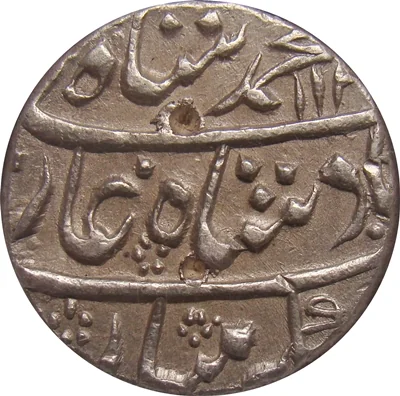
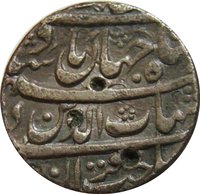
Obverse
Description:
Inscription, dated AH.
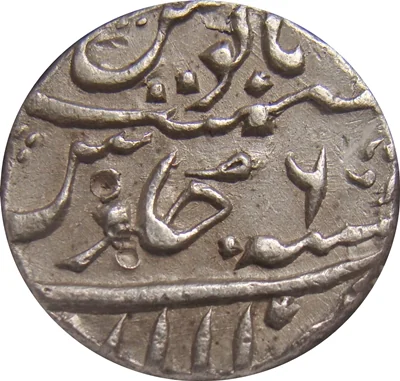
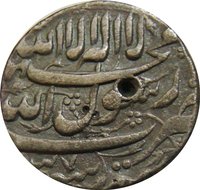
Reverse
Description:
Regnal year, mint below.
Edge
Mintings
| Year | Mint Mark | Mintage | Quality | Collection |
|---|---|---|---|---|
| 1723 | — | — | ||
| 1724 | — | — | ||
| 1726 | — | — | ||
| 1727 | — | — | ||
| 1728 | — | — | ||
| 1729 | — | — | ||
| 1730 | — | — | ||
| 1731 | — | — | ||
| 1732 | — | — | ||
| 1733 | — | — | ||
| 1734 | — | — | ||
| 1735 | — | — | ||
| 1736 | — | — | ||
| 1737 | — | — | ||
| 1738 | — | — | ||
| 1739 | — | — | ||
| 1740 | — | — | ||
| 1741 | — | — | ||
| 1741 | — | — | ||
| 1742 | — | — | ||
| 1743 | — | — | ||
| 1744 | — | — | ||
| 1745 | — | — | ||
| 1748 | — | — |
Historical background
By 1723, the Mughal Empire's currency system, once a pillar of its centralized power and economic integration, was under severe strain. The standard silver rupee, established by Emperor Sher Shah Suri and meticulously maintained by Akbar and his successors, remained the nominal unit of account. However, the empire's political fragmentation following the death of Aurangzeb in 1707 had direct monetary consequences. Provincial governors and emerging regional powers like the Nawabs of Bengal and Awadh began striking their own rupees, often with reduced weight or purity, while still bearing the name of the largely powerless Mughal emperor in Delhi. This led to a proliferation of currencies with varying intrinsic values, complicating trade and revenue collection.
The period was marked by a critical shortage of silver, the lifeblood of the rupee. This was caused by multiple factors: a decline in bullion imports from a weakening trade sector, the diversion of revenue to regional treasuries rather than the imperial coffers, and the immense outflow of silver as war indemnity to the invading Marathas following their victories over Mughal armies. The scarcity of precious metal drove the increased production and use of copper dams for smaller transactions, but these too suffered from debasement and local variability. Furthermore, the gold mohur, traditionally used for high-value transactions and hoarding, became even more detached from the silver rupee, with its exchange rate fluctuating wildly based on local supply.
Consequently, the monetary landscape of 1723 was one of growing complexity and uncertainty. Merchants and moneychangers (sarrafs) gained significant influence, as their expertise was required to assess the true weight and fineness of coins from different mint towns. Long-distance trade increasingly relied on bills of exchange (hundis) to avoid the risks of transporting adulterated coinage. In essence, the disintegration of a uniform imperial currency mirrored the political dissolution of the empire itself, moving from a centralized system to a contested and regionalized one, undermining economic stability and foreshadowing the deeper financial crises of the mid-18th century.
The period was marked by a critical shortage of silver, the lifeblood of the rupee. This was caused by multiple factors: a decline in bullion imports from a weakening trade sector, the diversion of revenue to regional treasuries rather than the imperial coffers, and the immense outflow of silver as war indemnity to the invading Marathas following their victories over Mughal armies. The scarcity of precious metal drove the increased production and use of copper dams for smaller transactions, but these too suffered from debasement and local variability. Furthermore, the gold mohur, traditionally used for high-value transactions and hoarding, became even more detached from the silver rupee, with its exchange rate fluctuating wildly based on local supply.
Consequently, the monetary landscape of 1723 was one of growing complexity and uncertainty. Merchants and moneychangers (sarrafs) gained significant influence, as their expertise was required to assess the true weight and fineness of coins from different mint towns. Long-distance trade increasingly relied on bills of exchange (hundis) to avoid the risks of transporting adulterated coinage. In essence, the disintegration of a uniform imperial currency mirrored the political dissolution of the empire itself, moving from a centralized system to a contested and regionalized one, undermining economic stability and foreshadowing the deeper financial crises of the mid-18th century.
💎 Extremely Rare