

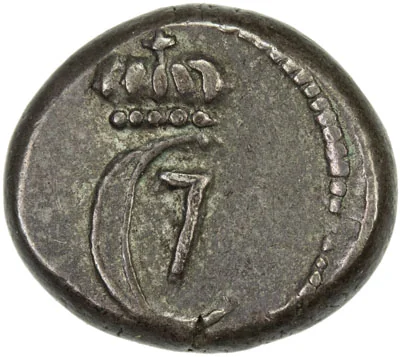
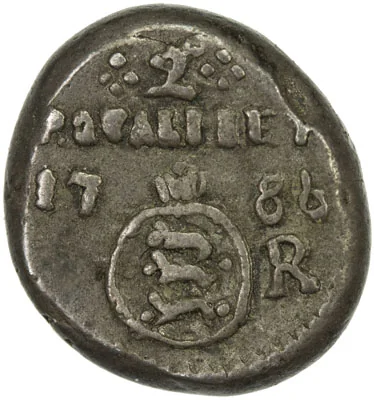
2 Royalins – Danish India
India
Context
Year: 1786
Country: India 
Issuer: Danish India
Ruler: Christian VII
Currency:
(1730—1818)
Demonetized: Yes
Material
References
KM: #Click to copy to clipboard172
Numista: #119830
Value
Bullion value: $7.66
Obverse
Reverse
Description:
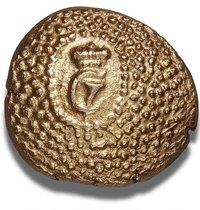
Value and date, letter R below, initial A. Fr. Restorff.
Inscription:
2
ROYALINER
17 86
R
ROYALINER
17 86
R
Script: Latin
Edge
Mintings
| Year | Mint Mark | Mintage | Quality | Collection |
|---|---|---|---|---|
| 1786 | R | — |
Historical background
In 1786, the currency situation in Danish India, centered on the trading enclaves of Tranquebar (Tharangambadi) and Serampore (Frederiksnagore), was characterized by complexity and instability, mirroring the region's fragmented political economy. The Danish Asiatic Company, operating with limited capital and influence, struggled to impose a unified monetary system. While the company issued its own silver rix-dollars (rigsdaler) and copper coins for local use, these circulated alongside a plethora of other currencies. Most significant was the widespread use of the Arcot rupee and other Indian silver rupees from neighboring powers, which were the preferred media for substantial trade and revenue collection.
This multiplicity created chronic problems of exchange rate fluctuation and valuation. The value of silver relative to copper, and of one state's rupee against another's, shifted constantly based on purity, weight, and political fortunes. For the Danish administration, this meant recurrent revenue shortfalls and difficulties in paying troops and securing supplies, as the value of collected taxes could erode between assessment and treasury. Furthermore, the enclaves were deeply integrated into the regional economy of the Coromandel Coast and Bengal, making it impractical to insulate themselves from the monetary turbulence of the surrounding Mughal successor states, particularly the financially strained Nawab of Arcot and the expanding British East India Company.
Consequently, the Danish response in this period was largely reactive and pragmatic rather than reformative. Authorities published frequent exchange rate bulletins to guide transactions and attempted to standardize accepted weights and measures for silver. However, without the political or economic clout to enforce a single standard, the system remained a messy bazaar of competing coins. This monetary ambiguity reflected Denmark's weakening position as a minor colonial power, increasingly overshadowed by the British and dependent on adapting to the financial ecosystems they did not control.
This multiplicity created chronic problems of exchange rate fluctuation and valuation. The value of silver relative to copper, and of one state's rupee against another's, shifted constantly based on purity, weight, and political fortunes. For the Danish administration, this meant recurrent revenue shortfalls and difficulties in paying troops and securing supplies, as the value of collected taxes could erode between assessment and treasury. Furthermore, the enclaves were deeply integrated into the regional economy of the Coromandel Coast and Bengal, making it impractical to insulate themselves from the monetary turbulence of the surrounding Mughal successor states, particularly the financially strained Nawab of Arcot and the expanding British East India Company.
Consequently, the Danish response in this period was largely reactive and pragmatic rather than reformative. Authorities published frequent exchange rate bulletins to guide transactions and attempted to standardize accepted weights and measures for silver. However, without the political or economic clout to enforce a single standard, the system remained a messy bazaar of competing coins. This monetary ambiguity reflected Denmark's weakening position as a minor colonial power, increasingly overshadowed by the British and dependent on adapting to the financial ecosystems they did not control.
✨ Legendary