

1 Filippo – Milan
Italy
Context
Years: 1652–1657
Country: Italy 
Issuer: Milan
Ruler: Philip III
Currency:
(1515—1796)
Demonetized: Yes
Material
References
KM: #Click to copy to clipboard55
Numista: #88788
Value
Bullion value: $77.14
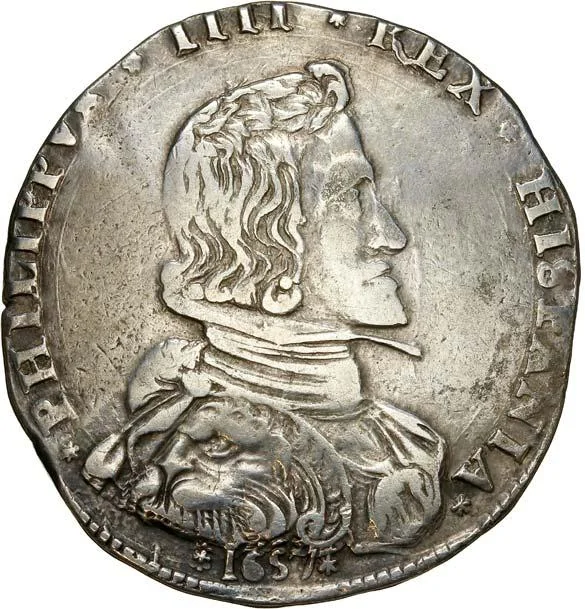
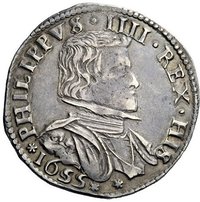
Obverse
Description:
Bust right, date below shoulder.
Inscription:
PHILIPPVS*IIII*REX*HISPANIARV
*1657*
*1657*
Script: Latin
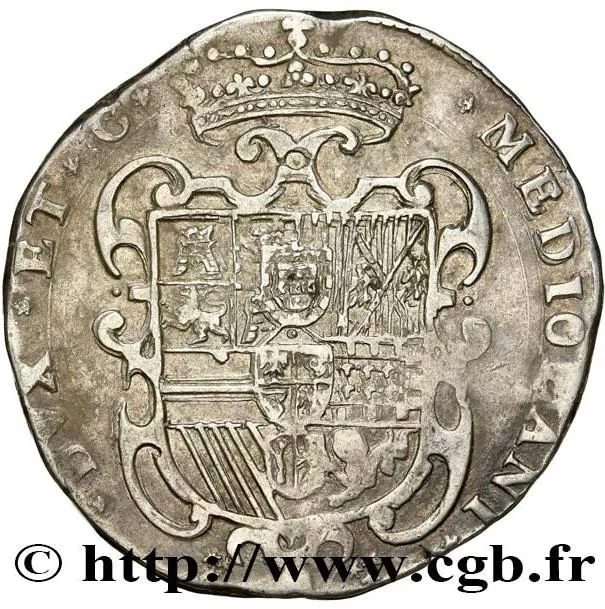
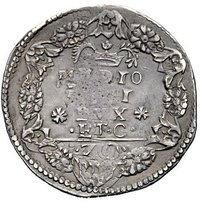
Reverse
Description:
Crowned baroque shield with many arms.
Inscription:
*MEDIOLANI* DVX*ET*C*
Script: Latin
Edge
Categories
| Object> Armour |
| Symbols> Coat of Arms |
Mints
| Name | Mark |
|---|---|
| Milan | — |
Mintings
| Year | Mint Mark | Mintage | Quality | Collection |
|---|---|---|---|---|
| 1652 | — | — | ||
| 1657 | — | — |
Historical background
In 1652, the Duchy of Milan, a Spanish Habsburg possession, was grappling with a severe and complex monetary crisis. The primary issue was the widespread circulation of heavily debased silver coinage, particularly the sesino and the soldo. Years of currency manipulation by the state, which reduced the silver content to fund military campaigns and administrative costs, had led to a classic manifestation of Gresham's Law: "bad money drives out good." Full-weight silver coins were hoarded or exported, leaving the economy reliant on poor-quality, unreliable currency that merchants and the public deeply distrusted.
This debasement triggered rampant price inflation and crippled daily commerce. The situation was exacerbated by the broader economic strain of the Thirty Years' War (1618-1648), which had only recently concluded, leaving the region's trade and agriculture weakened. Local authorities in Milan found themselves powerless to rectify the situation, as monetary policy was dictated by the central Spanish government, which prioritized fiscal demands from Madrid over local economic stability in its Italian territories.
The crisis culminated in 1652 with a bold, if controversial, attempt at a solution. Under the governance of the Spanish-appointed Junta Monetaria, Milan embarked on a drastic monetary reconversion. The state announced the demonetization of the old debased coinage and the introduction of a new, sound silver currency. While intended to restore confidence, the process was socially disruptive, causing short-term hardship for those holding the old coins and leading to public protests. Nonetheless, this decisive action marked a critical turning point, aiming to re-anchor the Milanese economy to a stable monetary standard after years of erosion.
This debasement triggered rampant price inflation and crippled daily commerce. The situation was exacerbated by the broader economic strain of the Thirty Years' War (1618-1648), which had only recently concluded, leaving the region's trade and agriculture weakened. Local authorities in Milan found themselves powerless to rectify the situation, as monetary policy was dictated by the central Spanish government, which prioritized fiscal demands from Madrid over local economic stability in its Italian territories.
The crisis culminated in 1652 with a bold, if controversial, attempt at a solution. Under the governance of the Spanish-appointed Junta Monetaria, Milan embarked on a drastic monetary reconversion. The state announced the demonetization of the old debased coinage and the introduction of a new, sound silver currency. While intended to restore confidence, the process was socially disruptive, causing short-term hardship for those holding the old coins and leading to public protests. Nonetheless, this decisive action marked a critical turning point, aiming to re-anchor the Milanese economy to a stable monetary standard after years of erosion.
✨ Legendary