

1 Ducaton – Milan
Italy
Context
Years: 1622–1630
Country: Italy 
Issuer: Milan
Ruler: Philip III
Currency:
(1515—1796)
Demonetized: Yes
Material
References
KM: #Click to copy to clipboard43
Numista: #99067
Obverse
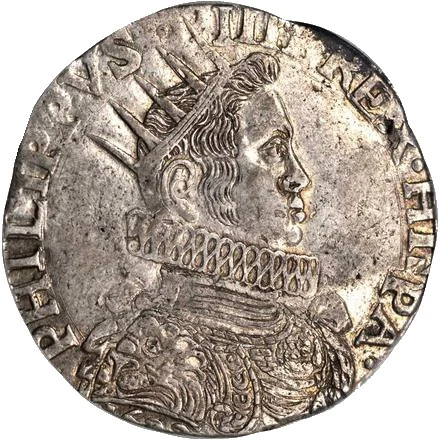
Description:
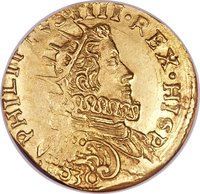
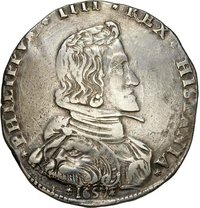
Crowned bust right, date below shoulder.
Inscription:
PHILIPPVS III REX·HISPA
1622
1622
Script: Latin
Reverse
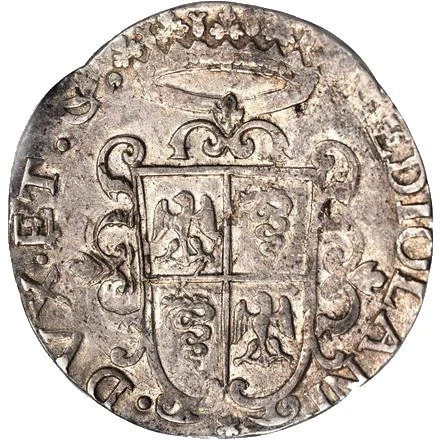
Description:
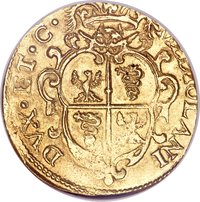
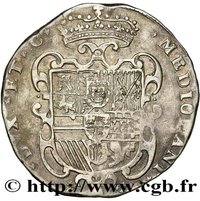
Crowned baroque shield with quartered arms.
Inscription:
MEDIOLANI ·DVX·ET·G·
Script: Latin
Edge
Mints
| Name | Mark |
|---|---|
| Milan | — |
Mintings
| Year | Mint Mark | Mintage | Quality | Collection |
|---|---|---|---|---|
| 1622 | — | — | ||
| 1625 | — | — | ||
| 1630 | — | — |
Historical background
In 1622, Milan, as the capital of the Spanish Duchy of Milan, was grappling with a severe and complex monetary crisis rooted in the "Price Revolution" of the 16th century. The influx of silver from the Spanish Americas had caused widespread inflation across Europe, devaluing the large silver scudo and other coins. Meanwhile, the small-denomination coins used daily by the populace, minted from copper or billon (a silver-copper alloy), were being heavily debased by both the Milanese mint and neighboring states. This created a destructive imbalance: the intrinsic metal value of these petty coins often fell below their face value, leading to Gresham's Law in action—"bad money drives out good." People hoarded older, purer coins, and the circulating currency became increasingly unreliable.
The Spanish authorities, desperate for revenue to fund their ongoing military commitments in the Thirty Years' War and the defense of their Italian territories, often resorted to currency manipulation as a fiscal tool. In the years leading up to 1622, the mint had issued vast quantities of debased sesini and soldi, eroding public trust. This situation was exacerbated by rampant counterfeiting and the circulation of even more debased foreign coins from nearby regions like the Swiss Cantons. The result was a chaotic monetary environment where the exchange rates between different coin types fluctuated wildly, causing confusion in the marketplace, harming legitimate commerce, and effectively imposing a hidden tax on the poor, who dealt primarily in the devalued small change.
Attempts at reform were fraught with difficulty. In 1619, the Spanish government had introduced a new silver-based currency, the ducatone, in an effort to stabilize the system, but the underlying pressures were too great. By 1622, the monetary chaos was a central economic and social problem. It disrupted tax collection, complicated the payment of troops (a critical issue for a strategic garrison city like Milan), and fueled social tension. The situation demanded a decisive intervention, which would culminate in the comprehensive monetary reform of 1623, an attempt to reassert state control, recall debased coinage, and restore a unified and trustworthy currency for the Duchy.
The Spanish authorities, desperate for revenue to fund their ongoing military commitments in the Thirty Years' War and the defense of their Italian territories, often resorted to currency manipulation as a fiscal tool. In the years leading up to 1622, the mint had issued vast quantities of debased sesini and soldi, eroding public trust. This situation was exacerbated by rampant counterfeiting and the circulation of even more debased foreign coins from nearby regions like the Swiss Cantons. The result was a chaotic monetary environment where the exchange rates between different coin types fluctuated wildly, causing confusion in the marketplace, harming legitimate commerce, and effectively imposing a hidden tax on the poor, who dealt primarily in the devalued small change.
Attempts at reform were fraught with difficulty. In 1619, the Spanish government had introduced a new silver-based currency, the ducatone, in an effort to stabilize the system, but the underlying pressures were too great. By 1622, the monetary chaos was a central economic and social problem. It disrupted tax collection, complicated the payment of troops (a critical issue for a strategic garrison city like Milan), and fueled social tension. The situation demanded a decisive intervention, which would culminate in the comprehensive monetary reform of 1623, an attempt to reassert state control, recall debased coinage, and restore a unified and trustworthy currency for the Duchy.
✨ Legendary