

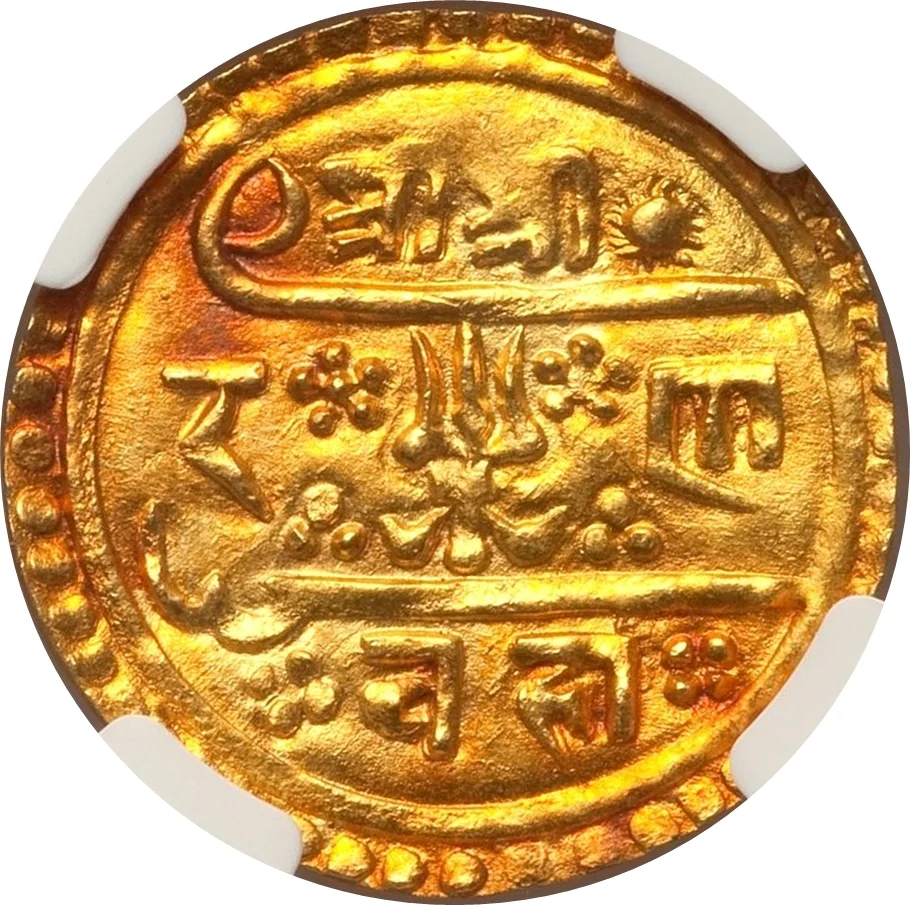
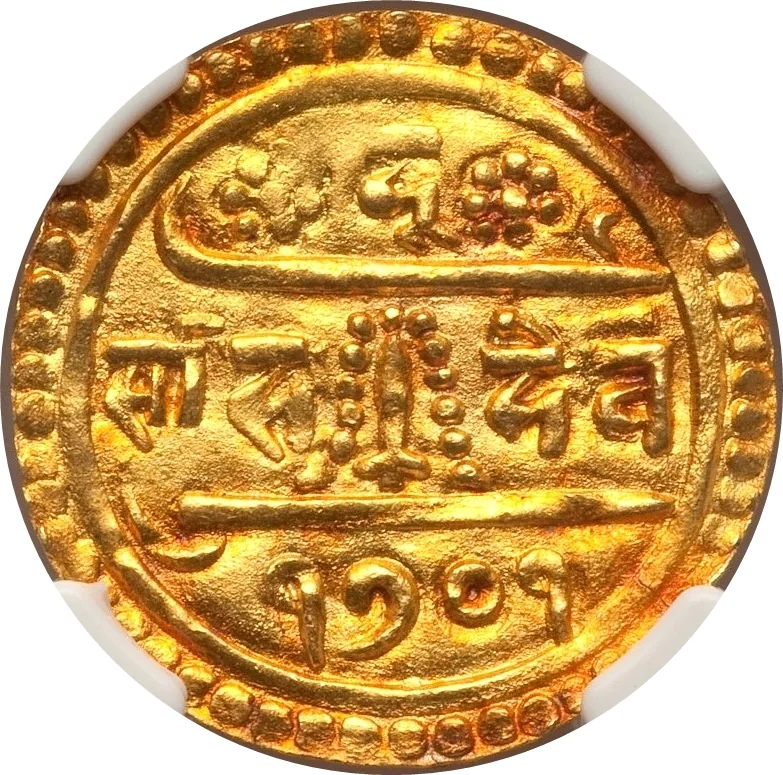
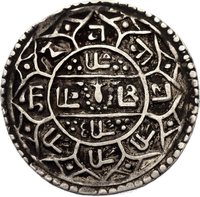
½ Mohar – Nepal
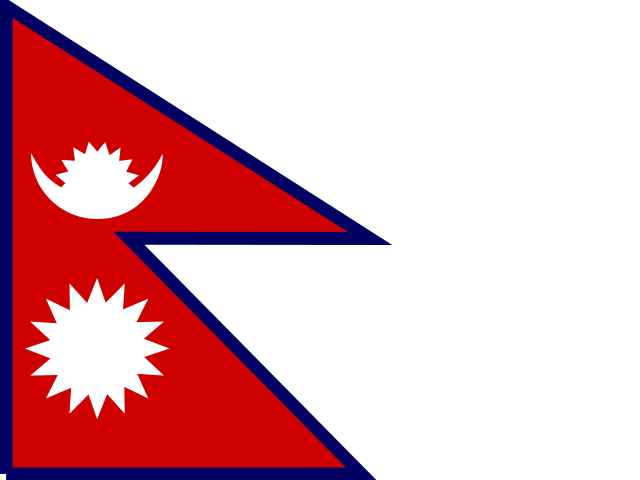
Nepal
Obverse
Reverse
Edge
Mintings
| Year | Mint Mark | Mintage | Quality | Collection |
|---|---|---|---|---|
| 1779 | — | — | ||
| 1790 | — | — |
Historical background
In 1779, Nepal was not a unified nation but a collection of small, competing hill states, primarily the Gorkha Kingdom, the Kathmandu Valley kingdoms (Kathmandu, Patan, Bhaktapur), and numerous others. There was no standardized national currency. Economic activity relied on a complex mosaic of coinage, with each sovereign kingdom minting its own. The most prominent coins in circulation were the silver Mohars of the Valley kingdoms, which bore symbols of their respective Hindu and Buddhist deities, and the distinctive silver Gorkhali Rupees minted by Prithvi Narayan Shah of Gorkha, often stamped with the sword of the Khukuri.
The monetary situation was further complicated by the widespread use of older, debased Malla-period coins and the influx of foreign currency, particularly Tibetan silver Tangkas and Indian Mughal Rupees, due to Nepal's vital position in the trans-Himalayan trade. This created a system where exchange rates fluctuated not only between kingdoms but also between coin types, based on weight, purity, and reputation. Money changers (sarrafs) played a crucial role in this environment, assessing and exchanging this heterogeneous mix of specie.
This fragmented currency landscape was a direct reflection of the political fragmentation of the region. However, it was also a period of imminent change. By 1779, Prithvi Narayan Shah had already conquered the Kathmandu Valley (1768-69), and his Gorkha Kingdom was actively consolidating its rule. A key part of this state-building project was the gradual imposition of Gorkhali coinage over the territories he conquered, laying the administrative and economic groundwork for a unified monetary system that would emerge in the coming decades as the Gorkha Empire expanded.
The monetary situation was further complicated by the widespread use of older, debased Malla-period coins and the influx of foreign currency, particularly Tibetan silver Tangkas and Indian Mughal Rupees, due to Nepal's vital position in the trans-Himalayan trade. This created a system where exchange rates fluctuated not only between kingdoms but also between coin types, based on weight, purity, and reputation. Money changers (sarrafs) played a crucial role in this environment, assessing and exchanging this heterogeneous mix of specie.
This fragmented currency landscape was a direct reflection of the political fragmentation of the region. However, it was also a period of imminent change. By 1779, Prithvi Narayan Shah had already conquered the Kathmandu Valley (1768-69), and his Gorkha Kingdom was actively consolidating its rule. A key part of this state-building project was the gradual imposition of Gorkhali coinage over the territories he conquered, laying the administrative and economic groundwork for a unified monetary system that would emerge in the coming decades as the Gorkha Empire expanded.

✨ Legendary