

½ Paisa – Nepal
Nepal
Context
Material

References
KM: #Click to copy to clipboard489
Numista: #519625
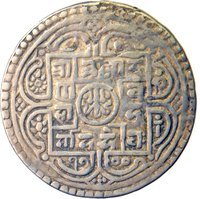
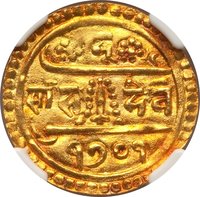
Obverse
Description:
Deccan Arabic script lettering for "King."
Script: Arabic
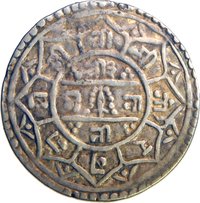
Reverse
Description:
Hyderabad Arabic date near bottom.
Script: Arabic
Edge
Plain
Mintings
| Year | Mint Mark | Mintage | Quality | Collection |
|---|---|---|---|---|
| 1778 | — | — | ||
| 1788 | — | — | ||
| 1793 | — | — |
Historical background
In 1778, the currency situation in the Kathmandu Valley, then divided into the three rival kingdoms of Kantipur, Lalitpur, and Bhaktapur, was complex and fragmented. Each kingdom minted its own distinct silver mohar coins, which served as the primary medium for significant transactions and state revenue. These coins were not uniform; they varied in weight, purity, and design, bearing the symbols and script of their respective issuing kingdom, leading to constant exchange rate fluctuations and transactional friction within a small geographic area. This monetary fragmentation was a direct reflection of the intense political rivalry and lack of economic unity among the Malla rulers.
The broader economy, however, still relied heavily on a dual system of coinage and commodity money. For daily local trade, especially in rural areas and for smaller purchases, barter and payment in kind (like grains, salt, or livestock) remained widespread. Furthermore, the region's position on the trans-Himalayan trade routes meant that foreign currencies, particularly Tibetan silver tangkas and Indian Mughal rupees, circulated alongside the local mohars. These foreign coins were crucial for financing the lucrative trade in wool, salt, borax, and textiles, creating a multi-currency environment where merchants had to be adept at assessing and exchanging various metallic contents.
This unstable and competitive monetary landscape would soon be swept away by the rising Gorkha kingdom to the west. Under Prithvi Narayan Shah, the Gorkhalis were in the final stages of their conquest, having already captured Kantipur (Kathmandu) in 1768 and Lalitpur (Patan) in 1769. By 1778, they were consolidating power, and a key project was the standardization of currency to assert sovereignty and unify the economy. The Gorkha administration began replacing the various Malla mohars with a uniform national coinage minted from the silver of newly acquired mines, laying the monetary foundation for the modern Nepali state. Thus, 1778 represents a transitional moment, marking the end of the fractured Malla coinage system and the beginning of a centralized monetary policy under the Shah dynasty.
The broader economy, however, still relied heavily on a dual system of coinage and commodity money. For daily local trade, especially in rural areas and for smaller purchases, barter and payment in kind (like grains, salt, or livestock) remained widespread. Furthermore, the region's position on the trans-Himalayan trade routes meant that foreign currencies, particularly Tibetan silver tangkas and Indian Mughal rupees, circulated alongside the local mohars. These foreign coins were crucial for financing the lucrative trade in wool, salt, borax, and textiles, creating a multi-currency environment where merchants had to be adept at assessing and exchanging various metallic contents.
This unstable and competitive monetary landscape would soon be swept away by the rising Gorkha kingdom to the west. Under Prithvi Narayan Shah, the Gorkhalis were in the final stages of their conquest, having already captured Kantipur (Kathmandu) in 1768 and Lalitpur (Patan) in 1769. By 1778, they were consolidating power, and a key project was the standardization of currency to assert sovereignty and unify the economy. The Gorkha administration began replacing the various Malla mohars with a uniform national coinage minted from the silver of newly acquired mines, laying the monetary foundation for the modern Nepali state. Thus, 1778 represents a transitional moment, marking the end of the fractured Malla coinage system and the beginning of a centralized monetary policy under the Shah dynasty.
✨ Legendary