

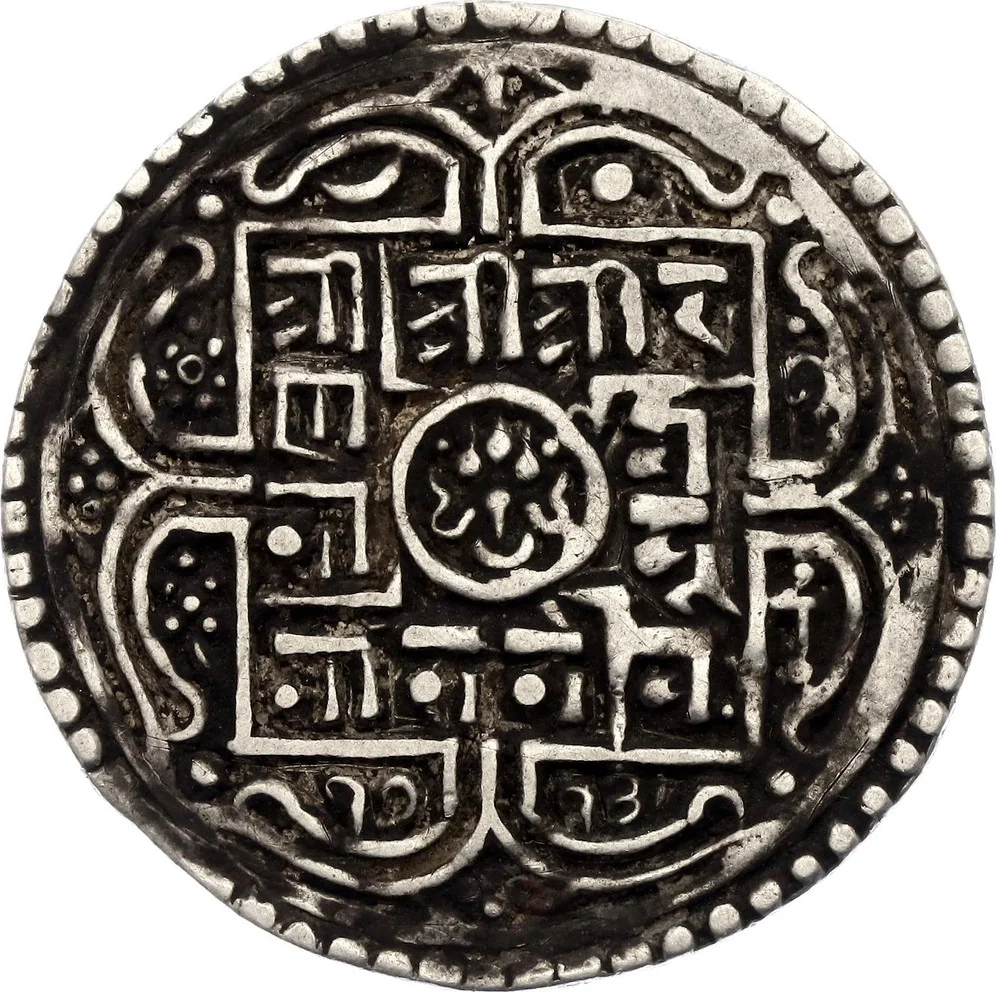
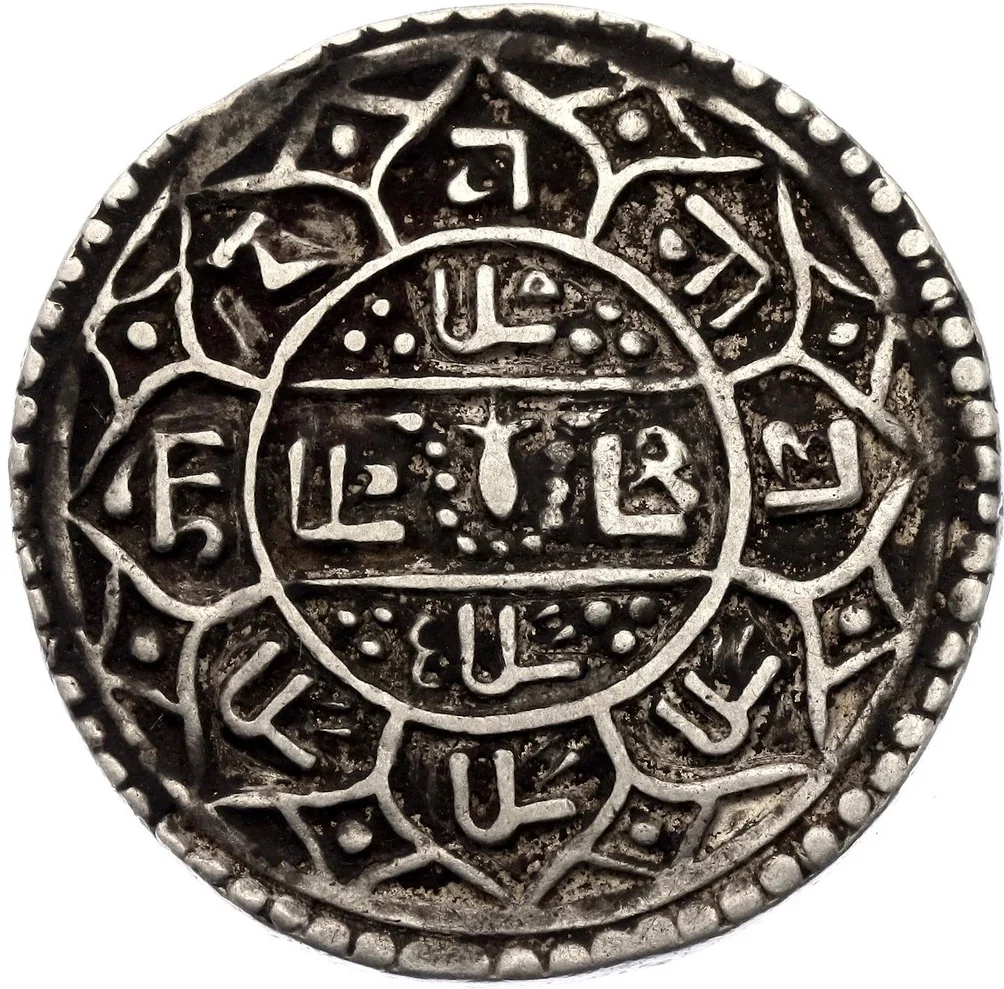
1 Mohar – Nepal
Nepal
Context

Material
References
KM: #Click to copy to clipboard502.2
Numista: #58958
Value
Bullion value: $16.27
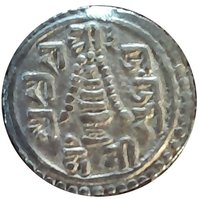
Obverse
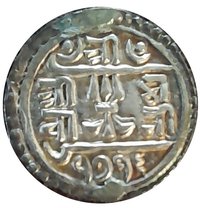
Reverse
Edge
Plain
Mintings
| Year | Mint Mark | Mintage | Quality | Collection |
|---|---|---|---|---|
| 1789 | — | — | ||
| 1790 | — | — | ||
| 1791 | — | — | ||
| 1792 | — | — | ||
| 1794 | — | — | ||
| 1795 | — | — | ||
| 1796 | — | — | ||
| 1797 | — | — | ||
| 1798 | — | — |
Historical background
In 1789, the currency situation in the Kingdom of Nepal was defined by a complex and fragmented system of metallic coinage, primarily under the reign of King Rana Bahadur Shah. The state did not issue a unified national paper currency; instead, the economy operated on a silver standard, with the Mohar being the principal silver coin. However, the monetary landscape was complicated by the concurrent circulation of coins minted by various semi-autonomous principalities (like the 22 and 24 principalities), local rulers, and even foreign currencies, particularly the Mohurs of the Mughal Empire and coins from neighboring Indian states. This lack of standardization meant that exchange rates and purity could vary significantly, hindering large-scale trade and state revenue collection.
The authority to mint coins was a crucial symbol of sovereignty and a significant source of revenue (seigniorage). While the Shah kings in Kathmandu held central minting rights, regional powers, especially in the western hills and the Kathmandu Valley's earlier Malla kingdoms, often continued producing their own local coinage. These coins, along with clipped and worn foreign pieces, created a chaotic marketplace where merchants and tax collectors had to constantly assess the weight and metal content of each coin. The state's primary focus was on securing a steady supply of silver, often obtained through trade with Tibet, to mint its own coins and assert its economic authority.
This period also saw the early stages of military expansion that would later impact Nepal's currency. The unification campaign led by Prithvi Narayan Shah (completed just years before, in 1769) had consolidated the Kathmandu Valley, but integrating the monetary systems of conquered territories was a slow process. The economic demands of ongoing warfare and administration put pressure on the royal treasury, making the control of minting and the flow of precious metals a matter of strategic importance. Thus, in 1789, Nepal's currency was not a single system but a contested and evolving mosaic of metal, reflecting the political struggle between centralization and regional autonomy in a rapidly changing state.
The authority to mint coins was a crucial symbol of sovereignty and a significant source of revenue (seigniorage). While the Shah kings in Kathmandu held central minting rights, regional powers, especially in the western hills and the Kathmandu Valley's earlier Malla kingdoms, often continued producing their own local coinage. These coins, along with clipped and worn foreign pieces, created a chaotic marketplace where merchants and tax collectors had to constantly assess the weight and metal content of each coin. The state's primary focus was on securing a steady supply of silver, often obtained through trade with Tibet, to mint its own coins and assert its economic authority.
This period also saw the early stages of military expansion that would later impact Nepal's currency. The unification campaign led by Prithvi Narayan Shah (completed just years before, in 1769) had consolidated the Kathmandu Valley, but integrating the monetary systems of conquered territories was a slow process. The economic demands of ongoing warfare and administration put pressure on the royal treasury, making the control of minting and the flow of precious metals a matter of strategic importance. Thus, in 1789, Nepal's currency was not a single system but a contested and evolving mosaic of metal, reflecting the political struggle between centralization and regional autonomy in a rapidly changing state.
💎 Very Rare