

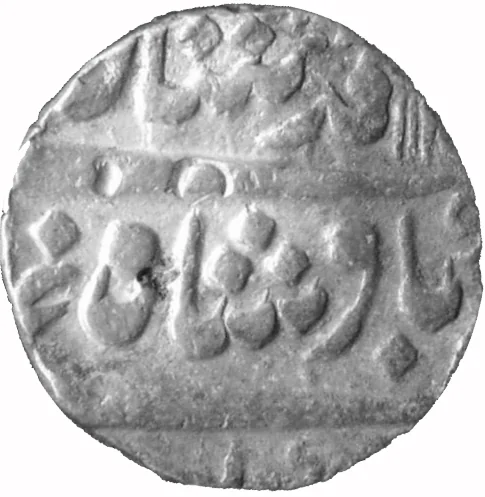
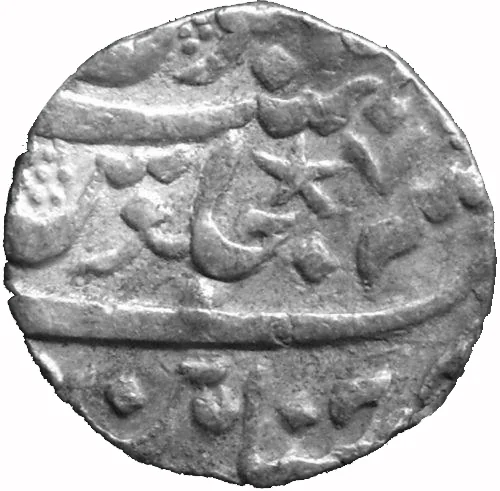
1 Rupee – Madras Presidency
India
Context

Material
References
KM: #Click to copy to clipboardG302
Numista: #87929
Value
Bullion value: $33.11
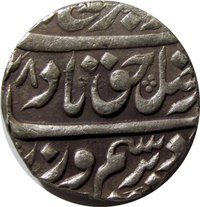
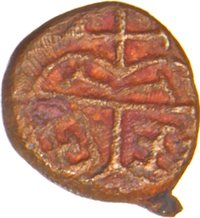
Obverse
Description:
Coins of Emperor Muhammad Shah
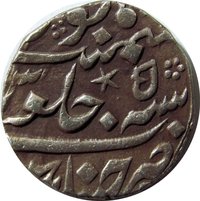
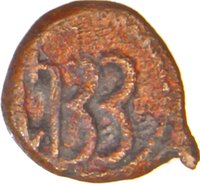
Reverse
Description:
Zarb Chinapatan, RY Maimanat
Inscription:
٧
Edge
Plain
Mintings
| Year | Mint Mark | Mintage | Quality | Collection |
|---|---|---|---|---|
| 1723 | — | — | ||
| 1726 | — | — | ||
| 1727 | — | — | ||
| 1728 | — | — | ||
| 1730 | — | — |
Historical background
In 1723, the currency situation in the Madras Presidency was a complex and often chaotic system, reflecting its position as a major hub of the English East India Company’s trade. The primary challenge was the coexistence of multiple, competing currencies. The Company conducted its high-value transactions and accounting in Pagodas, a gold coin of varying purity and weight, which was the traditional standard of the Coromandel Coast. Alongside this, silver rupees from the Mughal Empire (especially Arcot rupees) and a plethora of foreign silver coins—like Spanish dollars, Dutch ducatoons, and Portuguese xerafins—circulated widely, each with fluctuating market values against the pagoda.
This multiplicity led to constant instability and confusion. The exchange rates between gold pagodas, silver rupees, and the various foreign coins shifted frequently based on supply, the reliability of minting authorities, and the intrinsic metal content. The Company itself operated a mint at Fort St. George, producing gold pagodas and silver rupees, but it struggled to impose uniformity. Local merchants, weavers, and tax collectors often preferred specific coins, forcing the Company to maintain complex conversion tables and engage in constant arbitrage. Furthermore, the widespread practice of clipping and adulterating coins exacerbated the problem, making every transaction an exercise in assessment and negotiation.
Ultimately, this monetary fragmentation was a significant hindrance to commerce and administration. It created opportunities for profit for savvy money-changers (shroffs) but added layers of cost and risk to everyday trade. The year 1723 falls within a period of ongoing struggle for the Company to assert greater monetary control, a process that would gradually lead to the standardization of the rupee as the principal currency later in the century, but for the time being, the Presidency operated in a financially polyglot and uncertain environment.
This multiplicity led to constant instability and confusion. The exchange rates between gold pagodas, silver rupees, and the various foreign coins shifted frequently based on supply, the reliability of minting authorities, and the intrinsic metal content. The Company itself operated a mint at Fort St. George, producing gold pagodas and silver rupees, but it struggled to impose uniformity. Local merchants, weavers, and tax collectors often preferred specific coins, forcing the Company to maintain complex conversion tables and engage in constant arbitrage. Furthermore, the widespread practice of clipping and adulterating coins exacerbated the problem, making every transaction an exercise in assessment and negotiation.
Ultimately, this monetary fragmentation was a significant hindrance to commerce and administration. It created opportunities for profit for savvy money-changers (shroffs) but added layers of cost and risk to everyday trade. The year 1723 falls within a period of ongoing struggle for the Company to assert greater monetary control, a process that would gradually lead to the standardization of the rupee as the principal currency later in the century, but for the time being, the Presidency operated in a financially polyglot and uncertain environment.
✨ Legendary