

1 Lira – Bozzolo
Italy
Context
Years: 1613–1636
Country: Italy 
Issuer: Bozzolo
Ruler: Scipione Gonzaga
Currency:
(1497—1670)
Demonetized: Yes
Material
Diameter: 30 mm
Weight: 5 g
Silver weight: 5.00 g
Shape: Irregular round
Composition: Silver
Magnetic: No
References
KM: #Click to copy to clipboard51
Numista: #87606
Value
Bullion value: $14.31
Obverse
Description:
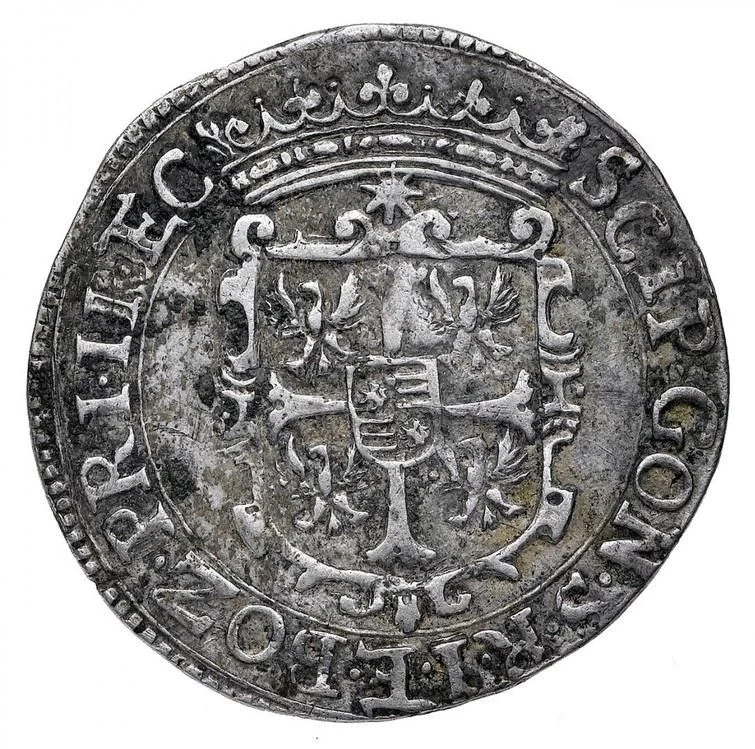
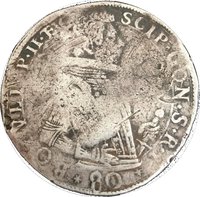
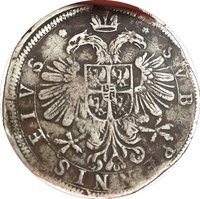
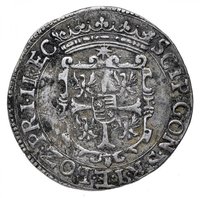
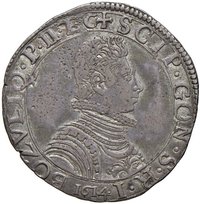
Quartered arms, crowned and framed ornately, within a thin inner circle.
Inscription:
SCIP · GON · S · R · I · E · BOZ · PRIN II · ETC
Script: Latin
Reverse
Description:
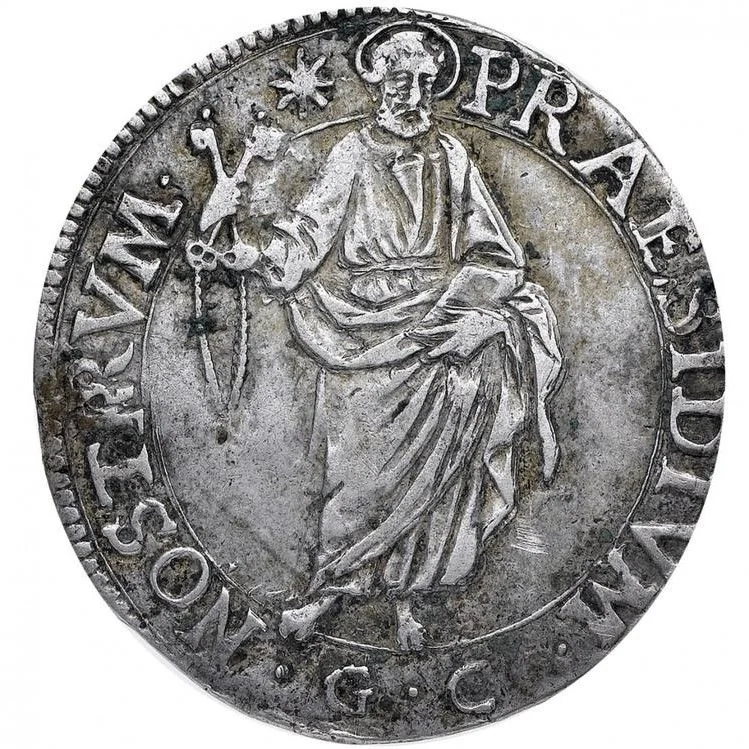
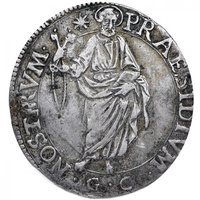
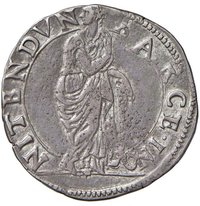
Saint Peter holding keys, dividing circle. Initials below.
Inscription:
PRAESIDIVM NOSTRUM ✽
G C
G C
Script: Latin
Edge
Categories
| Person> Religious figure |
| Symbols> Coat of Arms |
Mints
| Name | Mark |
|---|---|
| Bozzolo | — |
Mintings
| Year | Mint Mark | Mintage | Quality | Collection |
|---|---|---|---|---|
| — | — | — |
Historical background
In 1613, the small northern Italian Duchy of Bozzolo, ruled by Duke Ferrante Gonzaga, existed within a complex and fragmented monetary landscape typical of the Italian peninsula. The duchy did not possess its own independent minting authority. Instead, its economy operated on a daily basis using a mixture of circulating coinage from larger neighboring states, particularly the silver-based currencies of the Duchy of Milan (like the lira, soldo, and denaro) and the gold scudo from the Spanish Empire, which held hegemony over the region. This created a constant practical challenge for merchants and officials, who had to be familiar with multiple coinage systems and their fluctuating exchange rates.
The monetary situation was further strained by the pervasive problem of debasement and the influx of low-quality coinage. Larger states, often funding near-constant warfare, frequently reduced the silver content in their coins, a practice that inevitably affected satellite territories like Bozzolo. Consequently, older, purer coins were often hoarded or melted down (Gresham's Law in practice), leaving poorer-quality money in active circulation. This erosion of trust in coinage values complicated tax collection, long-distance trade, and even basic market transactions, as the intrinsic metal value could differ significantly from the face value.
For Duke Ferrante, the currency situation was a matter of both economic stability and sovereign prestige. While issuing independent Bozzolo coinage was a theoretical symbol of authority, it was a costly and logistically difficult endeavor for a small state, unlikely to displace the entrenched regional currencies. Therefore, his administration’s focus in 1613 would have been on pragmatic regulation: publishing official tavole di cambio (exchange tables) to fix rates between different coin types for legal purposes, decreeing which foreign coins were acceptable for tax payments, and attempting to police against the worst counterfeits, all in an effort to impose a semblance of order on a inherently disordered monetary system.
The monetary situation was further strained by the pervasive problem of debasement and the influx of low-quality coinage. Larger states, often funding near-constant warfare, frequently reduced the silver content in their coins, a practice that inevitably affected satellite territories like Bozzolo. Consequently, older, purer coins were often hoarded or melted down (Gresham's Law in practice), leaving poorer-quality money in active circulation. This erosion of trust in coinage values complicated tax collection, long-distance trade, and even basic market transactions, as the intrinsic metal value could differ significantly from the face value.
For Duke Ferrante, the currency situation was a matter of both economic stability and sovereign prestige. While issuing independent Bozzolo coinage was a theoretical symbol of authority, it was a costly and logistically difficult endeavor for a small state, unlikely to displace the entrenched regional currencies. Therefore, his administration’s focus in 1613 would have been on pragmatic regulation: publishing official tavole di cambio (exchange tables) to fix rates between different coin types for legal purposes, decreeing which foreign coins were acceptable for tax payments, and attempting to police against the worst counterfeits, all in an effort to impose a semblance of order on a inherently disordered monetary system.
✨ Legendary