

1 Liard – Austrian Netherlands
Belgium
Context
Years: 1776–1780
Country: Belgium 
Issuer: Austrian Netherlands
Ruler: Maria Theresa
Currency:
(1744—1798)
Demonetized: Yes
Total mintage: 6,726,842
Material
References
KM: #Click to copy to clipboard28
Numista: #8750
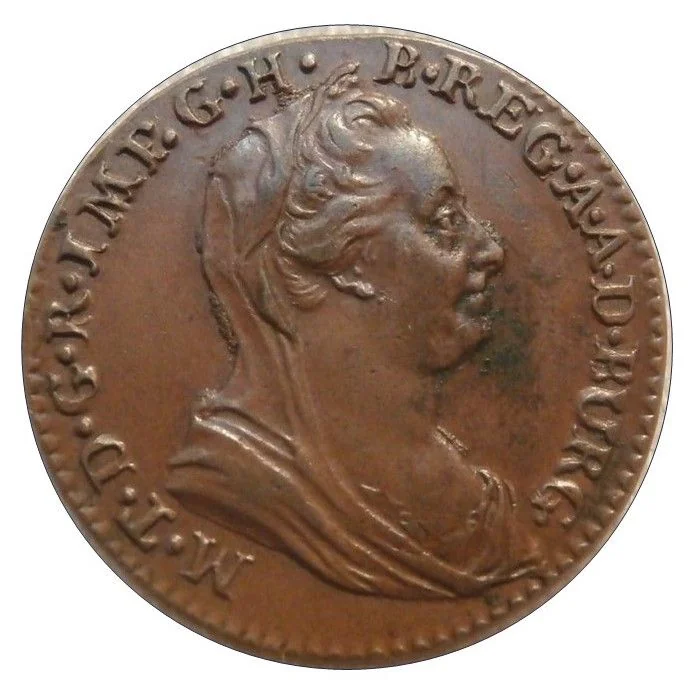
Obverse
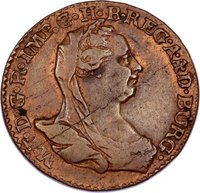
Description:
Veiled profile facing right.
Inscription:
M·T·D·G·R·IMP·G·H B·REG·A·A·D·BURG·
Script: Latin
Engraver: Théodore Van Berckel
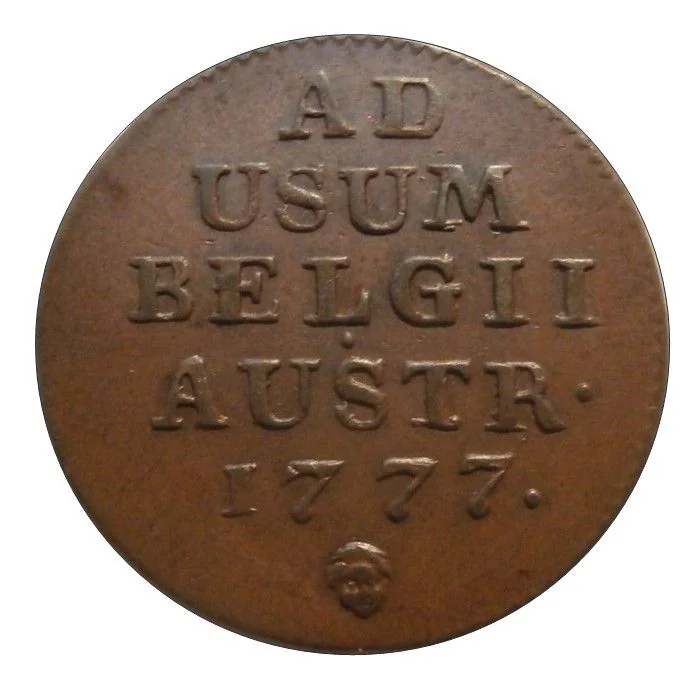
Reverse
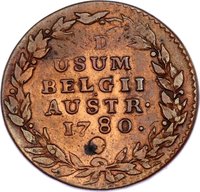
Description:
Legend in four lines,
date below,
mint mark under.
date below,
mint mark under.
Inscription:
AD
USUM
BELGII
AUSTR·
1777·
(marque d'atelier)
USUM
BELGII
AUSTR·
1777·
(marque d'atelier)
Script: Latin
Engraver: Théodore Van Berckel
Edge
Plain
Mints
| Name | Mark |
|---|---|
| Royal Mint of Belgium | angelface |
Mintings
Historical background
In 1776, the Austrian Netherlands (approximately modern-day Belgium and Luxembourg) was grappling with a complex and unstable monetary situation, a legacy of its history as a crossroads of European trade. The territory was not a sovereign state but a possession of the Habsburg Monarchy, governed from Vienna. This political reality meant it lacked a unified, authoritative currency issued by a central bank. Instead, its economy operated on a chaotic system of concurrent circulation, where numerous foreign and domestic coins—including Dutch guilders, French écus and louis d'or, Austrian thalers, and Spanish pistoles—all circulated simultaneously at fluctuating market-determined values.
The core of the problem lay in the official currency unit, the Brabant guilder or florin, which existed primarily as an accounting standard for government and large-scale commerce. Its relationship to the physical coins in circulation was set by official tariffs (valuation decrees). However, these government-set rates often failed to reflect the real market value or precious metal content of the coins, leading to chronic instability. Bad money (debased or worn coin) would flood in, while good, full-weight coinage was hoarded or exported—a classic illustration of Gresham’s Law. This created constant confusion for daily transactions, hampered commerce, and facilitated widespread fraud.
Attempts at reform were piecemeal and largely ineffective. The Habsburg government, distant and often preoccupied with other imperial concerns, issued periodic ordinances to re-tariff coins and ban certain foreign currencies, but these measures addressed symptoms rather than the structural cause. The monetary chaos of 1776 was therefore a persistent drain on the region's economic potential, contributing to merchant grievances and highlighting the administrative challenges of governing a prosperous but financially fragmented province from afar. This instability would persist until more forceful reforms were attempted under Emperor Joseph II in the following decade.
The core of the problem lay in the official currency unit, the Brabant guilder or florin, which existed primarily as an accounting standard for government and large-scale commerce. Its relationship to the physical coins in circulation was set by official tariffs (valuation decrees). However, these government-set rates often failed to reflect the real market value or precious metal content of the coins, leading to chronic instability. Bad money (debased or worn coin) would flood in, while good, full-weight coinage was hoarded or exported—a classic illustration of Gresham’s Law. This created constant confusion for daily transactions, hampered commerce, and facilitated widespread fraud.
Attempts at reform were piecemeal and largely ineffective. The Habsburg government, distant and often preoccupied with other imperial concerns, issued periodic ordinances to re-tariff coins and ban certain foreign currencies, but these measures addressed symptoms rather than the structural cause. The monetary chaos of 1776 was therefore a persistent drain on the region's economic potential, contributing to merchant grievances and highlighting the administrative challenges of governing a prosperous but financially fragmented province from afar. This instability would persist until more forceful reforms were attempted under Emperor Joseph II in the following decade.
🌱 Fairly Common