

1 Thaler – Austrian Empire
Austria
Context
Years: 1648–1649
Country: Austria 
Issuer: Austrian Empire
Ruler: Ferdinand III
Currency:
(1520—1754)
Demonetized: Yes
Material
References
KM: #Click to copy to clipboard959
Numista: #86957
Value
Bullion value: $81.35
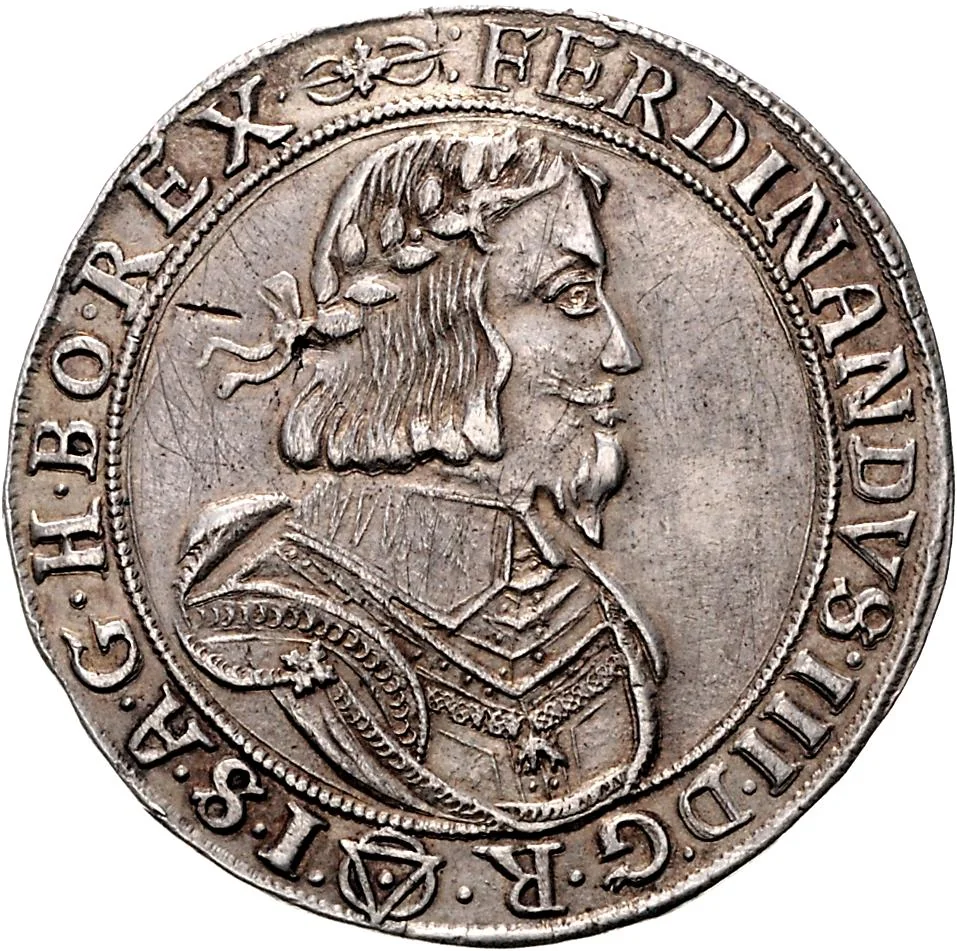
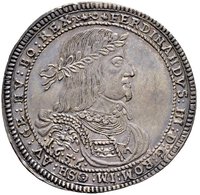
Obverse
Description:
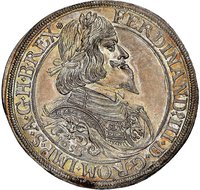
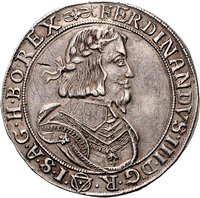
Laureate portrait right, flat collar, beaded inner circle. Legend divided by mint mark (circle with triangle and dot).
Inscription:
FERDINANDUS III D G R ( Y) I S A G H BO REX
Script: Latin
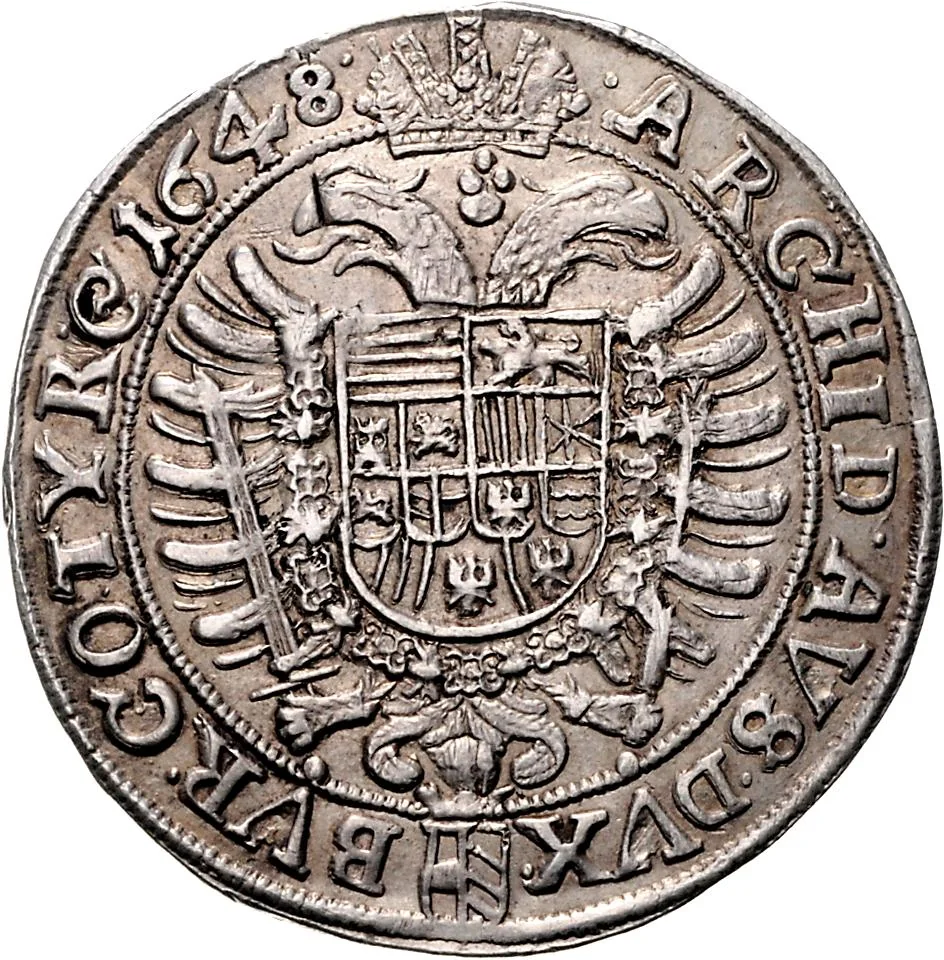
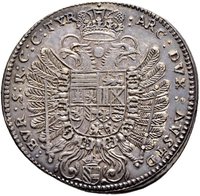
Reverse
Description:
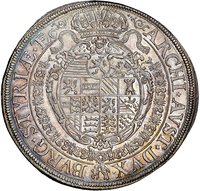
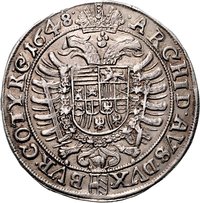
Double-headed imperial eagle in beaded circle, orb above, composite arms at center, Austria shield in legend below.
Inscription:
ARCHID AVS DVX // BVR CO TYR EC 1648
Script: Latin
Edge
Mints
| Name | Mark |
|---|---|
| Münze Österreich | — |
Mintings
| Year | Mint Mark | Mintage | Quality | Collection |
|---|---|---|---|---|
| 1648 | — | — | ||
| 1649 | — | — |
Historical background
In 1648, the Austrian Habsburg monarchy, a core component of the Holy Roman Empire, operated without a unified national currency. The monetary landscape was a complex and fragmented system, characterized by the simultaneous circulation of numerous foreign and domestic coins. The most important unit of account was the Guiden (Gulden or Florin), divided into 60 Kreuzer. However, the actual coins in daily use included a bewildering variety: Reichsthalers from the Empire, Dutch daalders and ducats, Spanish pesos and doubloons, and a plethora of lower-value regional kreuzer and heller coins minted by various Austrian territories, bishoprics, and imperial cities.
This fragmentation led to chronic monetary instability. The value of coins was not strictly tied to their precious metal content (specie value) but was often set by official proclamation (Kurantgeld), creating a gap between face value and intrinsic value. This environment encouraged clipping (shaving metal from coins) and counterfeiting, while princes and cities frequently debased their own subsidiary coinage to generate seigniorage revenue, especially to finance the immense costs of the Thirty Years' War (1618-1648). The Peace of Westphalia in 1648 itself, which ended that war, did nothing to resolve this monetary chaos, instead reinforcing the political decentralization that allowed it to persist.
Consequently, trade and taxation were fraught with difficulty. Money changers (Wechsler) were essential figures in market towns, and complex exchange tables were needed for basic commerce. The Habsburg state's own finances suffered, as it struggled to collect taxes in reliable specie. While there were attempts at imperial regulation, such as the Reichsmünzordnung (Imperial Coinage Ordinance), enforcement was weak. Thus, in 1648, the Austrian monetary situation was one of debilitating complexity, a direct reflection of the Empire's political fragmentation and a significant obstacle to economic cohesion and state-building.
This fragmentation led to chronic monetary instability. The value of coins was not strictly tied to their precious metal content (specie value) but was often set by official proclamation (Kurantgeld), creating a gap between face value and intrinsic value. This environment encouraged clipping (shaving metal from coins) and counterfeiting, while princes and cities frequently debased their own subsidiary coinage to generate seigniorage revenue, especially to finance the immense costs of the Thirty Years' War (1618-1648). The Peace of Westphalia in 1648 itself, which ended that war, did nothing to resolve this monetary chaos, instead reinforcing the political decentralization that allowed it to persist.
Consequently, trade and taxation were fraught with difficulty. Money changers (Wechsler) were essential figures in market towns, and complex exchange tables were needed for basic commerce. The Habsburg state's own finances suffered, as it struggled to collect taxes in reliable specie. While there were attempts at imperial regulation, such as the Reichsmünzordnung (Imperial Coinage Ordinance), enforcement was weak. Thus, in 1648, the Austrian monetary situation was one of debilitating complexity, a direct reflection of the Empire's political fragmentation and a significant obstacle to economic cohesion and state-building.
✨ Legendary