

½ Thaler – Austrian Empire
Austria
Context
Years: 1651–1656
Country: Austria 
Issuer: Austrian Empire
Ruler: Ferdinand III
Currency:
(1520—1754)
Demonetized: Yes
Material
References
KM: #Click to copy to clipboard974
Numista: #93579
Value
Bullion value: $40.57
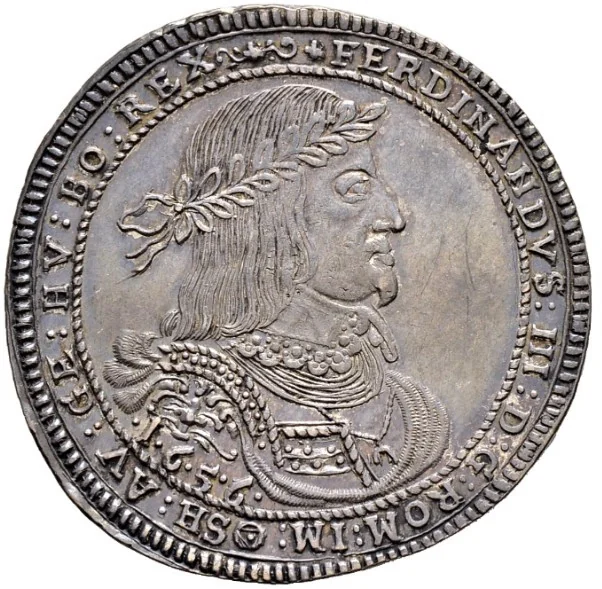
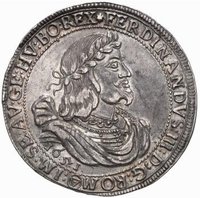
Obverse
Description:
Portrait right within beaded circle. Lion’s head may appear at shoulder; date below bust or in legend.
Inscription:
FERDINANDVS III D G ROM IM SH AV GE HV BO REX
Script: Latin
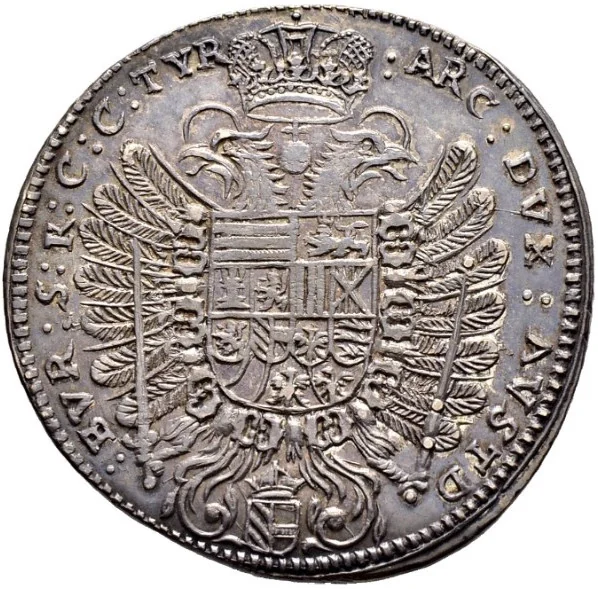
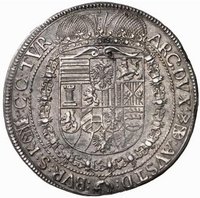
Reverse
Description:
Double-headed imperial eagle with halos, orb between heads. Austrian shield in tail feathers splits legend. No inner circle.
Inscription:
ARC DVX AVST D // BVR S K C C TYR
Script: Latin
Edge
Mints
| Name | Mark |
|---|---|
| Münze Österreich | — |
Mintings
| Year | Mint Mark | Mintage | Quality | Collection |
|---|---|---|---|---|
| 1651 | — | — | ||
| 1652 | — | — | ||
| 1653 | — | — | ||
| 1655 | — | — | ||
| 1656 | — | — |
Historical background
In 1651, the Habsburg Monarchy, often referred to as the Austrian Empire, was grappling with a severe and protracted currency crisis rooted in the financial exhaustion of the Thirty Years' War (1618-1648). The immense costs of financing armies had led successive emperors, particularly Ferdinand II and Ferdinand III, to drastically debase the coinage. By minting coins with ever-lower silver content but the same face value, the treasury sought to create artificial profit (seigniorage) to fund the war effort. This practice, however, triggered a classic "bad money drives out good" scenario (Gresham's Law), where older, full-value coins were hoarded or melted down, leaving the economy flooded with unreliable, depreciated currency.
The primary circulating coin was the Kreuzer, but its value had become wildly unstable. The crisis was most acutely felt with the Kipper- und Wipperzeit (the "Clipping and Swinging" period) of the early 1620s, a peak of chaotic debasement. While the worst had passed by 1651, the monetary system remained fractured and untrusted. Different regions within the Habsburg lands often used different standards, and the value of coins fluctuated based on their actual metal content rather than their stamped denomination, causing confusion, price inflation, and hindrance to trade.
Emperor Ferdinand III recognized the need for stabilization. In the years around 1651, efforts were underway to implement monetary reforms that would standardize the coinage and restore confidence. These efforts would culminate in the Reichsmünzordnung (Imperial Coinage Ordinance) of 1659, which aimed to establish a stable, silver-based Reichsthaler as a standard across the Holy Roman Empire. Thus, 1651 represents a transitional point—a period still suffering the deep scars of wartime finance, but with initial steps being taken towards the long and difficult process of monetary recovery and centralization under the Habsburg crown.
The primary circulating coin was the Kreuzer, but its value had become wildly unstable. The crisis was most acutely felt with the Kipper- und Wipperzeit (the "Clipping and Swinging" period) of the early 1620s, a peak of chaotic debasement. While the worst had passed by 1651, the monetary system remained fractured and untrusted. Different regions within the Habsburg lands often used different standards, and the value of coins fluctuated based on their actual metal content rather than their stamped denomination, causing confusion, price inflation, and hindrance to trade.
Emperor Ferdinand III recognized the need for stabilization. In the years around 1651, efforts were underway to implement monetary reforms that would standardize the coinage and restore confidence. These efforts would culminate in the Reichsmünzordnung (Imperial Coinage Ordinance) of 1659, which aimed to establish a stable, silver-based Reichsthaler as a standard across the Holy Roman Empire. Thus, 1651 represents a transitional point—a period still suffering the deep scars of wartime finance, but with initial steps being taken towards the long and difficult process of monetary recovery and centralization under the Habsburg crown.
✨ Legendary