

½ Thaler – Austrian Empire
Austria
Context
Years: 1731–1739
Country: Austria 
Issuer: Austrian Empire
Ruler: Charles VI
Currency:
(1520—1754)
Demonetized: Yes
Material
References
KM: #Click to copy to clipboard1643
Numista: #86736
Value
Bullion value: $40.64
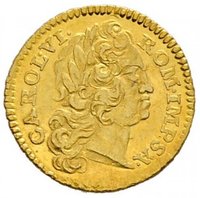
Obverse
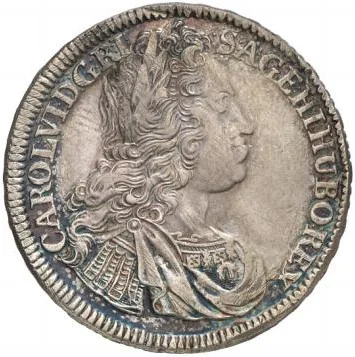
Description:
Laureate portrait right, head breaking legend. Legend around (starts 8h).
Inscription:
CAROL VI D G R I // S A GE HI HU BO REX
Script: Latin
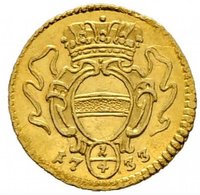
Reverse
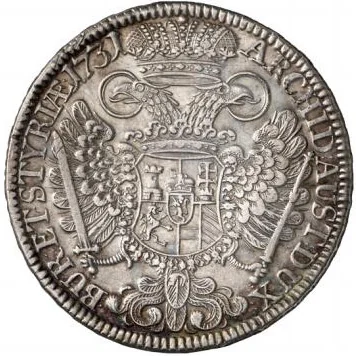
Description:
Imperial double-headed eagle with crowned shields of Castile, Hungary, Bohemia, and Austria, ancient Burgundy at center with a small Styria shield, encircled by the Golden Fleece chain. Legend around, date at end.
Inscription:
ARCHID AUST DUX // BUR ET STYRIÆ date
Script: Latin
Edge
Mints
| Name | Mark |
|---|---|
| Graz | — |
Mintings
| Year | Mint Mark | Mintage | Quality | Collection |
|---|---|---|---|---|
| 1731 | — | — | ||
| 1738 | — | — | ||
| 1739 | — | — |
Historical background
In 1731, the currency situation within the Habsburg-ruled Austrian Empire was complex and fragmented, reflecting the empire's diverse and decentralized political structure. There was no single, unified imperial currency. Instead, the monetary landscape was a patchwork of various silver Taler and gold Gulden coins, whose values and silver content could differ significantly between the hereditary lands (like Austria and Bohemia) and the Kingdom of Hungary. Furthermore, numerous smaller principalities and free cities within the Empire often minted their own subsidiary coinage, leading to a confusing multiplicity of circulating mediums.
This system was plagued by chronic instability and debasement. To finance the enormous costs of the War of the Spanish Succession (1701-1714) and subsequent conflicts, the state had frequently reduced the silver content in its coinage, a practice that eroded public trust and sparked inflation. By 1731, a decade after the financial scandals of the "Viennese City Bank" collapse, the treasury remained under severe strain. The result was a circulation of coins of varying intrinsic worth, which hampered commerce and created arbitrage opportunities that further drained precious metal from the imperial coffers.
Consequently, the primary monetary challenges facing Emperor Charles VI in 1731 were the lack of a standardized currency for the entire empire and the poor state of public finances that made meaningful reform difficult. While there were ongoing discussions about currency stabilization, comprehensive reform would not be achieved until the reign of his daughter, Maria Theresa. Her later monetary ordinances, particularly from 1750 onward, would successfully introduce a stable, unified silver Conventionstaler that became a benchmark currency for much of Central Europe.
This system was plagued by chronic instability and debasement. To finance the enormous costs of the War of the Spanish Succession (1701-1714) and subsequent conflicts, the state had frequently reduced the silver content in its coinage, a practice that eroded public trust and sparked inflation. By 1731, a decade after the financial scandals of the "Viennese City Bank" collapse, the treasury remained under severe strain. The result was a circulation of coins of varying intrinsic worth, which hampered commerce and created arbitrage opportunities that further drained precious metal from the imperial coffers.
Consequently, the primary monetary challenges facing Emperor Charles VI in 1731 were the lack of a standardized currency for the entire empire and the poor state of public finances that made meaningful reform difficult. While there were ongoing discussions about currency stabilization, comprehensive reform would not be achieved until the reign of his daughter, Maria Theresa. Her later monetary ordinances, particularly from 1750 onward, would successfully introduce a stable, unified silver Conventionstaler that became a benchmark currency for much of Central Europe.
✨ Legendary