

3 Grosetti – Republic of Ragusa
Croatia
Context
Years: 1627–1701
Country: Croatia 
Issuer: Republic of Ragusa
Period:
(1294—1803)
Currency:
(1294—1803)
Demonetized: Yes
Material
References
KM: #Click to copy to clipboard4
Numista: #86525
Value
Bullion value: $5.17
Obverse
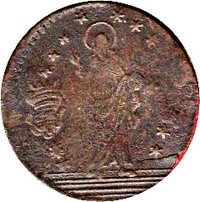
Description:
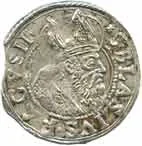
Head of St. Blase, right. Legend encircling.
Inscription:
S・BLASIVS RAGVSII
Script: Latin
Reverse
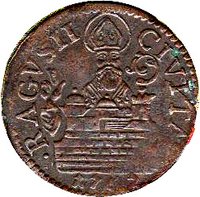
Description:
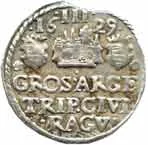
Upper town: numeral III flanked by dates. Below, two Ragusan coats of arms. Lower half: three-line inscription.
Inscription:
・III・
・(ye ar)・
GROS・ARGE
TRIP・CIVI
・RAGV・
・(ye ar)・
GROS・ARGE
TRIP・CIVI
・RAGV・
Script: Latin
Edge
Plain
Mintings
| Year | Mint Mark | Mintage | Quality | Collection |
|---|---|---|---|---|
| 1627 | — | — | ||
| 1628 | — | — | ||
| 1629 | — | — | ||
| 1630 | — | — | ||
| 1631 | — | — | ||
| 1632 | — | — | ||
| 1633 | — | — | ||
| 1635 | — | — | ||
| 1642 | — | — | ||
| 1643 | — | — | ||
| 1644 | — | — | ||
| 1645 | — | — | ||
| 1646 | — | — | ||
| 1647 | — | — | ||
| 1648 | — | — | ||
| 1649 | — | — | ||
| 1675 | — | — | ||
| 1683 | — | — | ||
| 1684 | — | — | ||
| 1685 | — | — | ||
| 1686 | — | — | ||
| 1692 | — | — | ||
| 1701 | — | — |
Historical background
In 1627, the Republic of Ragusa (modern-day Dubrovnik) operated within a complex and challenging monetary environment, characteristic of a small mercantile state embedded in the overlapping spheres of influence of two great empires: the Ottoman and the Habsburg. The republic's official currency was the Ragusan perper, but its silver content and value had been eroded over time due to the fiscal pressures of paying the annual tribute (harac) to the Ottoman Porte and funding extensive fortification projects following a devastating earthquake in 1667 (which, notably, occurred four decades later, indicating long-standing fiscal strain). Consequently, a plethora of foreign coins circulated widely in daily commerce, most notably the heavy silver Turkish asper (akçe) and the prized Spanish silver real and ducat, which were essential for Ragusa's vast maritime and overland trade networks across the Mediterranean and the Balkans.
The primary monetary issue in this period was the chronic shortage of high-quality specie, leading to a dual system where stable foreign coins were hoarded or used for large international transactions, while debased local and regional coins fueled a problematic inflation in local markets. The Ragusan Senate frequently issued decrees to fix exchange rates between these various coins in an attempt to impose order, but the laws of supply and demand, coupled with the influx of underweight Ottoman coinage, often rendered these measures ineffective. This created significant confusion for merchants and citizens alike, as the proclaimed value of a coin often differed from its market value in metal content or its acceptance by foreign trading partners.
Ultimately, Ragusa's currency situation in 1627 reflects its delicate political and economic balancing act. The republic's monetary stability was directly tied to its commercial prosperity and its ability to navigate the demands of powerful neighbors. While the government struggled to maintain the integrity of its own coinage, the economy's real resilience lay in its merchants' adept use of international specie, making the city-state's financial system a hybrid one—locally administrated but globally dependent, a microcosm of Ragusa's broader position as a sovereign Christian republic surviving under Ottoman suzerainty.
The primary monetary issue in this period was the chronic shortage of high-quality specie, leading to a dual system where stable foreign coins were hoarded or used for large international transactions, while debased local and regional coins fueled a problematic inflation in local markets. The Ragusan Senate frequently issued decrees to fix exchange rates between these various coins in an attempt to impose order, but the laws of supply and demand, coupled with the influx of underweight Ottoman coinage, often rendered these measures ineffective. This created significant confusion for merchants and citizens alike, as the proclaimed value of a coin often differed from its market value in metal content or its acceptance by foreign trading partners.
Ultimately, Ragusa's currency situation in 1627 reflects its delicate political and economic balancing act. The republic's monetary stability was directly tied to its commercial prosperity and its ability to navigate the demands of powerful neighbors. While the government struggled to maintain the integrity of its own coinage, the economy's real resilience lay in its merchants' adept use of international specie, making the city-state's financial system a hybrid one—locally administrated but globally dependent, a microcosm of Ragusa's broader position as a sovereign Christian republic surviving under Ottoman suzerainty.
💎 Extremely Rare