

1 soldo – Republic of Ragusa
Add to wishlist
Croatia
Context
Years: 1678–1797
Country: Croatia
Issuer: Republic of Ragusa
Period:
(1294—1803)
Currency:
(1294—1803)
Demonetized: Yes
Material
References
KM: #
Numista: #78700
Obverse
Description:
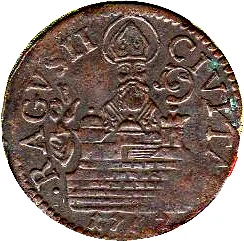
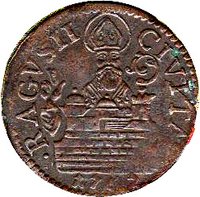
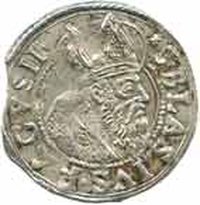
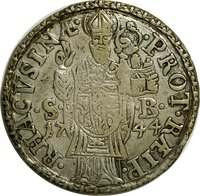
Bust of Saint Vlaho over a brick pattern.
Inscription:
RAGVSII CIVITAS 1762
Reverse
Description:
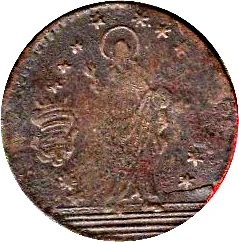
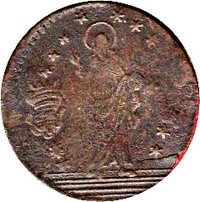
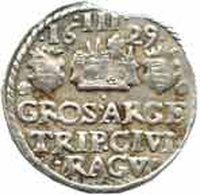
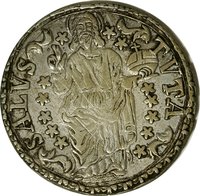
Christ between Ragusa's coats of arms, encircled by stars.
Edge
Mintings
| Year | Mint Mark | Mintage | Quality | Collection |
|---|---|---|---|---|
| 1678 | — | — | ||
| 1682 | — | — | ||
| 1689 | — | — | ||
| 1706 | — | — | ||
| 1707 | — | — | ||
| 1712 | — | — | ||
| 1720 | — | — | ||
| 1723 | — | — | ||
| 1729 | — | — | ||
| 1731 | — | — | ||
| 1750 | — | — | ||
| 1752 | — | — | ||
| 1762 | — | — | ||
| 1770 | — | — | ||
| 1771 | — | — | ||
| 1780 | — | — | ||
| 1781 | — | — | ||
| 1791 | — | — | ||
| 1793 | — | — | ||
| 1795 | — | — | ||
| 1796 | — | — | ||
| 1797 | — | — |
Historical background
In 1678, the Republic of Ragusa (modern-day Dubrovnik) operated a sophisticated and multi-layered currency system, a direct reflection of its unique geopolitical and economic position. As a small but prosperous maritime republic, Ragusa’s primary monetary reality was the widespread use of foreign coinage, particularly the large silver Thaler of the Austrian Habsburgs and the ubiquitous Spanish Piastre or piece of eight. These heavy silver coins were essential for Ragusa’s large-scale international trade, finance, and state reserves, linking its economy directly to the major monetary currents of the Mediterranean and Central Europe.
Alongside this "hard" foreign currency, the Republic maintained its own limited coinage, most notably the small silver Grosso and its fractions. However, the most visible currency in everyday local transactions was the Ragusan Perpera, a unit of account that had long since ceased to be minted as a physical coin. Prices, salaries, and small-scale trade were often quoted in this notional perpera, but actual payment was made in a jumble of physical coins, including Venetian Lire and Soldi, Ottoman Akçe, and various Italian issues, all circulating at officially mandated exchange rates. This created a complex environment of constant calculation and potential for friction.
The currency situation in 1678 was one of careful state management and inherent vulnerability. The Ragusan Senate and the monetary magistrates (Officio della Moneta) vigilantly regulated exchange rates and tried to combat the export of full-weight silver coin, a common problem of the era. Their goal was to maintain monetary stability and ensure the smooth functioning of commerce, upon which the republic’s independence and neutrality between the Ottoman Empire (to which it paid annual tribute) and the Christian powers of Europe depended. Thus, Ragusa’s currency system was not one of sovereign minting power, but rather one of adept financial intermediation and strict legal control over a diverse circulating medium.
Alongside this "hard" foreign currency, the Republic maintained its own limited coinage, most notably the small silver Grosso and its fractions. However, the most visible currency in everyday local transactions was the Ragusan Perpera, a unit of account that had long since ceased to be minted as a physical coin. Prices, salaries, and small-scale trade were often quoted in this notional perpera, but actual payment was made in a jumble of physical coins, including Venetian Lire and Soldi, Ottoman Akçe, and various Italian issues, all circulating at officially mandated exchange rates. This created a complex environment of constant calculation and potential for friction.
The currency situation in 1678 was one of careful state management and inherent vulnerability. The Ragusan Senate and the monetary magistrates (Officio della Moneta) vigilantly regulated exchange rates and tried to combat the export of full-weight silver coin, a common problem of the era. Their goal was to maintain monetary stability and ensure the smooth functioning of commerce, upon which the republic’s independence and neutrality between the Ottoman Empire (to which it paid annual tribute) and the Christian powers of Europe depended. Thus, Ragusa’s currency system was not one of sovereign minting power, but rather one of adept financial intermediation and strict legal control over a diverse circulating medium.
💎 Extremely Rare