

1 grosso – Republic of Ragusa
Add to wishlist
Croatia
Context
Years: 1626–1761
Country: Croatia
Issuer: Republic of Ragusa
Period:
(1294—1803)
Currency:
(1294—1803)
Demonetized: Yes
Material
References
KM: #
Numista: #42257
Value
Bullion value: $1.38
Obverse
Description:
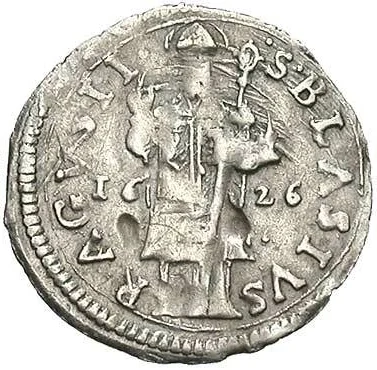
Saint Blase facing, right hand raised in blessing. Inscription encircling him, date on either side.
Inscription:
・S ・BLASIVS RAGVSII
16 26
16 26
Script: Latin
Reverse
Description:
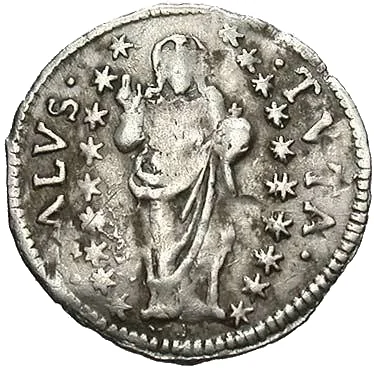
Christ facing forward, blessing with his right hand, holding the world in his left, encircled by stars.
Inscription:
・TVTA ・SALVS・
Script: Latin
Edge
Sharp plain
Mintings
| Year | Mint Mark | Mintage | Quality | Collection |
|---|---|---|---|---|
| 1626 | — | — | ||
| 1627 | — | — | ||
| 1628 | — | — | ||
| 1629 | — | — | ||
| 1630 | — | — | ||
| 1631 | — | — | ||
| 1635 | — | — | ||
| 1642 | — | — | ||
| 1643 | — | — | ||
| 1644 | — | — | ||
| 1645 | — | — | ||
| 1646 | — | — | ||
| 1647 | — | — | ||
| 1648 | — | — | ||
| 1649 | — | — | ||
| 1650 | — | — | ||
| 1651 | — | — | ||
| 1652 | — | — | ||
| 1653 | — | — | ||
| 1654 | — | — | ||
| 1655 | — | — | ||
| 1656 | — | — | ||
| 1657 | — | — | ||
| 1658 | — | — | ||
| 1659 | — | — | ||
| 1660 | — | — | ||
| 1661 | — | — | ||
| 1662 | — | — | ||
| 1663 | — | — | ||
| 1664 | — | — | ||
| 1665 | — | — | ||
| 1666 | — | — | ||
| 1667 | — | — | ||
| 1676 | — | — | ||
| 1677 | — | — | ||
| 1678 | — | — | ||
| 1679 | — | — | ||
| 1680 | — | — | ||
| 1681 | — | — | ||
| 1682 | — | — | ||
| 1683 | — | — | ||
| 1684 | — | — | ||
| 1685 | — | — | ||
| 1686 | — | — | ||
| 1687 | — | — | ||
| 1688 | — | — | ||
| 1689 | — | — | ||
| 1690 | — | — | ||
| 1691 | — | — | ||
| 1692 | — | — | ||
| 1694 | — | — | ||
| 1695 | — | — | ||
| 1696 | — | — | ||
| 1697 | — | — | ||
| 1698 | — | — | ||
| 1699 | — | — | ||
| 1700 | — | — | ||
| 1701 | — | — | ||
| 1702 | — | — | ||
| 1703 | — | — | ||
| 1704 | — | — | ||
| 1705 | — | — | ||
| 1706 | — | — | ||
| 1707 | — | — | ||
| 1708 | — | — | ||
| 1709 | — | — | ||
| 1710 | — | — | ||
| 1711 | — | — | ||
| 1712 | — | — | ||
| 1713 | — | — | ||
| 1714 | — | — | ||
| 1715 | — | — | ||
| 1716 | — | — | ||
| 1720 | — | — | ||
| 1721 | — | — | ||
| 1722 | — | — | ||
| 1723 | — | — | ||
| 1724 | — | — | ||
| 1725 | — | — | ||
| 1726 | — | — | ||
| 1727 | — | — | ||
| 1728 | — | — | ||
| 1748 | — | — | ||
| 1751 | — | — | ||
| 1754 | — | — | ||
| 1756 | — | — | ||
| 1757 | — | — | ||
| 1761 | — | — |
Historical background
In 1626, the Republic of Ragusa (modern-day Dubrovnik) operated a sophisticated and complex monetary system, a necessity for its survival as a small, independent maritime republic nestled between the powerful Ottoman Empire and Venetian territories. The state did not mint its own gold or large silver coins. Instead, its official currency was the Ragusan perpera (perpero), a silver-based accounting unit used for large transactions, state finances, and contracts. However, the actual coins circulating in its markets and ports were overwhelmingly foreign, creating a de facto multi-currency environment.
The most prominent circulating coins were Venetian, due to centuries of close commercial ties. The Venetian ducat (zecchino) in gold and the Venetian lira in silver were staples of high-value trade. Alongside these, a flood of other foreign specie entered through trade: Spanish reales and escudos from Atlantic commerce, Ottoman akçes and altınlıks from overland trade with the Balkans, and various Italian state coins. This proliferation caused persistent challenges with exchange rates, counterfeiting, and the fluctuating intrinsic value of silver versus gold.
To bring order to this chaos, the Ragusan government exercised strict monetary control through regulation rather than minting. The Officio della Moneta (Monetary Office) periodically issued official tariffe – fixed exchange rate tables that legally defined the value of dozens of foreign coins in terms of the perpera. The 1626 tariff would have been a critical document, stabilizing daily commerce by decree. This system aimed to protect Ragusan merchants from loss and maintain public faith in the monetary system, which was vital for the republic’s banking and credit operations that underpinned its extensive Mediterranean trade network.
The most prominent circulating coins were Venetian, due to centuries of close commercial ties. The Venetian ducat (zecchino) in gold and the Venetian lira in silver were staples of high-value trade. Alongside these, a flood of other foreign specie entered through trade: Spanish reales and escudos from Atlantic commerce, Ottoman akçes and altınlıks from overland trade with the Balkans, and various Italian state coins. This proliferation caused persistent challenges with exchange rates, counterfeiting, and the fluctuating intrinsic value of silver versus gold.
To bring order to this chaos, the Ragusan government exercised strict monetary control through regulation rather than minting. The Officio della Moneta (Monetary Office) periodically issued official tariffe – fixed exchange rate tables that legally defined the value of dozens of foreign coins in terms of the perpera. The 1626 tariff would have been a critical document, stabilizing daily commerce by decree. This system aimed to protect Ragusan merchants from loss and maintain public faith in the monetary system, which was vital for the republic’s banking and credit operations that underpinned its extensive Mediterranean trade network.
🌟 Limited