

2 Ducats – Austrian Empire
Austria
Context
Years: 1783–1787
Country: Austria 
Issuer: Austrian Empire
Ruler: Joseph II
Currency:
(1754—1857)
Demonetized: Yes
Total mintage: 78,000
Material
References
KM: #Click to copy to clipboard1876
Numista: #86445
Value
Bullion value: $1144.07
Obverse
Description:
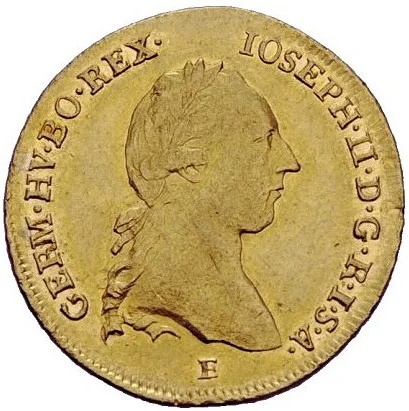
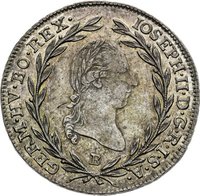
Laureate right-facing bust, mint mark beneath, encircling legend (starting at 1 o'clock).
Inscription:
IOSEPH II D G R I S A // GERM HV BO REX
Script: Latin
Reverse
Description:
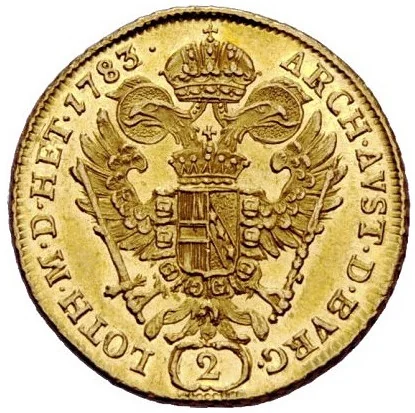
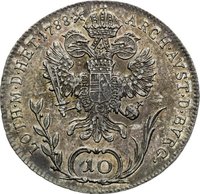
Imperial double-headed eagle with Habsburg-Lorraine arms, value in frame, legend around (begins at 1 o'clock).
Inscription:
ARCH AVST D BVRG (2) LOTH M D HET 1783
Script: Latin
Edge
Mints
| Name | Mark |
|---|---|
| Münze Österreich | A |
| Kremnica | B |
| Alba Iulia | E |
| Milan | M |
Mintings
Historical background
In 1783, the currency situation in the Habsburg Monarchy was characterized by the complex legacy of the Seven Years' War and the ongoing reforms of Emperor Joseph II. The state treasury was burdened by significant debt, and the empire operated on a bimetallic system based on the Conventionsthaler (or Konventionstaler), a large silver coin. However, the financial strain of past conflicts had led to the debasement of subsidiary coinage. Lower-value coins, particularly the ubiquitous kreuzer, were minted with less intrinsic silver than their face value, a practice that eroded public trust and caused frequent confusion and instability in everyday transactions.
Emperor Joseph II, ruling as co-regent with his mother Maria Theresa until her death in 1780, was actively pursuing centralizing and modernizing reforms. In monetary matters, this included efforts to standardize and control the coinage across the empire's diverse lands. The aim was to suppress the multitude of regional and foreign coins in circulation and assert Vienna's sole authority over minting. Nonetheless, these efforts met with limited success in 1783, as old habits and the practical realities of trade across such a vast realm made full standardization impossible. The economy still relied heavily on a mix of physical specie and paper money, notably the Bankozettel issued by the Wiener Stadtbanco.
Overall, the currency landscape in 1783 was one of transition and tension. While the official Conventionsthaler provided a stable large-unit standard, the everyday monetary experience for most subjects was one of complexity and uncertainty due to debased small coinage. Joseph II's attempts to create a unified, state-controlled currency were a work in progress, facing the immense challenge of overhauling a deeply entrenched financial system while managing substantial state debt—a situation that would continue to pose significant challenges for the monarchy's economic health.
Emperor Joseph II, ruling as co-regent with his mother Maria Theresa until her death in 1780, was actively pursuing centralizing and modernizing reforms. In monetary matters, this included efforts to standardize and control the coinage across the empire's diverse lands. The aim was to suppress the multitude of regional and foreign coins in circulation and assert Vienna's sole authority over minting. Nonetheless, these efforts met with limited success in 1783, as old habits and the practical realities of trade across such a vast realm made full standardization impossible. The economy still relied heavily on a mix of physical specie and paper money, notably the Bankozettel issued by the Wiener Stadtbanco.
Overall, the currency landscape in 1783 was one of transition and tension. While the official Conventionsthaler provided a stable large-unit standard, the everyday monetary experience for most subjects was one of complexity and uncertainty due to debased small coinage. Joseph II's attempts to create a unified, state-controlled currency were a work in progress, facing the immense challenge of overhauling a deeply entrenched financial system while managing substantial state debt—a situation that would continue to pose significant challenges for the monarchy's economic health.
💎 Extremely Rare