

1 Liard – Spanish Netherlands
Netherlands
Context
Years: 1624–1660
Country: Netherlands 
Issuer: Spanish Netherlands
Ruler: Philip IV
Currency:
(1506—1713)
Demonetized: Yes
Material
Diameter: 28 mm
Weight: 3.84 g
Shape: Irregular round
Composition: Copper
Magnetic: No
Technique: Hammered
Alignment: Coin alignment
flip
References
KM: #Click to copy to clipboard62
Numista: #8590
Obverse
Description:
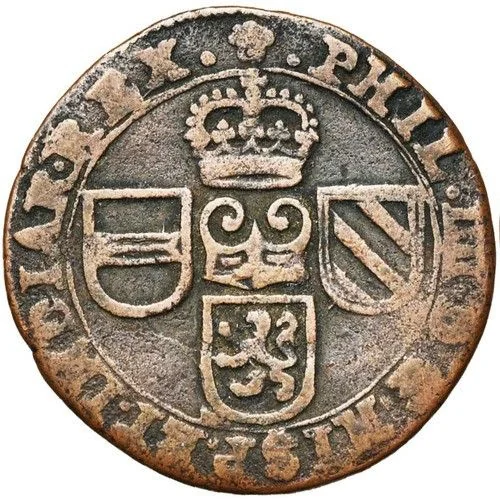
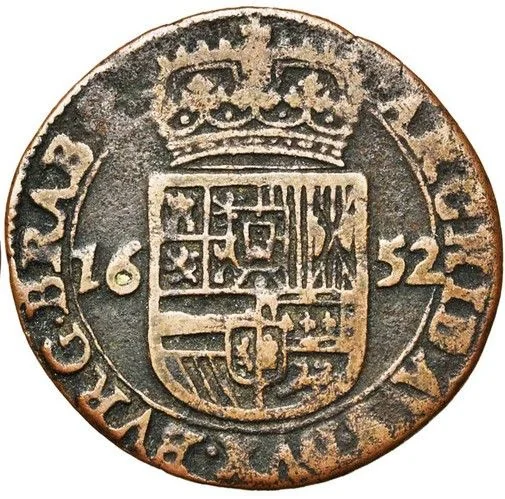
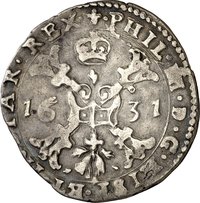
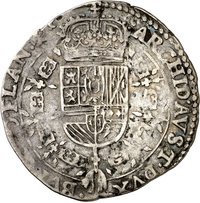
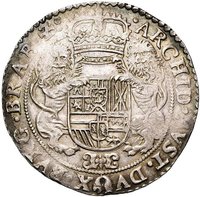
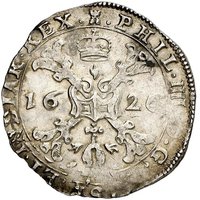
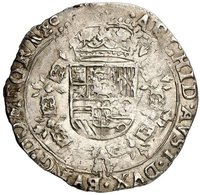
Crown over firesteel flanked by three shields.
Inscription:
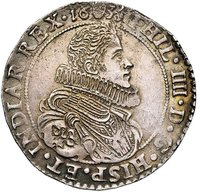
PHIL. IIII. D. G. HISP. ET. INDIAR. REX.
Script: Latin
Reverse
Edge
Plain
Mints
| Name | Mark |
|---|---|
| Antwerp | — |
| Maastricht | — |
| Royal Mint of Belgium | — |
Mintings
| Year | Mint Mark | Mintage | Quality | Collection |
|---|---|---|---|---|
| 1624 | — | — | ||
| 1625 | — | — | ||
| 1627 | — | — | ||
| 1628 | — | — | ||
| 1629 | — | — | ||
| 1630 | — | — | ||
| 1631 | — | — | ||
| 1632 | — | — | ||
| 1643 | — | — | ||
| 1644 | — | — | ||
| 1647 | — | — | ||
| 1648 | — | — | ||
| 1649 | — | — | ||
| 1650 | — | — | ||
| 1652 | — | — | ||
| 1653 | — | — | ||
| 1654 | — | — | ||
| 1655 | — | — | ||
| 1656 | — | — | ||
| 1659 | — | — | ||
| 1660 | — | — |
Historical background
In 1624, the Spanish Netherlands was grappling with a severe and protracted monetary crisis, a direct consequence of the ongoing Eighty Years' War (1568-1648). The region, a vital but beleaguered part of the Habsburg Empire, faced immense fiscal pressure from the conflict, leading the authorities to repeatedly debase the coinage. By lowering the precious metal content in coins like the patagon and ducatón while maintaining their face value, the government aimed to generate short-term revenue to fund its military campaigns. This practice, however, triggered Gresham's Law in earnest, where "bad" debased coins drove "good" full-weight coins out of circulation, as they were either hoarded or exported.
The situation was further complicated by the circulation of a chaotic mix of foreign currencies, including German, French, and Dutch coins, alongside the debased local issues. This monetary pluralism, combined with the deliberate overvaluation of certain foreign coins by official ordinance, created a bewildering and unstable exchange environment. Merchants and the public struggled with fluctuating values and widespread uncertainty, which stifled commerce and eroded trust in the currency system. The economic distress was acute in cities like Antwerp, whose trade had already been severely damaged by the war and the blockade of the River Scheldt.
Attempts to rectify the crisis, such as the monetary ordinance of 1619, had proven ineffective. By 1624, the Habsburg authorities, under the governance of the Infanta Isabella Clara Eugenia, were caught in a vicious cycle: the financial demands of the war necessitated debasement, which in turn damaged the economy and reduced long-term tax revenues, thus requiring further fiscal expedients. The currency chaos was not merely an economic issue but a symptom of the deeper political and military struggle, reflecting the immense difficulty of sustaining a war economy while maintaining a functioning monetary system in a fractured and contested territory.
The situation was further complicated by the circulation of a chaotic mix of foreign currencies, including German, French, and Dutch coins, alongside the debased local issues. This monetary pluralism, combined with the deliberate overvaluation of certain foreign coins by official ordinance, created a bewildering and unstable exchange environment. Merchants and the public struggled with fluctuating values and widespread uncertainty, which stifled commerce and eroded trust in the currency system. The economic distress was acute in cities like Antwerp, whose trade had already been severely damaged by the war and the blockade of the River Scheldt.
Attempts to rectify the crisis, such as the monetary ordinance of 1619, had proven ineffective. By 1624, the Habsburg authorities, under the governance of the Infanta Isabella Clara Eugenia, were caught in a vicious cycle: the financial demands of the war necessitated debasement, which in turn damaged the economy and reduced long-term tax revenues, thus requiring further fiscal expedients. The currency chaos was not merely an economic issue but a symptom of the deeper political and military struggle, reflecting the immense difficulty of sustaining a war economy while maintaining a functioning monetary system in a fractured and contested territory.
🌟 Limited