Logo Title
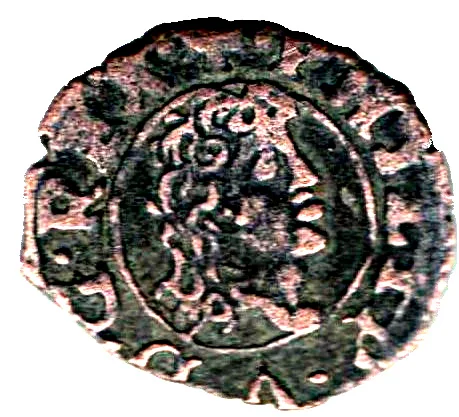
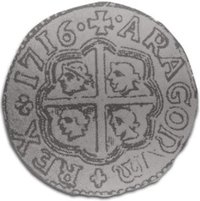
obverse
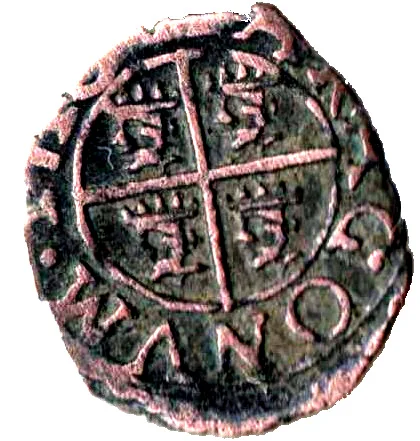
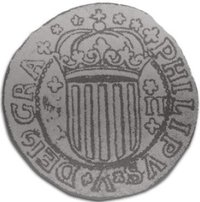
reverse
Juliandiazmr

1 Denier – Kingdom of Aragon

Spain
Context
Years: 1710–1719
Country: Spain Country flag
Ruler: Philip IV
Currency:
Demonetized: Yes
Material
Diameter: 13 mm
Weight: 0.7 g
Composition: Copper
Magnetic: No
Technique: Hammered
References
KM: #Click to copy to clipboard65
Numista: #84321

Obverse

Description:
Enter circle.
Inscription:
PHILIP.V.DG.REX.
Script: Latin

Reverse

Description:
Zaragoza arms in center, date in legend.
Inscription:
M.ARAGONVM. 1710
Script: Latin

Edge

Mints

NameMark
Zaragoza

Mintings

YearMint MarkMintageQualityCollection
1710
1711
1712
1713
1714
1715
1716
1717
1718
1719

Historical background

In 1710, the Kingdom of Aragon was embroiled in the final, desperate phase of the War of the Spanish Succession. Having thrown its support behind the Habsburg Archduke Charles III as an alternative to the Bourbon Philip V, the kingdom was a major battlefield. This political and military crisis directly caused severe monetary instability. The cost of maintaining armies and administration led both the Habsburg claimant's government in Barcelona and the local Aragonese authorities to engage in rampant debasement of the coinage. They reduced the silver content in coins like the real and peseta to fund the war effort, leading to a classic scenario of inflation and a loss of public confidence in the currency's value.

The monetary landscape was further fragmented and chaotic due to the circulation of multiple coinages with competing legitimacy. Coins minted under the authority of "Charles III" vied with older Spanish issues from the previous Habsburg dynasty and, increasingly, new Bourcoin coinage introduced by the advancing forces of Philip V. Furthermore, foreign currencies, particularly French louis d'or and Portuguese moidores, circulated widely, used by the opposing armies to pay for supplies. This created a complex and unreliable system where the value of money depended heavily on its origin and metallic content, hampering trade and crippling the local economy.

The currency situation of 1710 was inherently temporary and doomed to collapse with the military outcome. Following the decisive Bourbon victories at the battles of Almenara and Zaragoza that year, Philip V's forces consolidated control over Aragon. His subsequent Nueva Planta decrees in 1707 (for Aragon and Valencia) were being enforced, systematically dismantling Aragonese political institutions and, with them, its separate monetary authority. Therefore, the chaotic currency of 1710 represented the death throes of an autonomous Aragonese system, soon to be replaced by the centralized Bourbon monetary reforms that would unify Spain's coinage under the Crown of Castile's standards.
Somewhat Rare