

1 Paisa – Bombay Presidency
India

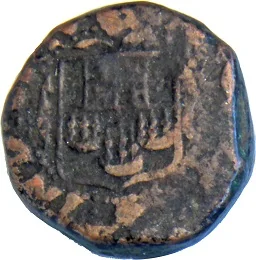
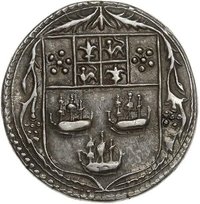
Obverse
Description:
East India Company shield with English inscription.
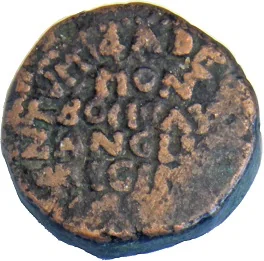
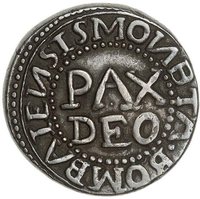
Reverse
Description:
Legend in English
Inscription:
MON. BOMBAY ANGLIC REGIMS Ao7o
Edge
Plain
Mintings
| Year | Mint Mark | Mintage | Quality | Collection |
|---|---|---|---|---|
| 1672 | — | — |
Historical background
In 1672, the currency situation within the Bombay Presidency was complex and transitional, reflecting its recent transfer from Portuguese to English control. The East India Company had received the islands of Bombay as part of Catherine of Braganza's dowry in 1661, but only assumed full administrative authority in 1665. The monetary landscape was a fragmented mix of Portuguese, Mughal, and other Indian currencies circulating alongside emerging Company issues. The Portuguese xerafin (or xeraphin) was a dominant silver coin for local trade, while the Mughal silver rupee was the paramount currency for wider regional commerce, its value fluctuating based on weight and purity.
The Company faced significant difficulties due to this lack of a standardized currency, which hampered trade and revenue collection. To address this, the Bombay Mint had been established in 1671, just a year prior, with the authority to issue coins that would facilitate Company business. Its early output included silver coins minted in the name of King Charles II, but these often struggled for acceptance outside Company settlements. The broader economy still operated on a bullion-based system, where foreign silver coins like Spanish reales and Dutch leeuwendaalders were imported, melted, and re-struck, their values constantly assessed against the benchmark rupee.
Therefore, the situation in 1672 was one of active but incomplete reform. The Presidency was caught between the lingering Portuguese monetary legacy, the overwhelming reality of the Mughal rupee's dominance, and the fledgling attempts by the East India Company to impose its own monetary order. This currency heterogeneity created opportunities for money changers (shroffs) who were essential to daily commerce but also led to confusion, fraud, and exchange losses, posing a persistent challenge to the Company's commercial and administrative consolidation on the islands.
The Company faced significant difficulties due to this lack of a standardized currency, which hampered trade and revenue collection. To address this, the Bombay Mint had been established in 1671, just a year prior, with the authority to issue coins that would facilitate Company business. Its early output included silver coins minted in the name of King Charles II, but these often struggled for acceptance outside Company settlements. The broader economy still operated on a bullion-based system, where foreign silver coins like Spanish reales and Dutch leeuwendaalders were imported, melted, and re-struck, their values constantly assessed against the benchmark rupee.
Therefore, the situation in 1672 was one of active but incomplete reform. The Presidency was caught between the lingering Portuguese monetary legacy, the overwhelming reality of the Mughal rupee's dominance, and the fledgling attempts by the East India Company to impose its own monetary order. This currency heterogeneity created opportunities for money changers (shroffs) who were essential to daily commerce but also led to confusion, fraud, and exchange losses, posing a persistent challenge to the Company's commercial and administrative consolidation on the islands.
✨ Legendary