

1 Rupee – Mughal Empire
India
Context
Years: 1110–1748
Country: India 
Issuer: Mughal Empire
Ruler: Muhammad Shah
Currency:
(1540—1842)
Demonetized: Yes
Material
Weight: 11.22 g
Silver weight: 11.22 g
Shape: Irregular round
Composition: Silver
Magnetic: No
Technique: Hammered
References
KM: #Click to copy to clipboard436.37
Numista: #83429
Value
Bullion value: $32.60
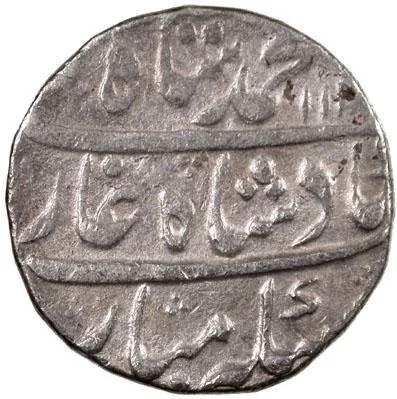
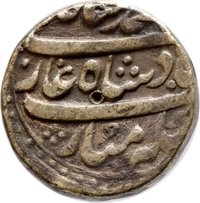
Obverse
Description:
Emperor's Name & AH Date
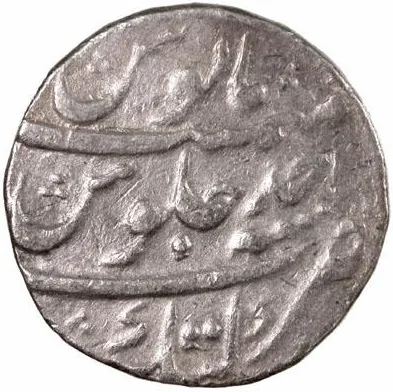
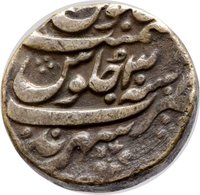
Reverse
Description:
Ry. Date & Mint
Edge
Plain
Mintings
| Year | Mint Mark | Mintage | Quality | Collection |
|---|---|---|---|---|
| 1110 | — | — | ||
| 1111 | — | — | ||
| 1112 | — | — | ||
| 1113 | — | — | ||
| 1114 | — | — | ||
| — | — | — |
Historical background
The year 1110 AH (1698-1699 CE) in the Mughal Empire fell within the later reign of Emperor Aurangzeb Alamgir, a period marked by immense military expenditure and growing fiscal strain. The empire's currency system, however, remained robust in its core formulation, based on the trimetallic standard established under Emperor Sher Shah Suri and refined by Akbar. The primary circulating coins were the silver rupee (the standard unit of account), the gold mohur (primarily for hoarding and high-value transactions), and the copper dam (for everyday local trade). These coins were renowned for their high purity and consistent weight, minted at imperial mints (dar al-zarb) across the subcontinent, which ensured wide acceptance.
Despite this structural stability, the currency situation in 1110 was under significant pressure due to Aurangzeb's protracted Deccan campaigns (1681-1707). The enormous cost of maintaining vast armies in the field for decades was draining the imperial treasury. This led to a critical shortage of silver, as bullion was diverted to pay troops and procure supplies, potentially affecting the minting of new rupees. Furthermore, the empire's expanding frontiers and continuous warfare began to strain the efficient administration of mints, sometimes leading to local variations and a slight decline in the meticulous oversight that characterized earlier periods.
Consequently, while the official currency system was not in a state of collapse, the fiscal demands of the era were setting the stage for future difficulties. The outflow of silver to fund war, combined with the gradual weakening of central administrative control in some regions, planted the seeds for the monetary challenges that would become more acute in the 18th century. Thus, in 1110 AH, the Mughal currency retained its prestigious form but was operating under the heavy weight of an empire engaged in a costly, endless war.
Despite this structural stability, the currency situation in 1110 was under significant pressure due to Aurangzeb's protracted Deccan campaigns (1681-1707). The enormous cost of maintaining vast armies in the field for decades was draining the imperial treasury. This led to a critical shortage of silver, as bullion was diverted to pay troops and procure supplies, potentially affecting the minting of new rupees. Furthermore, the empire's expanding frontiers and continuous warfare began to strain the efficient administration of mints, sometimes leading to local variations and a slight decline in the meticulous oversight that characterized earlier periods.
Consequently, while the official currency system was not in a state of collapse, the fiscal demands of the era were setting the stage for future difficulties. The outflow of silver to fund war, combined with the gradual weakening of central administrative control in some regions, planted the seeds for the monetary challenges that would become more acute in the 18th century. Thus, in 1110 AH, the Mughal currency retained its prestigious form but was operating under the heavy weight of an empire engaged in a costly, endless war.
✨ Legendary